
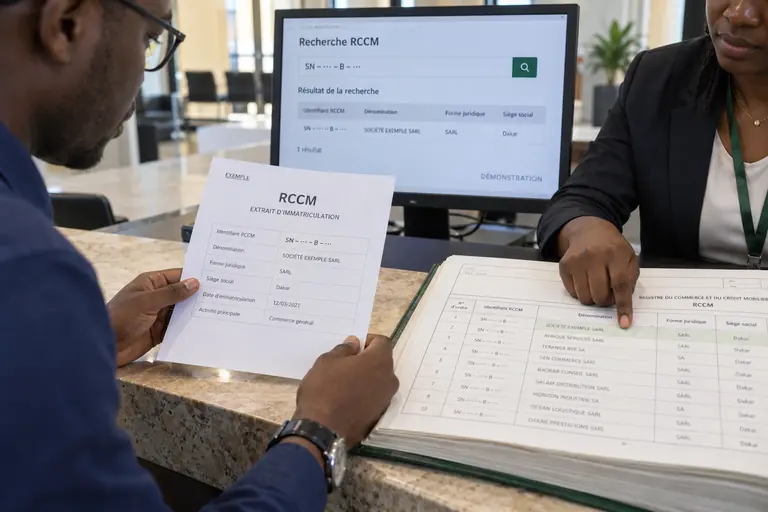
The OHADA company and movable credit register, known as the RCCM, serves two purposes at once across the member states of the organisation for the harmonisation of business law in Africa. It records traders and commercial companies, and it publicises security interests granted over movable assets such as equipment or stock. Its rules come from a common uniform act that applies directly in each state without national transposition, while practical organisation remains with the individual countries. The RCCM therefore gives lenders, suppliers and administrations a comparable reference from one jurisdiction to another.
A shared legal framework for many countries
OHADA brings together states that chose to adopt common business rules, issued as uniform acts. The register is provided for by the uniform act on general commercial law, and that text is directly applicable in every member state. No national law is needed to bring it into force, which gives traders in very different countries the same starting principles when they register a business.
This uniformity makes the RCCM a coherent system across jurisdictions as varied as Senegal, Cameroon or Côte d'Ivoire. A merchant in any of them follows the same logic of registration, even if each state decides locally where the register is kept and which office receives the files. The common court of justice and arbitration interprets the rules and helps keep their application consistent.
In daily practice the register is used by banks, suppliers and public bodies. A partner with a valid registration number and a recent extract inspires a first level of confidence, and the document has become a routine item in account-opening files and calls for tenders. The organisation publishes the reference texts and information about the institutions on its official website.
Why the words credit mobilier appear in the name
The register is not limited to commerce. Its second function concerns movable credit, meaning security interests that burden movable property. Pledges and certain privileges are entered so that the guarantee can be invoked against third parties. Without that publicity, a creditor would have a right that nobody else could see before dealing with the debtor, and could lose out when several lenders claim the same asset.
The need is practical. A lender must be able to check whether an item of equipment, a stock of goods or a receivable is already pledged to someone else. Registration establishes the ranking among creditors and protects those who act in good faith, which brings the RCCM close to a public file of security interests over movable assets and makes lending against equipment or stock more predictable for banks.
The substantive rules on securities are laid down in a separate uniform act. The register provides the publicity, but it cannot replace a reading of that text or of the contract concerned. Entries are made at the creditor's request through formalities set by OHADA law, and they may be cancelled once the debt is extinguished; the date of entry often decides priority between two creditors, so creditors tend to register promptly after signing the security.
Who has to register and what the status brings
Registration is in principle compulsory for individuals who carry on a commercial activity and for commercial companies. Economic interest groupings and certain other entities are also covered. Each registration produces a number specific to the entity, which then appears on its commercial papers and is requested by banks and public authorities when they open files, so the number should always be quoted exactly as issued.
OHADA law also recognises a lighter status, that of the entreprenant, aimed at small operators. It allows a modest activity to be carried out with a simplified declaration. The register therefore receives different levels of formality, and a reader checking a counterparty should understand which status the entry reflects before drawing conclusions about its size or obligations, since a simplified declaration does not carry the same duties as a full registration.
A commercial company acquires legal personality on registration, and until then it cannot act as a separate person. That is why the entry should be verified before signing. Public limited companies and limited liability companies follow forms laid down in another uniform act on commercial companies; the register proves their existence, while that text governs how they operate. Reading the two together gives the full picture of a company's existence and powers.
Local registry, national file and regional file
The system rests on three levels, each with a distinct task. The local register is kept by the registry of the competent court or by another authority designated by each state. A national file centralises the information for the whole country, and a regional file, held by the common court of justice and arbitration, gathers data across the whole organisation, which allows cross-border checks.
The architecture is meant to ease checks and to limit duplicates and fraud. In principle a business is registered once, at its main place of business, and secondary establishments are declared in connection with that main entry, which keeps the whole business traceable under one reference. A person looking for a company should therefore start at the place where the head office or the principal establishment is located, and not at a branch or a warehouse.
Each state may arrange the details differently, including which court registry or office is competent, how files are submitted and what online services exist. These details evolve, so they should be checked with the national authority rather than assumed. A foreign reader should also expect that records are kept in the official language of the country, often French but not everywhere, so a translation may be needed for use abroad.
Obtaining an extract and reading its mentions
An extract from the register is the usual proof that a business exists and is registered. It states the name, the legal form, the place of business, the activity and the registration number, and it may mention managers and security interests entered. The extract is requested from the competent registry, in person or through any online service that the country offers, depending on what the registry has put in place for applicants.
Practical details such as supporting papers, form of application and charges vary by state, and no general figure can be given. Before relying on a document, check its date, since a recent extract is far more reliable than an old copy that may no longer reflect the current position of the business, as managers and pledges can change within weeks.
A careful reader looks beyond the first lines. Entries on managers, on a lapse of the registration or on pledged assets can change the picture, and the regional or national file may help confirm what the local register shows. Where doubts persist, a written confirmation from the registry itself is the safest answer, because it comes from the body responsible for the entry.
Limits and precautions when relying on the RCCM
The register shows legal facts, not commercial quality. A business may be correctly entered and still be weak financially, and an entry says nothing about the sincerity of its managers or about disputes that have not yet reached a court. Searches in the register should therefore be combined with other checks, such as references from known partners and verification of identity documents.
Information quality depends on how well each national registry is staffed and equipped. Some offices are digitised and quick, while others still work mostly on paper, so response times and detail differ. This is not a reason for distrust, but a reason to ask the right office and to keep copies of everything received, along with the date of each request.
The explanations here are general and do not constitute legal advice. For a transaction involving security over movable assets or a cross-border contract, a lawyer familiar with the law of the countries concerned can confirm how the uniform acts apply to the case and which entries should be checked before signing, and what should appear in the contract to protect each side.
Frequently asked questions
What does the RCCM register apart from companies?
Besides traders and commercial companies, it publicises security interests over movable property, such as pledges and certain privileges. This lets a lender see whether equipment, stock or receivables are already encumbered. The rules on those securities sit in a separate uniform act, and the register provides only their publicity.
Is the RCCM the same in every OHADA country?
The core rules are common because the uniform act applies directly in all member states. Practical organisation differs: each country decides which registry or authority keeps the local file, how files are lodged and which online services exist. Always confirm local details with the competent office.
What is the entreprenant status?
It is a lighter status recognised by OHADA law for small operators, who can declare their activity in a simplified way. It differs from registration as a full trader or company, so a reader of an entry should check which status applies before assuming the size or obligations of the business.