
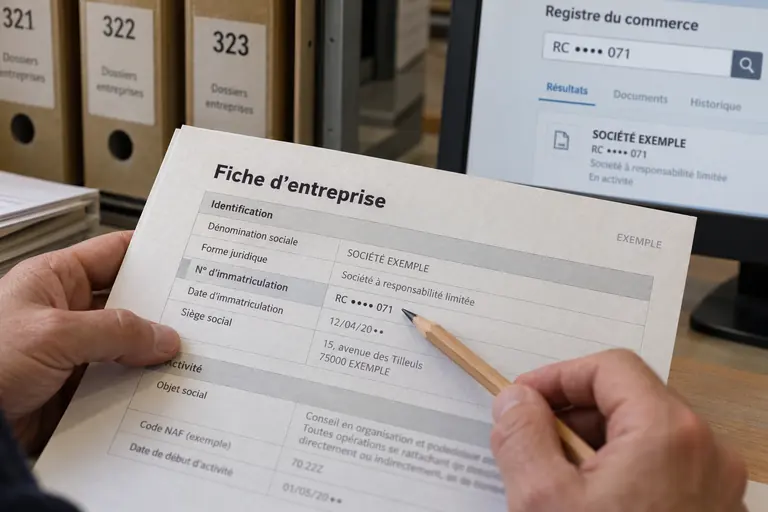
Across Ciudad Real province, the commercial register company records form the legal memory of local business: every limited company, public limited company and registered trader has a file held by a registrar, who examines documents before entering them. The file shows corporate name, form, registered address, purpose, administrators and later changes. Competence follows the legal seat, so a company producing wine in La Mancha but headquartered elsewhere is filed elsewhere. The entries guarantee legal facts, yet they do not measure turnover, profit or the quality of anyone's products.
Why buyers and suppliers look at the register
In a province where agriculture, food processing, transport and construction are intertwined, commercial relationships are often built on handshakes and long habit. That works until the first dispute. A quick look at the company file before agreeing terms reveals who really runs a business, which legal form it uses and whether it has recently changed its identity, all facts that are hard to judge from a brochure or a website.
Wholesale buyers of wine, olive oil, cheese or saffron frequently deal with producers they have never met. Before committing to large orders or advance payments, a prudent importer will verify that the supplier exists as a registered company, that the person signing has authority and that no dissolution has been entered. These are modest checks that prevent very expensive misunderstandings. Importers who skip them often discover the problem only when a shipment is already on the road.
The same logic applies in reverse. A small manufacturer selling on credit to a distributor can read the distributor's registered data to understand its structure and history. The register is no credit bureau, but it supplies the starting facts on which any serious assessment depends, and it costs far less than recovering an unpaid invoice. Few safeguards in commerce are as cheap.
Commercial agents, haulage firms and building contractors who work with public or semi-public clients also use the registered data to confirm that the entity they bill is legally capable of contracting. Building the habit of checking on first contact, and again after a long gap, protects against surprises caused by quiet changes of control. Contracts renewed on autopilot are where such surprises usually surface.
The registrar and the territory
The commercial register of Ciudad Real is run by a registrar who reviews the legality of each document submitted and decides whether it can be entered. National legislation governs the work, mainly the Commercial Code, the law on capital companies and the registry regulations, so the rules are the same as in any other Spanish province. What differs is the territory served and the practical contact point.
Castilla-La Mancha has authority over many matters, such as local commerce promotion, cooperatives and regional development, but it does not legislate on commercial law. A company formed in Ciudad Real therefore follows the same incorporation requirements as one formed in Valencia or Seville. Confusion sometimes arises because regional aid programmes mention company registration, although they have no role in the registry itself.
Territorial competence depends on the registered seat in the articles of association. Companies with farms or plants in the province but a head office in Madrid or Toledo appear in the registry of that seat. When a search yields nothing, the likeliest explanation is that the company is registered somewhere else, not that it fails to exist. Patience here is rewarded.
Foreign visitors sometimes trip over this rule, because a Spanish company may use a trade name, a legal name and a group name that all differ. The legal name and the tax number are the only dependable keys. Matching them to the registered seat is the first step toward the correct registry, and the one that most often saves repeated requests.
Reading a company file
An entry opens with the legal name and form, such as a limited company or a public limited company, together with the date of incorporation and the registered address. The corporate purpose follows, listing the activities the company may legally undertake. Many purposes are drafted very broadly, so the purpose alone is not proof of what the business actually does day to day.
Appointments of administrators come next, with the type of administration chosen: a sole administrator, joint administrators acting together or separately, or a board. This tells a counterparty exactly who can bind the company and how. Subsequent entries record resignations, new appointments, powers of attorney granted by the company and any revocation of those powers. Authority can end as quickly as it began.
Operations that alter the structure are visible as well. Increases and reductions of capital, mergers, transformations and changes of address leave marks, and so do special situations like dissolution and liquidation. A reader who goes through the entries in order can reconstruct how the business developed, which often reveals more than the opening page alone. Each entry is dated, which makes the sequence reliable.
Powers granted to employees and representatives deserve a special look. A company may have appointed a director for a particular region or product line, with limits that differ from the general powers of the administrators. Anyone relying on a signature should check that the person acted within those limits and that the authority had not been withdrawn by the time of signing.
Vineyards, cooperatives and family estates
Much of the economic fabric around Ciudad Real is agricultural, and legal forms vary accordingly. Large wine estates may be limited companies, while many growers belong to cooperatives that are registered in a separate cooperative register. A search in the commercial files will therefore find the former but not the latter, which regularly surprises visitors who assume a single database covers every enterprise.
Family estates add another layer. Land often belongs to individuals or to inheritance communities, while an operating company leases it and runs the business. The commercial register describes the operating company but says nothing about who owns the soil, a question answered by the property register. Understanding who holds which asset is indispensable for lenders and investors. Mistaking one for the other is easy.
Groups of related companies complicate matters further. One entity may own the vineyards, another the winery and a third the brand, with common shareholders behind all three. Each has its own file, and only by comparing them can an analyst see where the real risk lies and which entity would stand behind a particular promise or guarantee. Guarantees from the wrong entity are worthless in practice.
Seasonal and temporary activity can be misleading too. A harvesting or logistics firm may employ many workers for a few months and show little permanent presence, yet it is perfectly regular on paper. Conversely, a grand-sounding name can conceal a dormant shell. The register helps separate substance from appearance, provided it is read together with other evidence. Site visits and references remain valuable.
Ordering an extract or a certificate
A simple extract is the standard route for a quick check and is requested with the company's name or tax identification number. It reflects the current data and is returned as a concise document that is easy to share with colleagues, a lender or a lawyer. It is informative, however, and does not carry the formal weight of a certificate. Ask which document the recipient prefers.
When proof must be presented to a bank, an authority or a court, the registrar issues a certificate. It may reproduce full entries, summarise them or confirm that a given matter is not recorded. The type should be chosen carefully, because an unsuitable certificate can be refused and the whole process has to be repeated. A short enquiry beforehand avoids this.
Charges and timings depend on the service and may be updated from time to time. Check them in the official channels of the registrars when you place the order, and expect to identify yourself and indicate why you need the information. That declaration is part of the normal framework for access to registered data. Honest answers keep requests smooth. Evasive ones tend to slow them.
Accounts, warnings and good judgement
Companies required to do so deposit annual accounts after approval. When they are available, these documents show balance sheets, results and notes, which allows comparison between years. They are the company's own figures reviewed only for form, so they should be read with some scepticism, ideally by someone familiar with accounting standards and the sector concerned. Lenders usually insist on this step.
If a company does not deposit its accounts on time, the registrar can close its sheet to new entries, with limited exceptions. This should be read as a prompt for questions, not as proof of wrongdoing. A closed sheet may come from administrative delay or neglect, but it can also accompany financial difficulty, so ask the company directly and gather other information.
Finally, remember that rules, charges and digital procedures evolve. For significant transactions, such as buying a business, financing machinery or signing a long-term supply contract, take professional advice, and always verify the current requirements in official sources instead of relying on memory or on outdated notes passed between colleagues. Old advice about forms and charges ages quickly. Ask the registry itself when in doubt.
Frequently asked questions
Is a wine producer in La Mancha always registered in Ciudad Real?
Not necessarily. Registration follows the legal seat stated in the company's articles, not the location of vineyards or cellars. A producer headquartered in another province is filed there, and cooperatives are inscribed in a separate cooperative register. Confirm the registered address of the business before choosing where to search.
What does a Ciudad Real company file prove?
It proves the legal facts entered by the registrar: name, form, registered address, corporate purpose, administrators, capital operations and special situations such as dissolution. It does not prove solvency, product quality or actual activity, so use it as one element in a wider verification alongside accounts and references.
When should I ask for a certificate instead of an extract?
Ask for a certificate when a third party such as a bank, notary, authority or court needs formal proof, because the registrar vouches for its content. A simple extract suits informal checks, for example before agreeing a supply contract. If unsure what the recipient accepts, ask them which document they require.