
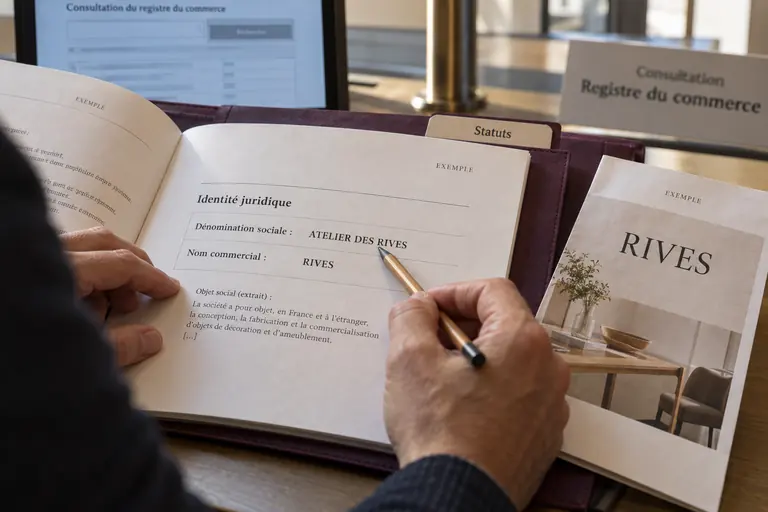
Spain's company name availability certificate is the official statement, issued by the Central Commercial Registry in Madrid, that no registered entity already bears the exact name a founder proposes. It is called negative because it certifies an absence of matches. The document concerns names only, so it grants no trademark protection. It is requested before the notary signs the deed of incorporation, it carries a limited period of validity, and it must still be in force on the day of signing. Without it, a notary will normally not proceed with the incorporation of a new company.
What the negative certificate actually certifies
When a business plan turns into a limited company, the first practical question is whether the chosen name is free. In Spain that question is answered by the Central Commercial Registry, which keeps the national section of company names. The certificate states that the database holds no identical name for the type of entity concerned. It says nothing about the quality of the project, the capital or the founders, and it does not create the company.
The certificate is also narrower than many founders assume. It does not protect a brand against competitors in the marketplace, because trademarks and commercial names follow their own rules and are handled by a different authority. A name can be free at the registry and still clash with a protected trademark. Careful founders therefore run both checks before printing stationery or buying a web domain.
Its practical value lies in sequencing. Notary fees, drafting of the articles of association and the capital deposit all come afterwards, so learning early that a name is taken avoids wasted effort. The notary also relies on the certificate to confirm that the name written in the first article of the bylaws was verified at the competent body, which keeps the later filing at the provincial registry smooth.
For people who live abroad, the point deserves emphasis. A founder in another country may assume that a name cleared in their home register is safe in Spain, yet each national database is independent. The Spanish certificate speaks only about the Spanish names section, so a group expanding into the country should treat the check as a local formality and not rely on earlier clearances elsewhere.
Who issues it and where the request is filed
Issuance belongs to the Central Commercial Registry, an office based in Madrid that depends on the Ministry of Justice. Unlike the provincial commercial registries, which record each company according to its registered address, this body centralises names for the whole country. A founder planning a company in Valencia, Seville or Bilbao therefore does not ask the local registry for the name check, but addresses the same national office.
The request can normally be lodged through the channels the registry itself offers: its online portal, a notary acting on the founders' behalf, or the electronic company-creation systems that link several administrations. Many founders instead hire a gestoría or a lawyer, who files the application and collects the result. The route changes convenience, not legal value, since the certificate issued has the same effect whichever door was used.
The applicant must identify themselves and state the legal form planned, such as a limited liability company or a public limited company. Foreign parent companies setting up a Spanish subsidiary follow the same path, though they usually need a representative holding identification valid in Spain. Whoever files should keep a copy of the application and the delivery receipt, because they prove the date from which the validity period starts to run.
Rules that make a company name admissible
Not every combination of words can be registered. Spanish company law requires the name to include an indication of the legal form, written out in full or in its customary abbreviation. A name may not mislead the public about the kind of entity or its activity, and certain terms are reserved by law, so that words such as bank, insurance or foundation come with sector conditions that must be satisfied first.
The registry also applies rules on what counts as an identical name. Changing a single letter, an accent or a punctuation mark does not escape a clash, because the system compares names using graphic and phonetic similarity. This is why advisers recommend preparing several alternatives in order of preference. The first choice is often taken, especially for short or descriptive names that many founders think of at the same time.
Personal names and geographical terms add further requirements. Using the name of a living person generally calls for that person's consent, and a place name in a company title may suggest an official status that the company does not have. When a doubt arises about a specific word, the prudent course is to ask the registry or a professional before filing, rather than discover the objection at the notary's desk.
Language is a further detail. Names can be coined from Spanish, regional languages or foreign words, and the registry accepts many forms, provided the legal form is clearly indicated and the result is not misleading. A founder who builds a name from a surname and a generic word should expect similarity checks to catch close relatives of existing names, even when the spelling differs slightly.
Reservation period, renewal and changes of mind
A negative certificate comes with a temporary reservation. While it remains valid, the registry will not allow another entity to adopt the same name. The length of that period is set by registry rules, and founders should read the current provision when they apply, because an expired certificate leaves the name free for anybody else. Nothing in the document itself makes the reservation permanent.
If the incorporation is delayed, the applicant may ask for a renewal on the terms the registry allows, and may request a different name if the project evolves, for example after a partner joins or a brand is rethought. Each procedure produces its own certificate, and the one handed to the notary must always be the one in force on the day the deed is signed, not an older copy kept in a folder.
A secondary market also exists for companies already formed and for reserved names offered by some agencies. Before choosing that shortcut, it is sensible to check who holds the reservation, under what conditions it can be transferred, and whether the name really fits the intended business. A ready-made name that is cheap to obtain can become expensive if it later forces a rebranding.
Timing matters most when several partners must coordinate. If one of them travels or the capital transfer is late, the reservation can run out before the notary appointment takes place. Booking the signature before applying, or applying only once the date is close, is a simple way to keep the document fresh and the name protected.
Practical steps and mistakes founders make
The process starts with the applicant's details and a list of proposed names with the intended legal form. The request is submitted through the chosen channel and any official charge is paid, the amount of which should be checked at the source because it changes over time. The registry then answers with a certificate for each free name, and it will not issue one for a name that is already occupied.
The certificate then travels with the deed of incorporation signed before the notary, who checks that the name in the bylaws matches the certified one and that the document is still valid. Even a small difference can lead the provincial commercial registry to point out a defect and suspend the entry until it is corrected. After signing, the deed is filed at the registry of the registered address, and once the company is entered, the name becomes part of the published data.
The most frequent mistake is to treat the certificate as proof that the company exists, when legal personality only arrives with registration. Others include letting the validity lapse, mistyping the name, omitting the legal form or mixing capitals and symbols that later differ from the bylaws. Public records reflect what is entered at a given moment, and a professional should be consulted when the project has unusual features.
Frequently asked questions
Does the certificate protect my business name as a trademark?
No. The certificate only shows that no registered entity carries the identical name in the registry's database. Trademarks and commercial names are governed by separate rules and a separate authority. A name may be free at the registry and still conflict with a protected brand, so founders should run a trademark search as well before committing to a name.
Who can ask for the certificate?
Any applicant who identifies themselves and states the legal form planned may ask for it, whether directly through the registry's channels or through a notary, gestoría or lawyer. Foreign companies creating a Spanish subsidiary follow the same procedure, usually with a representative holding valid identification. The certificate has the same value whichever route is used.
What happens if the certificate expires before the deed is signed?
An expired certificate no longer reserves the name, so another entity could take it in the meantime. The founder should ask for a renewal or a new certificate, and the notary will want the one valid on the day of signing. Keeping track of the validity period from the start avoids this delay.