
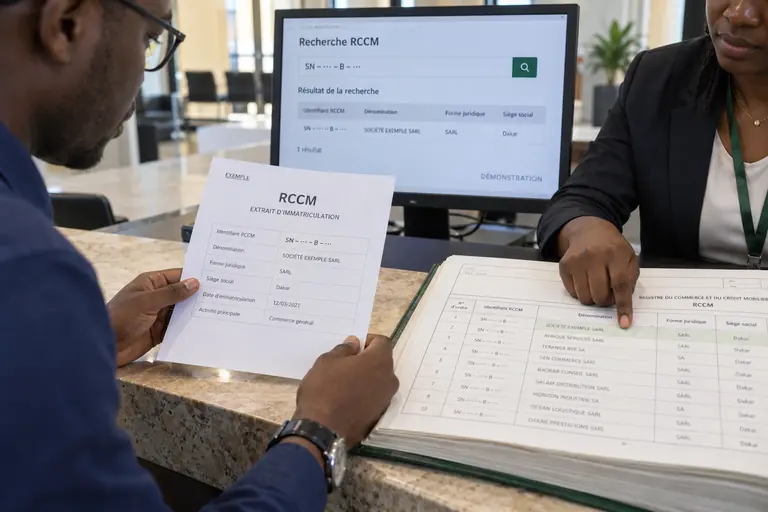
Ivory Coast commercial register RCCM registration fees are not one fixed price but a bundle of separate charges that accompany the creation of a business. They can include drafting the founding acts, registration duties on those acts, the entry itself, publication of a legal notice and sometimes the fees of an adviser. The register is kept under OHADA rules by the registry of the competent court, yet the scales come from national regulation and change over time. For that reason an entrepreneur should read the bill item by item and ask each body to confirm its own part.
Why there is no single price
Entrepreneurs who research what registration costs soon meet widely different figures, depending on the source. The reason lies in the nature of the process: it contains several steps, and each can carry its own expense. Legal form, share capital and the use of a professional change the total again, so two founders rarely pay the same sum. Comparing offers without a common basis therefore says little about which one is cheaper.
The register of commerce and personal property security operates in Ivory Coast within OHADA law. Entry at the competent court is one stage among others, next to the drafting of the articles, the registration of acts and publication of the notice. Scales evolve, which is why they should be checked at the source and not repeated from memory. A careful reader will also note the date on every tariff found online.
A sensible approach is to reason by items of expenditure and not by one global sum. Each item has a recipient, a legal basis and a way of being verified. This method separates official charges from optional fees. A founder who keeps a table with the date, amount, payee and receipt for every payment will follow the budget far more easily. Reviewing the table before each payment helps spot anything that looks unusual.
The cost items of a business creation
The first item is legal drafting. Articles of association for a company are written by the founder, a legal adviser or a notary, depending on the form and the legal requirements. The fees of that professional are not official charges, but they often weigh heavily in the overall cost of creation. Entrepreneurs sometimes assume that this fee is covered by the registration price, which is rarely the case.
The second item covers the duties collected by the administration. Registration of the acts with the competent service, the right to enter the business in the register and registry charges belong here. The amounts depend on the nature of the act and on the situation of the person filing, and the service that collects them holds the scale. These are the fees in the narrow sense. Some of these amounts may be paid by the professional on the client's behalf, so the invoice should say so clearly.
Next come costs for publishing the notice of incorporation in a medium that carries legal announcements. The investment promotion centre's website offers sections on creating a business and on legal notices, which help to understand the sequence. The list of items, and their order, can change when reforms are introduced. Publication costs can differ according to the medium chosen, so quotes are worth comparing.
The one-stop desk and the cost of creating a company
The centre is the public body that promotes investment. Its home page leads to business creation services, the investment code, legal notices and a check of the unique identifier. These services serve as an entry point to understand the procedure and to find the competent contact for each step of the process. It should not be treated as a price list, since the schedule of fees may be found elsewhere.
To learn what creating a business will cost, the best method is to question the desk before committing. It is possible to request the list of charges due at each stage and the names of those who receive them. Depending on the services offered, this request can be made at the counter, online or by telephone. Keeping a note of the person who gave each reply is useful if clarification is needed later.
Once the list is in hand, the entrepreneur can compare it with offers from service providers. A flat price quoted by an intermediary should break down into official charges and professional fees. If that breakdown is missing, ask for it before paying. This method is also useful for members of the diaspora preparing a project from abroad who cannot easily visit: a written enquiry, kept with the replies, is a useful record.
What makes a total higher or lower
Legal form is the first variable. A sole trader, a limited liability company and a public limited company do not carry out the same acts, and the number of acts affects the duties payable. The capital chosen can also play a part in some registration duties, depending on the regulations in force. Founders who plan several businesses may find that costs differ with the number of acts involved.
The place of filing is the second variable. The register is held by competent courts, and practices can differ between cities, particularly in the way desks are organised. Filing in Abidjan and filing in another town do not always run in the same way, which can affect timing as well as paperwork. Local enquiries are therefore valuable, and a short phone call can avoid a wasted journey.
The third variable is support. A founder can handle some steps alone or turn to a notary, a lawyer or a formalities firm. That choice changes the total but not the official charges, which must be kept separate from fees. For two businesses in a comparable legal situation, official duties should in principle be identical, which the desk can confirm. Disagreements over the amounts are best resolved with the issuing office, never with an intermediary.
Checking the scales with official bodies
Three sources allow checking: the business creation desk, the registry of the court where entry is requested and the published texts. OHADA law, presented on the organisation's website, sets the rules of the register, but charges are determined by national regulation. The scales therefore do not appear in the uniform acts. Where a published scale exists, a founder should print it and bring it along.
A receipt should be demanded for every payment. It identifies the service, the date and the object of the payment, serves as evidence in a dispute and feeds the company's accounts. Without a receipt, there is no way to prove what was paid or to whom. Ask the clerk to explain each line of the receipt if anything is unclear, and keep the stamped page.
Payments should travel through the channels set by the official services. Handing money to someone who promises to speed up a file without giving a receipt is risky. Every sum in the procedure, the RCCM charges included, should be verified against papers delivered by the administration. Official channels typically provide a receipt that can be matched with the bank statement of the company.
What the registration charges do not include
The charges for entry do not cover the obligations that come after it. Taxes, social contributions, sector licences and operating permits belong to other administrations, each with its own rules and amounts. A founder who budgets only for the entry may be surprised by the first tax or social invoice. Planning for the whole life cycle, not just the opening costs, gives a far more realistic view of the money needed in the first year.
The company may also face running costs that nobody mentioned, such as domiciliation, bookkeeping, insurance and bank account opening. These do not belong to registration, but they belong to the launch budget, and a careful estimate counts them from the start. Founders are well advised to ask about amounts for each of those later steps before choosing between legal forms or advisers, and to reserve a modest sum so that routine updates can be paid without delay.
Later updates to the register can also cost money. A change of manager, seat or capital triggers an amending entry with its own charges, and cancellation at the end of the business may carry a cost as well. Planning for these events avoids unpleasant surprises. Such points are general and a notary, lawyer or the one-stop desk can set out the amounts that apply.
Frequently asked questions
Is there a single official price for registration?
No. The total is made of several items such as legal drafting, registration duties, the entry in the register, publication and possibly adviser fees. The scales are set by regulation and may change, so ask the registry or the one-stop desk for the current list and keep every receipt.
How can I tell official charges from adviser fees?
Ask for a written breakdown naming each item and its recipient. Official duties are collected by the competent services and come with a scale. Fees of a notary, lawyer or formalities firm are separate and negotiable. A package price without such a breakdown deserves further questions before payment.
Are later changes to the register free?
Not necessarily. A change of manager, seat or capital leads to an amending entry that can carry its own charges, and cancellation may also cost something. The current scale should be requested from the registry before the change is decided, so that it can be included in the planning.