
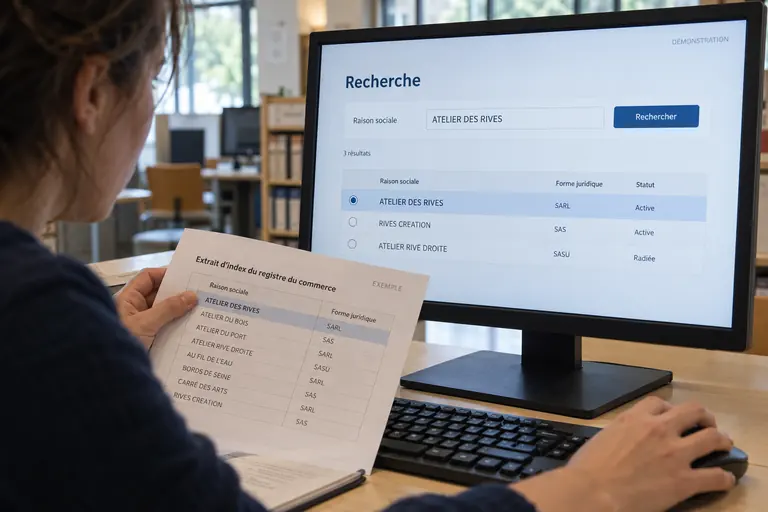
Libya's company register and business records form the official record in which commercial companies and traders are entered, giving each one a legal identity that banks, ministries and customers can rely on. Responsibility lies with government departments linked to the economy and trade, and entries are generally prepared in Arabic. A file typically lists the name, the form of the business, its purpose, the managers and the place where it is established. Reliability depends heavily on current conditions, so every extract deserves independent confirmation.
The legal setting for trading in Libya
Commercial activity in Libya is governed by a commercial code and by company legislation, supplemented by decisions of the authorities responsible for the economy and for trade. These texts distinguish traders acting in their own name from companies, and they set out which forms of company can be created, who can manage them and what obligations follow registration. The detail of the law has been amended several times, so current wording must be checked. Lawyers working with Libyan clients usually begin by identifying which version of each text is in force.
Foreign participation is treated through separate rules that have shifted with policy and with the political situation. Some activities are restricted, others require partnership with local persons, and sectors such as oil, banking and telecommunications operate under their own regimes. A company may therefore be validly registered in the commercial register and still need further authorisations before it can legally carry out its stated activity.
For a reader abroad, the lesson is to separate three layers: the law that creates the company, the register that records it and the sector authorisations that allow it to operate. Confusing these layers is a common source of misunderstanding. A clean register entry does not replace permits, and a permit does not replace a register entry. Keeping them apart makes every later question simpler to frame.
Corporate law also addresses how a company ends. Dissolution, liquidation and removal from the register have their own conditions, and a business that has stopped trading may remain visible in older records. When reviewing a file, look for signs of a closure procedure, because an apparently active entity could in reality be winding down and unable to honour new commitments. Such details matter when a counterpart claims a long history.
Institutions that hold the records
Registration of commercial entities in Libya has traditionally been associated with a commercial registry operating under the ministry responsible for economy and trade, with local offices in the main cities. Chambers of commerce also play a role, since membership and certificates issued by a chamber are often requested alongside the register extract when dealing with banks or customs. Ask early which city office holds the original file, because copies from different offices can differ.
Institutional arrangements have not always been stable. Since the political divisions of recent years, offices in different regions have at times operated with different procedures and different levels of connection to central systems. Anyone requesting records should therefore ask which office issued a document, in which city and under which authority, because acceptance may depend on that answer. A mismatch between offices is not unusual and can usually be explained once the history is known.
In practice, the most dependable way to obtain a current extract is to act through a Libyan lawyer, a customs broker or a representative with local standing. They know which counter is functioning, what supporting papers are required and how to obtain stamps. Direct requests from abroad are possible in some cases, but they can be slow and uncertain. Fees for such help should be agreed beforehand and linked to clear deliverables.
Reading a Libyan business file
A business file normally starts with the commercial name and the registration number, followed by the legal form such as a joint stock company, a limited liability company, a partnership or an individual trader. The stated purpose of the business and its capital structure appear next, along with the names of partners and managers. Because the original is in Arabic, transliteration of names can vary between documents. Reading the Arabic carefully, or having it read for you, removes much uncertainty.
That transliteration issue deserves attention. The same person or company can appear in Latin letters in several spellings, and a search based on one spelling may miss a match. Ask for the Arabic name as written, compare it with the Arabic on contracts, and use certified translations whenever the document will be used before a bank, a court or a foreign authority.
Check the dates of the entries and the validity of any commercial licence attached to the file. A licence that has not been renewed, or a file that has not been updated after a change of management, can indicate that the information is out of date. Stale data is a frequent difficulty and not necessarily a sign of bad faith. Ask for a statement of current status in writing whenever the date of the last update is unclear.
Who may ask and what stays private
The commercial register is meant to give publicity to the existence and basic characteristics of businesses, so identification data about companies is usually accessible to those with a legitimate reason. Practice, however, depends on the office. Some counters release extracts to any applicant with proper identification, while others require a power of attorney or an official request from a ministry or a bank. Written authorisation from the company itself often unlocks a request that would otherwise be refused.
Information that touches on financial accounts, tax status or personal details of partners may be restricted. Tax files belong to the tax authority, and customs records to the customs service, so a register extract will not reveal tax debts or import history. If those points matter for a transaction, ask the counterpart to provide the corresponding certificates directly. This division of records is standard in most legal systems, not a Libyan peculiarity.
Consent is a practical solution. When the business being checked is cooperative, ask it to supply a recent extract and then verify authenticity through your representative on the spot. This approach avoids many access problems and also shows how responsive the counterpart is, which is itself useful information about a future partner. Both sides then work from the same paper, which reduces arguments later.
Risks to weigh before relying on a record
Libya's business environment carries elevated risk, and records can be affected by disruption of offices, loss of archives and parallel administrations. A document that looks perfectly formal may have been issued by an office whose authority is contested, which can matter in court or in a financing application. Always ask who stands behind the stamp. Insurance, shipping and payment terms should reflect that uncertainty.
Sanctions and compliance screening add another dimension. International banks check names of companies, owners and managers against lists maintained by governments and organisations, and they often ask for ownership details beyond what the commercial register provides. Expect requests for additional corporate documents, identification of beneficial owners and explanations of the structure of the group. Compliance teams rarely accept a bare extract as sufficient.
For these reasons, treat any extract as one element in due diligence. Combine it with reputation checks, references from banks, visits to premises and legal advice from someone who works in Libya. The text here is general information, not legal advice, and procedures should always be confirmed with the competent authorities before action is taken. A cautious, layered review is not distrust; it is how serious operators protect their funds in difficult markets.
A step-by-step approach for a first check
Begin by collecting everything you already have about the business: the Arabic and Latin names, the town, the activity, the names of managers and any number printed on its documents. This base makes every later step easier, whether you contact a lawyer, a chamber of commerce or an office in person. Do this before you pay any intermediary, so that fees are linked to clear tasks.
Next, ask your local contact to obtain a fresh extract and to describe, in plain language, what it shows and what it does not. Ask them to confirm the status of the licence and whether any changes are pending. Request scanned copies and keep the originals if they are issued to you, since institutions abroad may need the stamped paper. Where a document is in doubt, ask the issuing office to confirm its authenticity directly.
Finally, record your findings in a short note with dates and sources. If anything looks inconsistent, such as a different manager name or an address that does not match, raise it with the counterpart before signing. A calm, documented check protects both sides and builds the trust on which lasting business with Libya depends. Share that note with your advisers so that decisions rest on facts rather than impressions.
Frequently asked questions
In which language are Libyan company records written?
Official records are prepared in Arabic. For use abroad, a certified translation is usually needed, and names can be transliterated in several ways. Always compare the Arabic name on the register with the one on your contract so that you do not mistake two similar companies for one another.
Can I check a Libyan company from outside the country?
It can be difficult. Some information may be reachable through intermediaries, chambers of commerce or lawyers who can request extracts on your behalf. Direct online access is not something to count on, so plan for a local representative and allow time for stamps and certifications.
Does being registered mean a Libyan company may operate in any sector?
No. Registration records the existence of the business, while sectors such as energy, banking or telecommunications need specific approvals. Ask the company for its licences in addition to the register extract, and verify them with the authority that issued them.