
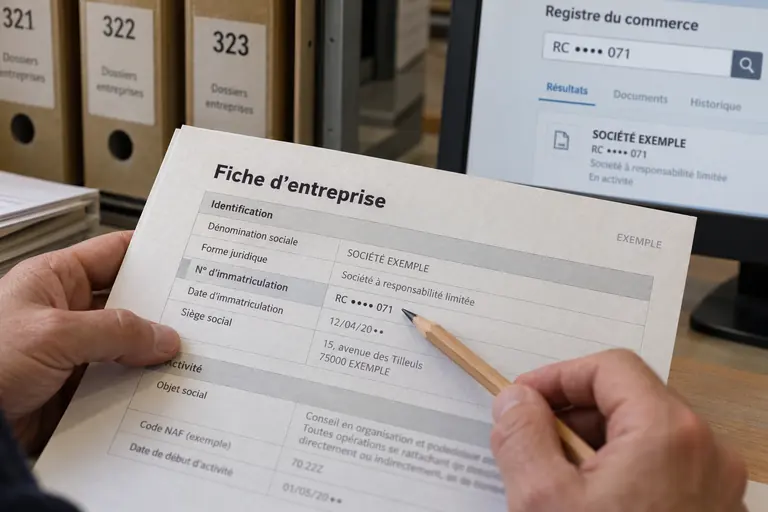
In France, the Kbis company register extract is the document that banks and clients ask for first: the official proof that a business is registered, in what legal form, at which address and under whose management. It is issued from the register kept at the clerk's office of the commercial court and reflects the situation on the day it is produced, which is why recipients insist on a recent copy. It concerns commercial companies and traders rather than every kind of entity.
The origin of the name and the register behind it
The letter K and the word bis come from the numbering of old registration forms, and the habit of calling the extract a Kbis has simply outlived the paperwork. The document is the extract of the commercial and companies register, whose French abbreviation is RCS. Companies carrying out commercial activity and individual traders are enrolled there, while other professionals may sit in different registers. Each registration is kept by the clerk's office attached to a commercial court, or an equivalent economic activities court in places where that reform has been applied.
The clerk checks the formalities, records the information and issues extracts on request. Since a national business register now centralises data across all registers, the Kbis remains the traditional proof for commercial companies, even as the technical setting evolves. The extract tells you about legal existence, not about commercial success. A company can have a perfectly valid Kbis and still be heavily indebted. Seeing the document as an identity card rather than a health certificate is the best way to avoid disappointment and to use it for what it was designed to do.
Historic records are available too: the extract can carry a trace of earlier transfers of the registered office, because the entry is moved from one court's register to another when the company relocates. This is helpful when tracing an older business whose address changed, and it explains why the registry city shown today may differ from the place where the firm began.
What you will find in the document
The top of the extract shows the date of issue and the registry identity of the business: its company number, which begins with the nine-digit SIREN attributed by the national statistics office, followed by the register and the city of registration. The date of registration indicates when the legal existence began, which is useful when checking how long a counterparty has been active. The identification block lists the corporate name, any trade name or sign, the legal form such as SAS, SARL or SA, the amount and nature of the share capital and the duration of the company.
The address of the registered office and the description of the activity follow. For individual traders, the document shows personal identity details instead of a corporate name. The management section names the people who can legally bind the company, such as the president, the managing director or the manager, and may mention auditors. Additional notes record insolvency proceedings, filings of accounts and any recent changes. These marginal notes deserve attention, because a pending procedure or a recent change of manager can alter the risk of dealing with the firm.
Who issues it and how to obtain it
Anyone can request an extract for any registered business, since the register is public. In practice, the manager of a company usually downloads the extract on behalf of the firm, whereas outsiders order it from the online services of the clerks' offices or from the portal run by the commercial courts' network. Some information, such as public company data, is also available through the national industrial property institute. Official extracts are typically paid for, although some digital channels distribute basic information free of charge.
Whichever channel you choose, check that the document bears the issue date, the identity of the issuing registry and, for the electronic version, the elements allowing the recipient to verify its authenticity, such as a code or a seal. For use abroad, the extract may need translation, and some authorities ask for an apostille or legalisation. France is party to the convention that simplifies this for many countries.
Ask the recipient what it needs before ordering, because the age of the copy and the language are the two details most often rejected. Digital delivery has changed expectations. Many recipients now accept a PDF that can be verified online, which saves the delay of the post, but some foreign authorities still ask for a paper original bearing the clerk's signature or stamp. Clarify this before ordering, and keep both versions on file when the document may be required again later.
Everyday uses of a Kbis
Banks ask for it when opening a business account, because it proves that the company exists and shows who can sign. Public buyers require it in tenders to confirm that candidates are properly registered. Landlords, suppliers and insurers use it to check the identity of a tenant, a customer or a policyholder before concluding a contract. Entrepreneurs also provide it themselves when they present a quote to a large client or when they apply for financing. Because the document is recognised throughout the country, it spares the recipient from investigating the status of the business.
A recent extract often makes the difference between a quick onboarding and weeks of back and forth. Foreign partners meeting a French company for the first time often request it as well, since it is the closest equivalent to a certificate of good standing. Be aware that the document should be recent: many recipients accept only an extract produced within the last few months, and an old copy may be refused even if nothing has changed.
Kbis, other documents and look-alikes
The Kbis should not be confused with the notice of situation issued from the national directory of businesses, which confirms the identification number and the activity code but not the registration at the commercial register. Nor is it the same as the certificate downloaded from the national business register, which relates to the registration of the entity in that register.
An individual trader who is not a company receives an extract of a different kind, historically labelled K without the bis, and some artisans are registered in a trades register that produces its own extract. Choosing the wrong document wastes time, so ask the requesting party which one it expects and for what purpose. Beware of websites that imitate official services and sell the extract at inflated prices, sometimes with misleading names.
Genuine channels clearly indicate the clerk's office or the official network behind them. When in doubt, begin from the official institution's own pages rather than from an advertisement in a search engine. Foreign investors sometimes mistake the Kbis for an equivalent of the certificate of incorporation. The two serve different functions: incorporation documents show how the company was founded, while the extract describes its present registered status. Keeping both at hand, together with the articles of association, gives counterparties the full legal picture they usually need.
Limits and precautions
A Kbis reflects the register on the day of production, and the register reflects what the company has declared. If a manager resigned yesterday and the change was not yet filed, the extract will still show the former name. For sensitive operations, ask for a very recent copy and confirm key points directly with the company. The document does not guarantee the company's solvency, its tax compliance or its right to carry out regulated activities, which may require separate authorisations.
It also does not replace the accounts, which are filed separately and can be requested from the register. Think of it as the first layer of verification rather than the last. Finally, protect the document itself. It contains data that could be misused for impersonation, such as the company number and the manager's name. Send it only to parties that need it, avoid posting it publicly and, when sharing a copy, consider marking it with the purpose and the recipient to limit potential abuse.
Frequently asked questions
What does a Kbis prove?
It proves that a business is registered in the commercial and companies register, with its legal form, address, activity and the people entitled to represent it, as of the day of issue. It does not prove solvency or good financial health, and it does not authorise regulated activities by itself.
Who is allowed to request a Kbis?
Anyone can request an extract for any registered business, because the register is public. The company's own manager usually orders it for the firm's needs, while partners, banks and suppliers can obtain their own copies from the official online services of the clerks' offices or authorised channels.
How recent must the extract be?
There is no single rule, since each recipient sets its own requirement. Banks, public buyers and large clients often accept only an extract issued within the last few months. Ask the requesting party in advance, and order a fresh copy rather than reusing an old one.