
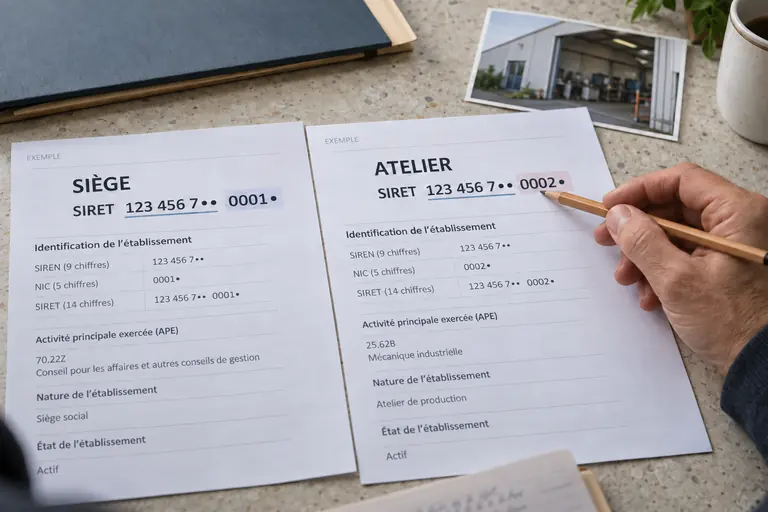
In France, an establishment search by SIRET number pinpoints one place of business, because the fourteen-digit SIRET identifies a single site rather than the whole enterprise. Its first nine digits are the company's SIREN and the last five form an internal classification number, so every shop, workshop or office of the same firm shares one SIREN but carries its own SIRET. The national statistics institute allocates it, and it follows the life of each site independently of the fate of the company.
How a SIRET is built and what each part means
A SIRET contains fourteen digits. The first nine are the SIREN, which identifies the business itself; the last five are the internal classification number, which identifies the establishment. Two sites run by the same enterprise therefore share the SIREN but differ in the last five digits. The structure lets a reader move easily from the company to its locations. This layout is easy to remember once it has been seen on a real invoice.
The SIREN answers the question of who the legal person or entrepreneur is, while the SIRET answers the question of which place of operation is meant. The digits carry no geographic or sector meaning; they only identify. Trying to guess a town or an industry from them is a mistake that foreign readers sometimes make. Remember this when a supplier asks you to quote the number exactly as printed.
A baker with three shops has one SIREN and three SIRET numbers, plus a fourth if a production workshop is declared as an establishment. If one shop closes, its SIRET is closed while the other two stay active. The number thus follows the life of each location, regardless of what happens to the enterprise as a whole. The example shows why one company often owns many numbers.
Who issues the SIRET and where it appears
The national statistics institute, which keeps the Sirene directory of businesses and establishments, allocates the number. Allocation follows the formalities of creation: when an enterprise declares its activity through the one-stop portal, its identifiers are generated and communicated. An individual entrepreneur also receives a SIREN and a SIRET, even when working from home. The portal also informs the partner bodies that need the identifier for their own files.
The number is printed on invoices, quotations, payslips, contracts and registration extracts. Many administrative procedures require it, as do exchanges with public buyers. When a document quotes it, the number can be verified in seconds in the open databases, which gives the reader an immediate way to test the paper in front of them. Always compare what the document says with what the directory returns.
For a private customer, the SIRET on a craftsman's quotation is a useful first control before signing. It lets the customer see that the business is known, that its activity matches the work proposed and that the declared address exists in the directory. The check does not guarantee quality, but it removes clearly invented documents. Such a simple test is within reach of any customer, with no special skills.
Searching an establishment in the Sirene directory
The directory is available online and is open to the public, subject to the rules on dissemination. Entering a SIRET returns the record of that establishment: name or the entrepreneur's identity, address, main activity, creation date and administrative status, whether open or closed. A search by number is the most reliable, because it removes the problem of namesakes. Keep in mind that the rules on dissemination may hide some personal details.
A search engine does not replace a careful reading of the record. Check that the address is the place you have in mind and that the site has not been closed for a long time. A business may remain active while one of its sites has ceased, which is why a SIRET can appear as closed although the company has not disappeared.
When the number is unknown, a search by name and town is possible. The results then list several establishments, and the SIRET is what lets you choose the right one. As soon as you find it, note it down, so that later checks start from the number and not from a name that may be shared by others. This small habit saves time on every later check and on repeated invoices.
Large groups sometimes complicate matters by using several establishments at the same street address, for example a head office and a service centre. The numbers are then distinguished only by the last five digits, so comparing the full fourteen digits rather than just the address is essential when you reconcile a statement or a payment request that concerns a specific site.
Reading the status: open, closed and transferred
The administrative status tells you whether the establishment is active or has ceased. A closed status with a date means the place no longer operates under that number. The reason can be a simple closure, a sale or a transfer, and the record alone does not always say which, so another source may be needed to understand what happened. The date shown next to the status is the most useful detail to look at first.
A transfer of head office does not necessarily create a new SIREN, but it can change the establishment record and its address history. Readers who follow a company over time should therefore read the history and not only the current address. Differences between an old invoice and today's directory entry often have this simple explanation. The same reasoning applies when an owner moves a workshop to a larger building.
Seasonal and small businesses show openings and closures that look odd to outsiders. A beach café, a market stall or a holiday rental may be declared and cancelled according to the rhythm of its activity. Treat such patterns as information about how the business operates, not as a warning sign by themselves. Context is the key to reading these patterns correctly.
Where the SIRET helps in daily business
Accounting teams use the SIRET to match supplier invoices with the right site, especially when a group has many branches and each has its own payment details. Public buyers also ask for it in tenders, and a wrong number is a classic reason why an electronic invoice is rejected by a platform. Entering the SIRET exactly as printed on the supplier's documents avoids most rejections.
Delivery companies, local authorities and insurers rely on it to identify the exact premises concerned, whether for a local tax, an inspection or a policy. A company with several sites in different towns can have different rules apply to each of them, so being precise about the establishment avoids confusion. Precision about the site also makes inspections and claims run more smoothly.
Journalists and researchers use it to count shops, plants or offices in a district, which is a different question from counting companies. For such work, remember that one company can appear many times through its establishments, and that totals mean different things depending on whether one counts legal units or sites. Without that distinction, statistics can give a misleading picture of local business density.
Limits of the number and prudent habits
A SIRET proves that a place was declared, not that it is trading today or that the company behind it is sound. The directory says nothing about insolvency proceedings, which are published in other official notices, nor about debts or disputes. A prudent check therefore adds other sources before a major commitment is made. Combining the directory with the official bulletin and the register gives a far more balanced picture.
Individual entrepreneurs may ask that some information not be disclosed, so a record may seem short without being suspicious. Comparing the address on the document with the one in the directory remains the best test of consistency, along with the activity declared and the date of creation. Differences between the address on a quotation and the directory should always be explained.
These remarks are general and not legal advice. The services offered, their terms of use and the update rhythm may change, so the official source should always be consulted. For significant transactions, an accountant or a lawyer can tell you which further checks are appropriate. Ask for professional help whenever the stakes are high or the facts are unclear to you.
Frequently asked questions
How is a SIRET different from a SIREN?
The SIREN has nine digits and identifies the business, while the SIRET has fourteen and identifies one establishment. It is formed of the SIREN followed by a five-digit internal number. A company with several shops has a single SIREN and a separate SIRET for each site.
Can a SIRET be closed while the company is still active?
Yes. Each establishment has its own life. When one shop or office ceases, its SIRET is closed, but the company, with its SIREN, and its other sites can continue. A closed SIRET therefore does not by itself mean that the firm has disappeared.
What can I find with a SIRET search?
The directory record of that site: name or entrepreneur's identity, address, main activity, creation date and whether it is open or closed. It will not show accounts, shareholders or insolvency proceedings, which must be looked up in other sources.