
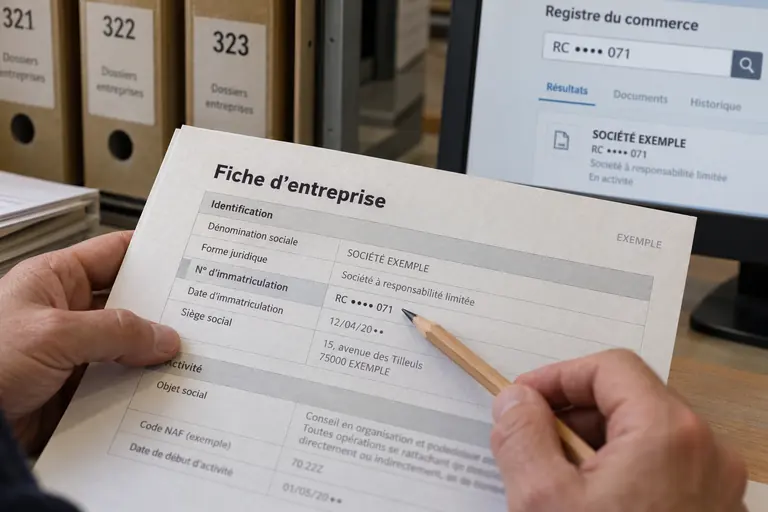
Djibouti's company register and business records are held by a public office that also handles patents and trademarks, the ODPIC. Every trader or company that wants to operate legally is entered with its name, legal form, activity, seat and managers, and receives a registration reference. The system rests on a commercial code shaped by French law, yet Djibouti remains outside OHADA. Because the country is a port and a regional logistics hub, these records matter to shippers, banks and investors who need to confirm quickly that a counterparty is lawfully established.
The office behind the register
In Djibouti the register of commerce and companies is run by the Office Djiboutien de la Propriété Industrielle et Commerciale, known by its initials ODPIC. It is a public body under the ministry responsible for trade, and it combines two missions that elsewhere are often separated: industrial property such as brands and patents, and commercial registration. That pairing explains why a visitor to the office may see founders registering a company at one counter and inventors depositing a trademark at another. For a reader tracing a business, it also means the same institution can often tell whether a company name is registered and whether a brand attached to it has been protected.
A magistrate is traditionally associated with supervising such registers in civil-law systems, and the prosecutor's office keeps an oversight role. This judicial element sets the register apart from a simple administrative list, because an entry is a legal act with consequences for third parties who rely on it, from banks granting credit to customers signing supply contracts. Anyone approaching the office for the first time should bring a clear statement of the question: confirming a name, obtaining an extract, or checking a brand. Clerks respond better to a precise request, and a well-prepared file shortens the visit considerably, particularly when documents must be certified or translated afterwards.
Legal tradition and the OHADA question
Djibouti's legal system draws on French law, adapted through national legislation after independence, with Islamic and customary influences in some areas. Commercial rules are found in a national commercial code and in company legislation. This foundation feels familiar to lawyers trained in French or Belgian systems, even when specific provisions differ. A frequent source of confusion is OHADA, the organisation whose uniform acts govern company law in many francophone African countries. Djibouti is not a member. A document from Dakar or Abidjan therefore follows another framework, and comparing the two requires care rather than assuming that the registers are interchangeable.
Arabic and French are the official languages, with Somali and Afar widely spoken. Registry documents are normally drafted in French, though Arabic versions may exist for some acts. Foreign readers should plan for translation when an extract must be presented abroad, and should ask the issuing office which language will appear on the final paper. The consequence for cross-border contracts is practical. A clause that refers to a register extract should name the issuing authority and the language, so that both parties understand which paper will count as proof if a dispute arises and which court will examine it.
What the record tells you
A typical entry names the trader or company, the legal form, the declared activity, the seat and the date the business began. For companies, it includes the corporate purpose and the identity of the managers or directors. These facts allow a buyer or lender to see who is legally responsible and which activity the firm is authorised to carry out.
Amendments appear as new entries. If a firm moves its office, changes manager or extends its activity, a diligent searcher expects to see a trace. When the record is silent about a change that everyone in the market knows about, that gap is worth questioning, because unregistered changes can complicate who may sign a contract. The register does not tell the whole financial story. It will not list invoices, disputes or banking relationships.
For that, a searcher turns to references, bank confirmation and, where relevant, court records. The commercial record answers whether the firm exists and how it is formally structured, which is the foundation for every other check. Comparing the registered activity with what the firm actually does is a simple but effective test. A company registered for general trade that suddenly offers specialised services such as shipping agency or customs brokerage may need extra permits that the extract alone will not show.
Searching and obtaining extracts
The most reliable route is to begin with the registration number printed on the firm's letterhead or contract. If that is unavailable, the legal name and the activity help narrow the search. Names in Djibouti can be written in French or transliterated from Arabic, so trying variations of spelling is sensible before concluding that nothing is registered. Extracts are issued on request to the registering office, usually with proof of identity and, when a third party applies, a mandate. Some services have been moved toward electronic channels as part of efforts to improve the business climate, but availability changes, so confirm directly which procedures are open to non-residents before relying on remote ordering.
Foreign companies commonly use a local lawyer, a business-setup agency or the chamber of commerce to obtain documents. This is often faster than a first visit by someone unfamiliar with the counters, and it provides a person who can explain the content of the extract in plain terms and flag anything unusual. Allow some margin for timing. Even when an extract is available quickly, the legal translation, certification and sometimes legalisation for use abroad can take longer than the retrieval itself, so plan the sequence before a signing date is fixed.
Free zones and special regimes
Djibouti hosts free zones and port-related areas designed to attract logistics, trading and manufacturing firms. Companies operating there may be subject to a distinct regime administered by the zone authority, with its own licensing and sometimes its own files. A searcher should not assume that a free-zone company appears in the same list as an onshore trader. When a counterparty claims to operate from a free zone, ask for both the registration document and the zone licence. The two together show legal existence and permission to operate in that specific area. If only one is produced, request the other before concluding the file is complete.
The same caution applies to branches of foreign groups. A branch is not a separate legal person, so its entry will point to a parent company abroad. To judge solvency, the searcher must look at the parent's own register, and ask for proof of the branch manager's authority in Djibouti. Finally, keep copies of every licence and registration paper provided by the counterparty, and note the dates on which each was issued. If the relationship later sours, that paper trail is useful evidence of what was represented at the outset.
Practical cautions before dealing with a firm
Treat a registry extract as proof of form, not of reliability. Check its issue date, compare the name and address with contracts and invoices, and confirm that the signatory is the person named as manager. A mismatch between a business card and the register is a common early warning. For significant transactions, combine the record with independent checks: a bank reference, a visit to the premises, and, where activities are regulated, confirmation from the competent ministry. Port-related services, customs agencies and transport firms often require specific licences that sit outside the commercial register.
Finally, regional trade adds complexity. Goods transiting to Ethiopia, for example, involve customs and logistics paperwork from several authorities. The commercial register helps identify the Djiboutian partner, but each cross-border step needs its own documents and approvals. Where a financing bank is involved, it will normally run its own verification. Aligning your checks with the bank's list of required documents avoids duplicate effort and uncovers requests that you might not have anticipated.
Frequently asked questions
Which body keeps the company register in Djibouti?
The ODPIC, a public office under the trade ministry, keeps the commercial and companies register while also handling patents, trademarks and designs. A magistrate supervises the register in line with civil-law practice. Requests for extracts or verifications should therefore be addressed to this office or to an agent acting for the applicant.
Does Djibouti use OHADA rules for company registration?
No. Djibouti is not a member of OHADA, so its company registration follows national law inspired by the French tradition. Documents, procedures and vocabulary may differ from those of members such as Senegal, Cameroon or Ivory Coast, which is why comparisons across borders need caution.
Can a foreign investor check a Djiboutian firm remotely?
Sometimes, but it depends on which services are currently open to non-residents. Many foreign investors rely on a local lawyer, an agent or the chamber of commerce to request extracts. Whatever route is used, compare the extract with the contract and confirm any sector licence separately.