
Sri Lanka's official company register records the birth, structure and later changes of every incorporated business on the island. It is kept by the Registrar of Companies, an office of the state that applies the national Companies Act. Each company receives a registration number with a letter prefix that signals its type, such as private or public. The register holds the name, registered office, directors, shareholders and filed documents, and it lets lenders, buyers and officials confirm that a company genuinely exists and who is authorised to act for it.
The Registrar of Companies and the law behind it
The central authority is the Department of the Registrar of Companies, based in Colombo. It operates under the Companies Act, which sets out how businesses may be incorporated, what they must disclose and how they must behave towards the register once they exist. Anyone who wants to understand what is on file should start from this legal framework, because it explains why certain items are public and others are not.
Sri Lanka follows a common-law tradition shaped by British rule and later reforms, and its company law reflects that heritage. Terms such as private limited company, public company, company limited by guarantee and overseas company will feel familiar to readers from India, Singapore or the United Kingdom. The vocabulary is easy to recognise, yet the detailed rules belong to the island's own statute and should be read in that light.
The register is a public-facing instrument. Its purpose is to let third parties rely on a company's recorded status rather than on promises made in negotiation. It does not certify that a business is profitable, honest or properly licensed for its sector. Those judgements belong to other bodies, and a careful reader keeps the register's narrow but valuable role clearly in mind.
Company types and registration numbers
The most common vehicle is the private limited company, usually identified by the letters PV in front of a serial number. Public companies carry a different prefix, and overseas companies that set up a presence in the country are listed under their own category. Reading the prefix is therefore a quick first test: it tells you what kind of entity you are dealing with before you open any document.
Companies are not the only businesses in the country. Sole traders and ordinary partnerships are generally recorded under separate business-name rules rather than the Companies Act, and the offices that handle those entries are different. A reader who searches the company register for a corner shop or a family partnership may find nothing, which does not prove the business is unlawful.
The registration number is the most reliable handle on a company. Names can be similar, translated or abbreviated, and several firms may share a common word such as Lanka, Ceylon or Holdings. Quoting the number in contracts, invoices and correspondence removes ambiguity, and it is the first detail an official will ask for when you request a certified document.
Foreign investors sometimes ask whether a company's prefix reveals who owns it. It does not. The letters describe only the legal category, so a private company may be wholly local, wholly foreign or jointly held. Ownership appears in the shareholder details filed with the office, and the quality of those details depends on how carefully the company has kept its returns up to date.
Searching for a company and reading the file
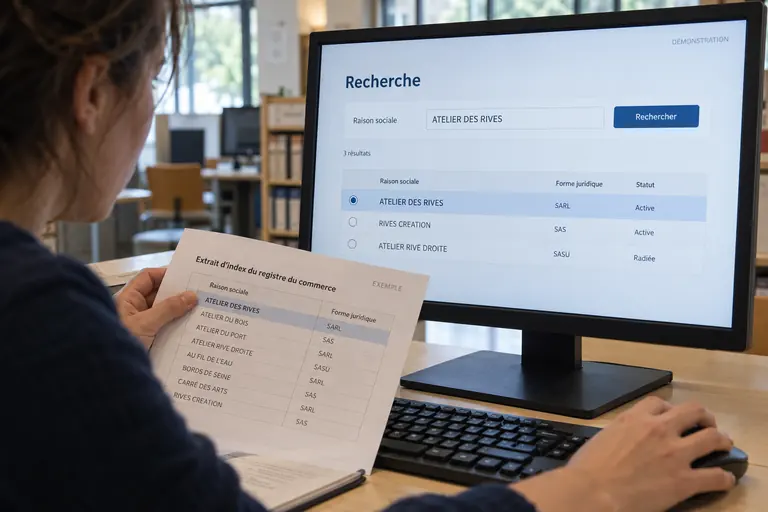
A search normally starts from the exact company name or the registration number. Name searches are sensitive to spelling, spacing and the position of words such as Limited or Private, so it helps to try several variants. If the name was given in Sinhala or Tamil on a signboard, ask the business for its English registered name, since that is the form most often used on filings.
The file of a company typically shows its registered address, the people appointed as directors and secretary, the share structure and the history of notable changes. Annual returns and amendments to the constitution may also appear. How much of this can be viewed remotely, and how much requires a visit or a formal application, depends on the services the office currently offers, so confirm the present procedure with the Registrar.
Do not stop at the first screen. Compare the registered address with the one on letterheads, check that the directors named match the people you are meeting, and note the status shown. A company that is struck off, in liquidation or dormant presents a different level of risk from one in good standing, even if its name still appears in older directories.
Documents, certificates and certified copies
The certificate of incorporation is the founding document. It confirms the date on which a company acquired legal personality and repeats its registered name and number. Banks, tender committees and foreign partners often ask for it, together with a recent statement of directors and registered office, to be sure that the structure they are dealing with matches the story told in meetings.
For use abroad, a simple copy rarely suffices. Embassies, courts and regulators elsewhere may demand a certified copy, sometimes followed by legalisation or an apostille-type formality depending on the destination country. Sri Lanka has been developing its cross-border document procedures over time, so ask the receiving authority exactly what it will accept before you order anything, and keep the originals safe.
Translations deserve attention too. Official records may be drafted in English, Sinhala or Tamil, and a foreign authority will often want a sworn or certified translation. Plan for that step early, because a perfectly valid certificate can still be refused when the language, the stamp or the date does not match what the receiving office expects.
What the register does not tell you
A company can be perfectly in order at the register and still be a poor business partner. The file says nothing about its credit record, unpaid taxes, pending lawsuits or the quality of its goods. For those questions you need other sources: tax clearances requested from the company itself, court record checks through a local lawyer, bank references and commercial credit reports.
Sector licences are also separate. Tourism operators, exporters, banks, insurers and food businesses answer to regulators or ministries whose records are independent of the company register. A legally incorporated company may still lack permission to carry on a regulated activity, and the reverse is true as well: a licence holder must still be properly incorporated.
Beneficial ownership is another area where caution is wise. A shareholder shown on file may be a nominee, a holding company or a trust. Whether the ultimate owner is visible depends on the disclosure rules in force and on how diligently filings were made, so serious transactions call for further enquiries beyond a single extract.
Reading the register also means reading its silence. If a document you expect to see is missing, that may reflect a filing that is overdue, a service that is not yet available electronically or a record held in paper form. Ask the office politely and in writing, and keep the reply, since it can later explain why your due-diligence file looks incomplete.
Practical advice for foreign readers
If you plan to buy from, invest in or hire a Sri Lankan company, build your checks in a sensible order. Ask the business for its full registered name, number, registered office and a recent certificate. Verify those details against the register, then compare them with what appears on contracts and bank details. Mismatches are not always fraud, but they always deserve an explanation.
Local professionals make the process far smoother. Attorneys-at-law and company secretarial firms in Colombo deal with the Registrar every day, understand the current forms and can tell you whether a service has moved online or still requires a visit. Their fees vary, so agree the scope of work before they begin, and ask for copies of everything they obtain.
Finally, remember that rules and procedures evolve. Fee schedules, filing formats and digital services change from time to time, and any figure you read elsewhere may be outdated. Treat the Registrar's own notices as the authority, and record the date on which you consulted the register so that you can show later what the position was when you decided.
Frequently asked questions
Who keeps Sri Lanka's official company register?
The Department of the Registrar of Companies keeps it. This state office applies the Companies Act, issues certificates of incorporation, records changes to directors and registered offices, and holds the filings that third parties may consult. Sole traders and partnerships are generally handled under separate business-name rules, so they may not appear there.
What does a Sri Lankan company registration number tell me?
It identifies one specific company and usually starts with letters that indicate its type, for example PV for a private company. Use the number rather than the name when you search or draft contracts, because several businesses can share similar names, and the number removes that confusion for banks, courts and officials.
Can I rely on the register to judge a company's reliability?
Not alone. The register confirms legal existence, status, officers and filed documents, but not solvency, tax compliance or sector licences. Combine it with bank references, tax clearances, court checks through a local lawyer and, where relevant, the regulator that supervises the activity before committing money.