
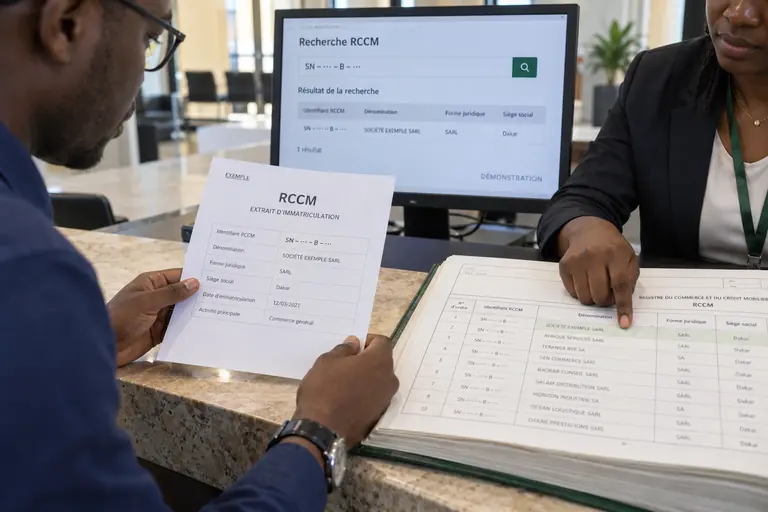
Benin's RCCM company register holds the business records of merchants and companies, kept under the common business law of the OHADA treaty. RCCM stands for the register of commerce and personal property credit, which combines the registration of traders with the publicity of certain security interests. Each trader or company receives a registration number, the file is held at the registry of the competent commercial court, and the data feed a national and a regional database. An entry proves existence, not financial health.
RCCM in the framework of OHADA law
Benin belongs to the Organisation for the Harmonisation of Business Law in Africa, known by its French initials OHADA. Under this regional system, the member states apply uniform acts in fields such as general commercial law, companies, securities and insolvency. The RCCM, the register of commerce and personal property credit, is governed by the uniform act on general commercial law.
The name reflects two functions. First, the register records merchants, whether individuals or companies, and gives them recognised legal existence towards third parties. Second, it publicises certain security interests over movable assets, which allows lenders and buyers to find out whether an asset has been pledged before relying on it.
Because the rules are common across the member states, someone who understands the system in Benin can read an entry from another OHADA country with relatively little adaptation. The practical details, such as the office in charge, the forms and the fees, still belong to each state, so they must be checked locally.
Reforms in recent years across the region have aimed at simplifying business formalities, for instance through single-window services that bring several procedures together. Whether and how such a service handles registration in Benin is something to confirm with the registry or the investment promotion bodies, since arrangements evolve and a summary can quickly become outdated.
Who keeps the register in Benin
In the OHADA model, the register is kept at the registry of the court with jurisdiction. Benin has created commercial courts, among them the one in Cotonou, the economic capital, and their registries handle the files of merchants in their areas. Other jurisdictions may also receive filings, depending on how the judicial map is organised.
The registry receives the application, checks the supporting documents, assigns the registration number and keeps the file. It also issues extracts and certificates and receives later changes, such as a new manager or a move of premises. The registrar, a court officer, is responsible for the accuracy of what is entered.
In addition to the local file, the system maintains a national file and a regional file. The regional one is kept at the level of the organisation, near the common court of justice and arbitration, and receives copies of the data. For an internet user, this means that references to more than one level of information can appear for the same business.
What a business file contains
For a company, the file typically includes its name and trade name, legal form, registered office, activity, share capital where declared, and the identity of managers and partners with unlimited liability. It also contains the registration number and the date of entry, along with documents supporting the application, such as the statutes.
For an individual merchant, the file shows the person's identity, the trade name, the address of the establishment and the type of activity. The file evolves through additional entries that record changes, such as a new address or the cessation of the business. Each entry is dated and signed by the registry, which gives the file its historical value.
Security interests registered in the personal property credit section appear in their own part of the system. A search may therefore reveal not just the identity of the trader but also whether certain movable assets are subject to a pledge. This is valuable for lenders, though it demands careful reading, because the absence of an entry does not guarantee that no other claim exists.
Why the registration number matters
The RCCM number identifies the business in contracts, invoices, tender documents and bank files. It allows counterparties to tell apart companies with similar names and to find the correct file at the registry. Many procedures in Benin ask for it, from opening a business account to submitting a bid to a public authority.
Its value is that of an identifier. It proves that the trader was registered and gives a pointer to the register, but it does not guarantee honesty, solvency or competence. A company with an impeccable number may still be heavily indebted, and a new entrant may be perfectly reliable despite having a short record. The number is best treated like a passport number: essential for identification, silent about character.
For that reason, professionals treat the number as the starting point of verification. They ask for a recent extract, compare the details with other documents such as tax registration and identity papers, and where the transaction is large, consult specialised sources on payment history and litigation. Registry evidence is solid, but it answers only a narrow question.
Public contracts offer a good illustration. A contracting authority checks that each bidder is registered, that the number matches the one on the application and that the extract is recent, and then proceeds to technical and financial evaluation. The registry step is a gate for admission, while the real selection takes place in the stages that follow.
Obtaining an extract and using it
The extract from the register is the usual proof of registration. Banks ask for it before opening a professional account, contracting authorities require it from bidders, and partners request it before signing agreements. It reproduces the main data in the file and carries the registry's authentication.
To obtain one, the trader or an authorised person applies to the registry holding the file, identifies the business by its number or name and pays the applicable charge. Requirements, delivery times and the availability of online channels depend on the office and on reforms under way, so it is wise to ask the registry about current practice before planning around a date.
Recent extracts carry more weight than old ones. A business can change managers, address or status within months, and a recipient who relies on an outdated paper may deal with the wrong person. Many institutions state a maximum age for the extract they accept, and it is sensible to ask before ordering so that the paper does not have to be obtained a second time at extra cost and delay.
Limits, checks and good practice
Registry records reflect what has been declared and entered. If a business fails to report a change, the file may lag behind reality. If a trader uses a different trade style in the market, a search by that style may find nothing. Searching by the registration number, the legal name and the address together gives a more reliable picture, and noting the date of each search shows later what was known at the time.
Cross-checking is the safest practice. Compare the extract with the identity of the signatory, the tax identification data and, for companies, the statutes and the minutes appointing the manager. Inconsistent names, mismatched addresses or an extract that looks altered are reasons to ask the registry to confirm what it holds.
For businesses themselves, good practice means filing changes promptly, keeping copies of every extract and statutes, and ensuring the number is quoted correctly on commercial documents. A well-maintained entry reduces friction with banks, customers and tax officials, and in a region where trade crosses borders, it makes the business easier to trust for partners who have never visited Cotonou.
Frequently asked questions
What does RCCM stand for?
It stands for the register of commerce and personal property credit, a register used in the OHADA member states. It records merchants and companies and publicises certain security interests over movable assets. Benin applies it under the uniform act on general commercial law, with local rules on offices, forms and fees.
Where are RCCM records held in Benin?
At the registry of the competent court, including the commercial court of Cotonou for businesses in its area. Data from local files also feed a national and a regional file. To find the right office, check where the business has its registered address or ask the registry directly.
Does an RCCM number prove a company is reliable?
No. It proves that the trader or company was registered and identifies the file in the register. It says nothing about solvency, honesty or performance. Combine it with a recent extract, tax and identity documents, references and, for large transactions, specialised credit and litigation checks.