
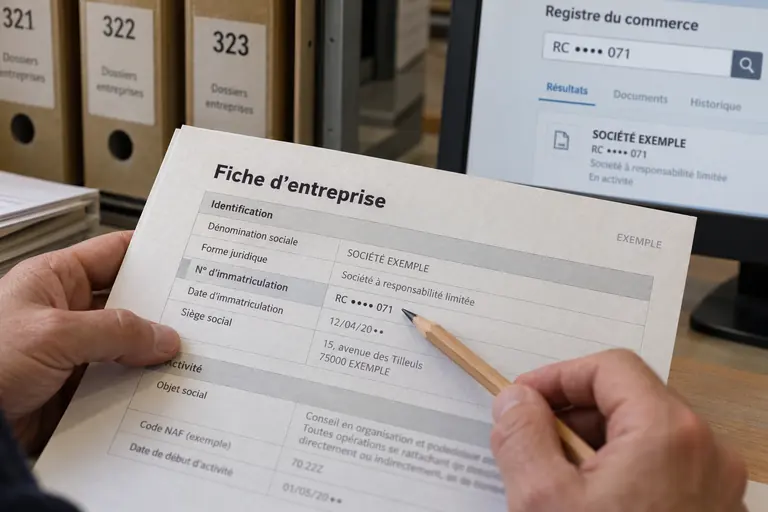
Historical company register extracts differ from ordinary ones because they keep what the current version leaves out: earlier names, past addresses, former managers, superseded capital figures and entries that have since been struck. Rather than describing a company only as it is today, the historical extract retraces how it became what it is, line by line and date by date. Registers in several countries offer it under varying labels, typically on request and sometimes for a higher charge than the standard certificate.
Current versus historical: the essential difference
A current extract is a photograph. It lists the entries that are valid on the day it is produced and omits anything that has been replaced or deleted. If the manager changed three times in ten years, you see only the present one. This is perfect for confirming who can sign a contract today, but it hides the path taken to reach that situation. A historical extract is more like a film.
It keeps the superseded entries visible, often with their dates, and may mark them as deleted or modified. Some registers present them in chronological order, from the first registration onwards, while others group them by category, such as names, addresses and officers, so that changes can be followed more easily. Different countries use different vocabulary. Swiss cantonal offices speak of extracts with deleted entries or chronological extracts, German registers can issue a chronological print, and French clerks' offices can supply an extract showing the history of mentions.
Whatever the label, check the description before ordering to be certain it covers the past entries you need. A third form sometimes encountered is the extract as of a specific date, which reconstructs the situation at a past moment instead of listing all the changes. It is the most direct answer to a legal question such as who was the manager on the day a contract was signed, and some registries can produce it on request for a defined date.
What a historical extract can contain
The most common additions are previous corporate names and trade names, which help trace a business that was renamed after a merger or a rebranding. Past registered addresses show relocations, including transfers between jurisdictions. Former objects of the company reveal how the activity shifted, sometimes from trading to holding or from one sector to another. People appear too. Former directors, managers, partners and sometimes signatories are listed with the dates of appointment and end of term, allowing you to see who was responsible at the time of a particular event.
For a dispute concerning a contract signed years ago, this is often the decisive information, since the current manager may not have been in office. Capital movements and structural events are also recorded: increases and reductions, conversions from one legal form to another, mergers, demergers and transfers of assets. Insolvency proceedings and their closure may appear as well. The extract will not reproduce full documents, but it indicates that a change occurred and gives a reference to the relevant filing.
Another useful detail is the reason for a change. Some registers record the type of event behind an entry, for example a resignation, a dismissal, an appointment by court or a transfer following a merger. These labels give context that raw dates cannot, and they help distinguish routine turnover from events that deserve closer investigation. Such small checks cost little and prevent most of the misunderstandings that slow down a file.
How long the past stays visible
Registers do not always keep old entries forever in a readily available form. Many retain them in digital archives for decades, while paper records from earlier periods may be stored in historical archives, requiring a different request. Retention rules depend on national law, and some jurisdictions allow deletion of personal data after a given time. For very old companies, the digital history may begin only when the register was computerised. Earlier entries then exist on paper or microfilm, and an extract of the electronic record can be incomplete.
If the period you need predates the digital system, ask the registry whether an archive service exists and what it can retrieve. Because of these limits, an absence in the extract does not prove that nothing happened. It may simply mean that the information was never digitised or was legitimately removed. When the stakes are high, supplement the extract with the published notices of the period or with the company's own minute books.
Struck-off companies and vanished entities
One valuable use is research on companies that no longer exist. After a striking-off, dissolution or liquidation, a current extract may be unavailable or may simply show the closed status. The historical record retains the life story of the entity and can help creditors, heirs and researchers understand what became of it. Heirs and successors may need to prove that a family business existed or that a person served as its manager. Former employees sometimes seek confirmation of a long-ago employer's identity for pension claims.
In these situations, the historical extract, combined with archive documents, gives a verifiable account that no other single paper provides. In cross-border cases, the same principle applies. A foreign court may ask for proof of the company's status at the date of an incident, and a certificate showing the past position is more convincing than today's snapshot. Ask the register whether it can issue a statement as of a specified date, as some do.
How to order one
Start by identifying the company precisely, with its registration number and the registry competent for it. Then look for the service offering extracts with history on the register's official channels. Online ordering is common for recent periods, whereas older records may require a written request or a visit to the archive department. State your purpose and the period of interest if the form allows.
Some registers let you select the type of content, such as only names and addresses or the complete chronology. Ordering exactly what you need keeps the document readable, and may lower the cost when charges depend on the volume of information supplied. Check the language and the format. In multilingual countries, the extract is issued in the official language of the registry, and a translation may be required for use elsewhere.
If a certified copy is needed for court, specify it in the request, because an informational print might be refused when formal evidence is demanded. Fees vary widely between countries and even between types of extract within the same register. Because of that, read the price information shown at the ordering stage and confirm what is included, such as whether certification, translation or postal delivery is extra, before approving the order. Surprises are rare when the description is read carefully.
Legal value and limits
A historical extract documents what was entered in the register, not necessarily what was true. If a person was recorded as a director, the entry shows the formal position, while the real influence of that person might have been greater or smaller. Treat it as evidence of declared facts, and corroborate with contracts, minutes and testimony. Its probative force depends on whether it is certified.
A signed and sealed version issued by the registry authority generally carries more weight in legal proceedings than an uncertified print. Rules vary, so ask the receiving authority which form it accepts, and request translations and legalisations early if the file will cross borders. Finally, remember data protection. Personal information about former directors is still personal data, and registers sometimes restrict access to older entries or require a legitimate reason.
Use the information for the stated purpose, store it securely and avoid sharing it widely, particularly when it concerns people who left the company long ago. One more caution concerns interpretation. A name that disappears from the list of directors may reflect a resignation filed late, so the date of the entry is not always the date of the real event. If precision matters, compare the registry date with the company's own records, and note any gap between the two when you present the evidence.
Frequently asked questions
What is the difference between a current and a historical extract?
A current extract shows only the entries valid on the day of issue. A historical extract also shows superseded or deleted entries, such as former names, addresses, directors and capital figures, usually with dates. It is the right document when you need to understand how a company changed over time.
Can I get a historical extract for a company that no longer exists?
Often yes, since registers keep the records of struck-off or dissolved entities for a period set by national law. Older records may sit in archives rather than the online system, so ask the registry which service holds them and whether a written request is needed.
Is a historical extract accepted as evidence in court?
A certified version signed or sealed by the registry authority is generally accepted as formal evidence, while an uncertified print is usually informational. Check the receiving court's requirements first, and ask for translation or legalisation in advance if the proceedings are abroad.