
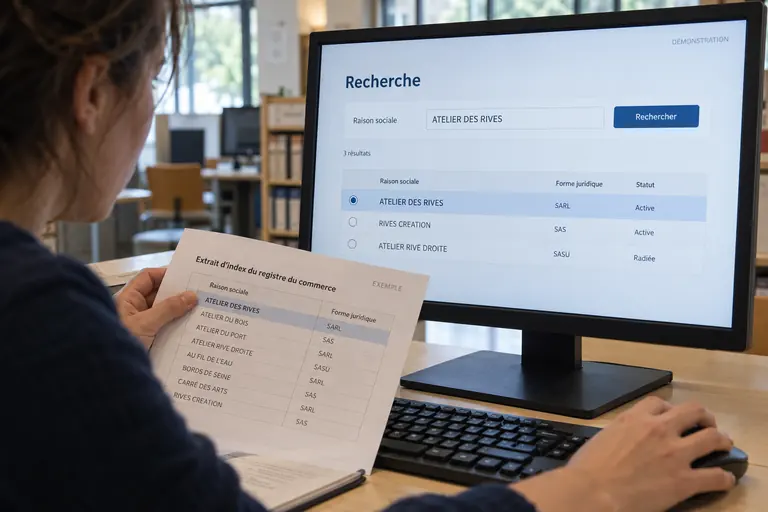
In Spain, the BORME's official company register notices are the corporate announcements that the state publishes in its commercial register bulletin. Issued by the national agency that also produces the general official gazette, it reports corporate facts such as incorporations, appointments, dissolutions and changes of statutes, together with legal announcements to partners and creditors. The bulletin spreads information that has already been entered in the registers, so it supports transparency without replacing them. Today it appears in electronic form, and any person with a browser can open the issues free of charge.
A gazette for companies and the public
The official commercial register bulletin is a publication of the Spanish state intended to broadcast the corporate information that the law requires to be made public. It is edited by the state agency responsible for the official gazette, and it works as a formal means of publicity that complements the data held in the commercial registers across the country. It is therefore a natural first stop for anyone who wants to follow corporate events.
The reasoning behind it is that third parties should be able to learn about certain relevant facts concerning companies. For this reason constitutions, appointments, dismissals, amendments to the articles and dissolutions are among the items published. Publication in the bulletin is added to entry in the register and strengthens the security of commercial dealings between businesses that have never met.
Historically, company publicity existed on paper only, and consulting it meant visiting newspaper archives or the register offices. Today the bulletin is distributed electronically and any person can open its issues from a browser. That change has made it far easier to monitor corporate information, whether one is a creditor, a journalist, an investor or simply a curious neighbour. Readers who used to rely on local libraries can now work from anywhere in the world.
For foreign investors the bulletin offers an inexpensive and practical way to learn whether a Spanish partner has recently changed its directors, registered office or capital. It also helps compliance teams to build a timeline of corporate events without waiting for formal certificates, although those certificates remain necessary whenever a document must be filed with a bank or an authority abroad, or to a court.
Registered first, published second
The bulletin does not replace the commercial register. It is a channel for spreading what has already been entered, not the source that gives validity to an entry. When a fact must be proved with evidential value, for instance before a bank, a court or a foreign authority, a certificate from the competent register is required rather than a printout of the bulletin.
This ordering explains certain delays. A company act is first examined and entered by the registrar, and only afterwards appears in the bulletin. A reader who searches for a very recent appointment may not find it yet, which says nothing about whether the appointment is valid or the registrar's work complete. A short wait and a second search normally solve the question.
It also means that the entries come from two sources. The provincial registers supply most of the content, and the central office, which centralises information from the provincial ones, contributes data of its own, including that relating to company names. The reader benefits from a consolidated view without having to visit each register separately. This division of labour is invisible to readers but explains why several offices appear behind one publication.
Structure of the bulletin and how issues are identified
The bulletin is divided into two main sections. The first is devoted to businesspeople and gathers the acts entered in the commercial registers, arranged by province and then by company. The second collects announcements and legal notices, such as calls to general meetings and certain communications that companies owe to their shareholders or creditors. The wording of each heading remains formal, so readers should expect legal rather than everyday language.
Each notice states the name of the company, the number of the entry and the content of the act. Because of this structure, it is easy to find information by territory, and a reader who knows the province of the registered office can go straight to the right part of the issue instead of scrolling through the entire publication. The notice number is useful when a later correction or reference needs to be traced.
The bulletin appears periodically on the days set by the rules governing it, and each issue is identified by its date and made up of one or more summaries. Depending on what the official site offers, an issue may be consulted by date, by section or by province, and the same notice can often be located by company name. Knowing these options saves time when an issue contains many pages.
Typical notices: from incorporation to winding up
Among the corporate notices are the incorporation of a company, the appointment and removal of directors, changes of registered office or corporate purpose, and increases or reductions of capital. Mergers, demergers and conversions are also published. These acts alter the legal structure of the firm, which is why the law wants them known to the public. A single act may be announced together with several others from the same meeting.
Another block covers the end of the company's life: dissolution, liquidation and cancellation of entries. Situations such as sole ownership and certain declarations about the state of the company also appear. The exact scope of what is published is defined by law, so a reader should not assume that every internal decision ends up in the bulletin. Liquidators and their appointments appear in the same way as other officers.
Not every registered fact is reproduced in full. The bulletin often gives only an extract of the content, and the complete detail has to be obtained from the register itself. For serious analysis, a notice should be treated as a starting point and not as the final document, particularly when the decision at stake is of some financial importance. Readers should therefore record the date of the notice they relied on.
Notices on capital operations deserve particular attention from creditors. A reduction of capital, for instance, can affect the guarantee that the equity provides, and the law attaches rights of opposition or information for creditors in certain cases. Reading the bulletin regularly allows interested parties to react within the relevant periods rather than discover the change months afterwards, when the deadlines have passed.
Searching the bulletin for a particular company
To trace a company, begin with its exact name and, if possible, its tax identification number, then search the bulletin by the company name or look through the relevant issues for the province of its registered office. A spelling variant, a former name or an abbreviation of the corporate form can hide a result, so alternative forms are worth trying.
A search should be read chronologically. Putting the notices in order by date tells the story of the company: its creation, the arrival and departure of directors, capital changes and eventually its closure. Gaps are normal, because not all events lead to a notice, but sudden changes of directors or office in quick succession may justify further checks. This chronological method is one of the simplest ways of testing the consistency of a company's story.
When researching a counterparty, many professionals subscribe to alerts from private services that read the bulletin for them. Such services are convenient, but they rely on the same public source and may contain transcription errors. Any important finding should be verified against the original notice and, if necessary, against a register certificate. Never make a payment or sign a contract on the strength of an alert alone.
Limits, cautions and good practice
The bulletin is a public source with a precise function. It does not assess the solvency of a company, and the absence of a notice does not prove that nothing happened. A company may also have its entries delayed, or the notice may contain a correctable error, so contradictory information should be taken to the registrar. Contacting the registrar in writing leaves a useful trace of the question and the reply.
Foreign readers should note that notices are written in Spanish legal vocabulary. Terms such as corporate purpose, sole shareholder or dissolution have precise meanings under Spanish law, and a loose machine translation can mislead. A short consultation with a translator or a lawyer who knows the field pays for itself when the matter is significant. Where the stakes are high, keep both the original Spanish text and the translation together.
These remarks are general and do not constitute legal advice. The structure of the publication, the rules on what is published and the way to consult it may change, so the current information provided by the official publisher should be checked before relying on any particular notice for a decision. Keep a dated copy of the notice and of the page from which you obtained it.
Frequently asked questions
Is the BORME the same as the commercial register?
No. The bulletin publishes information that has already been entered in the registers, but it is not the source that gives the entry validity. To prove a fact with evidential value you need a certificate from the competent commercial register, not a copy of a bulletin notice.
What kinds of acts are published in the bulletin?
Typical notices include incorporations, appointments and dismissals of directors, changes of registered office or corporate purpose, capital increases and reductions, mergers, dissolutions and liquidations. A second section carries legal announcements such as calls to meetings. The law defines exactly which acts must be published.
Can I read the bulletin for free?
Yes. It is distributed electronically by the publishing agency, and any person can open the issues from a browser. Searching by date, section or province is usually possible, depending on what the official site offers. Always check the official source rather than a paid intermediary.