
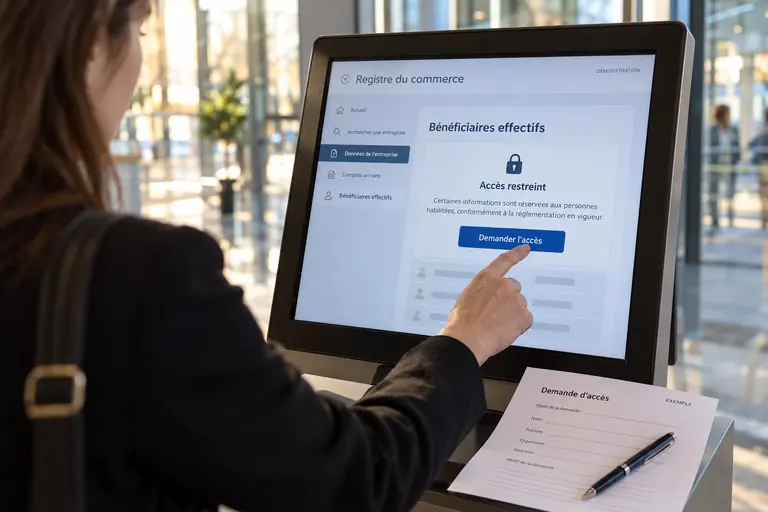
In Spain, the beneficial ownership register and company owners it reveals answer a simple question: which real people stand behind a business, even when the shares sit behind several layers of other entities? The data is gathered in a central register set up under anti-money-laundering rules and fed by notaries and registrars, with each company responsible for keeping its declaration current. Access is no longer fully open: authorities, regulated professionals and people showing a legitimate interest can consult it, while ordinary curiosity is not a sufficient ground.
Why beneficial ownership matters
A company is a legal person, and the names on its share register are not always the people who really profit from it. Nominees, holding companies and trusts can stand between the business and its true owner. Beneficial ownership rules exist to pierce that chain and name the individuals behind it, mainly to fight money laundering, tax evasion and the financing of crime. For a bank, a notary or a lawyer, knowing the real owner is part of mandatory customer checks.
For a supplier or an investor, it answers a practical question: who stands behind the signature? A company controlled by a person with a history of bankruptcies or sanctions is a different risk from one owned by a transparent group. The concept is not unique to Spain. It follows European anti-money-laundering directives that every member state has transposed into national law, so a Spanish file can be compared with those of France, Germany or Italy. Details differ from country to country, but the central idea of naming the individual behind the entity is common.
How the register is built
Spanish law assigns the task of collecting and centralising ownership data to a dedicated register under the supervision of the justice authorities. Two professional channels feed it: the notaries, who record ownership information when a company is incorporated or when its shares change hands, and the registrars, who hold the company's other registry data. The result is a database designed to cross-check several sources. Companies themselves must declare who their beneficial owners are and keep that information up to date.
Typically, a person is treated as a beneficial owner when holding more than a quarter of the capital or voting rights, or when exercising control by other means. Where nobody meets the test, the senior managing official is recorded instead, so the file is never left blank. Because the declaration depends on facts that can change quickly, accuracy is a recurring concern. A takeover, an inheritance or a restructuring can alter control overnight, and the company must report it.
Authorities may compare declarations with other records and ask for corrections where discrepancies appear, which keeps the register more reliable than a purely self-declared list. Cross-checking is encouraged by design. A notary who witnesses a share transfer, for example, records who ends up holding the capital, and that record can be compared with what the company has declared. When the two diverge, the discrepancy can trigger a request for clarification, which is one reason professionals trust the central database more than a bare statement made by a company.
Who is allowed to consult the data
For a period, many European registers were open to the general public. A ruling from the European Union's top court limited that approach, finding that unrestricted publication interfered too deeply with privacy. Since then, access in Spain has been narrowed to groups with a defined reason, which changes how ordinary users should plan their searches. Competent authorities such as courts, prosecutors, tax bodies and supervisors have direct access for their duties. Regulated entities, including banks, notaries and other professionals bound by anti-money-laundering obligations, may consult the data during customer checks.
Persons who can demonstrate a legitimate interest, for instance investigative journalists or organisations active in this field, may apply under the conditions set by law. If you do not belong to those groups, you will need another route. You may ask the counterparty itself to provide its ownership structure, ask your bank or lawyer to run the check, or rely on documents the company can lawfully share. A request without a clear justification is likely to be refused, so prepare a concise explanation of your purpose.
What an entry typically shows
An entry normally names the beneficial owner and identifies the person through basic personal details such as nationality, country of residence and an identification document reference. It also describes the nature of the ownership or control, for example a direct shareholding, an indirect holding through another company, or control exercised through agreements or voting arrangements. The record is often accompanied by the date from which the person qualifies and by the legal entity to which the declaration relates.
When a chain of companies exists, the chain may be described step by step, which helps a reviewer understand how a name at the top connects to the business at the bottom of the structure. Not every detail is visible to every requester. Even authorised users may see only the fields that their purpose justifies, and sensitive data can be withheld when disclosure would expose a person to disproportionate risk.
This tiered approach explains why two professionals consulting the same record might receive slightly different levels of detail. Ownership may also be described in terms of percentages or categories of holding, which helps a reviewer see whether control is concentrated or shared. A business with one dominant individual presents a different profile from a company split evenly among several families, and the entry makes that difference visible without requiring the reader to reconstruct the structure from deeds.
Owners, shareholders and directors are different
One frequent mistake is to treat the shareholder list, the board of directors and the beneficial owners as the same group. Directors run the company and appear in the Mercantile Registry because their appointment must be recorded. Shareholders hold the capital, but in a limited liability company their identities are not always displayed publicly, except where the company has a sole owner. Beneficial owners are a third category.
They may be shareholders, but they may equally be individuals who control a shareholder far up the chain, or who direct the business through side agreements. A person can be a beneficial owner without being a director, and a director can run a firm without owning anything. Because of this, the Mercantile Registry alone cannot answer the question of who ultimately owns a company. It confirms registered data such as the registered office, the object and the administrators.
Combining it with beneficial ownership information, where you are entitled to it, gives a more complete picture than either source offers separately. A practical tip when preparing due diligence is to ask early for the organisation chart of the counterparty. Such a chart, signed by a director, lets you compare the claimed structure with the registry data you are entitled to see, and any mismatch becomes an immediate question to raise before a contract is signed.
Privacy and responsible use
Ownership data is personal data, and its handling is covered by data protection law. Anyone who obtains it should use it only for the purpose that justified access, store it securely and avoid disclosing it beyond what is necessary. Misuse can lead to complaints, penalties and reputational harm for the user as well as the person concerned. Prepare your request carefully. State who you are, which company is concerned, and why the information is needed, for example to complete a compliance review or to evaluate a major contract.
Attach supporting documents where possible. Clear, proportionate requests are far more likely to succeed than vague ones. Finally, treat what you receive as a starting point. A register entry reflects a declaration at a certain date, and control can shift without immediate updates. For significant transactions, combine registry information with contracts, corporate documents and professional advice, and revisit the checks periodically as the business relationship evolves.
Frequently asked questions
Can anyone look up who owns a Spanish company?
Not freely. Since the European court ruling on public access, consultation is limited to authorities, regulated entities such as banks and notaries, and persons who can show a legitimate interest. Others can ask the company directly for its ownership information or rely on a bank or lawyer to perform the check.
Is the beneficial owner the same as a shareholder?
No. A shareholder holds shares, while a beneficial owner is the natural person who ultimately owns or controls the business, possibly through several companies or agreements. A shareholder can be another company, whereas a beneficial owner is always an individual, or the senior manager if no individual qualifies.
Does the Mercantile Registry show the real owners?
Only partly. It records the registered office, object, administrators and certain capital information, and it shows the sole shareholder of single-member companies. It does not by itself reveal the people behind holding structures, which is the function of the dedicated beneficial ownership register.