
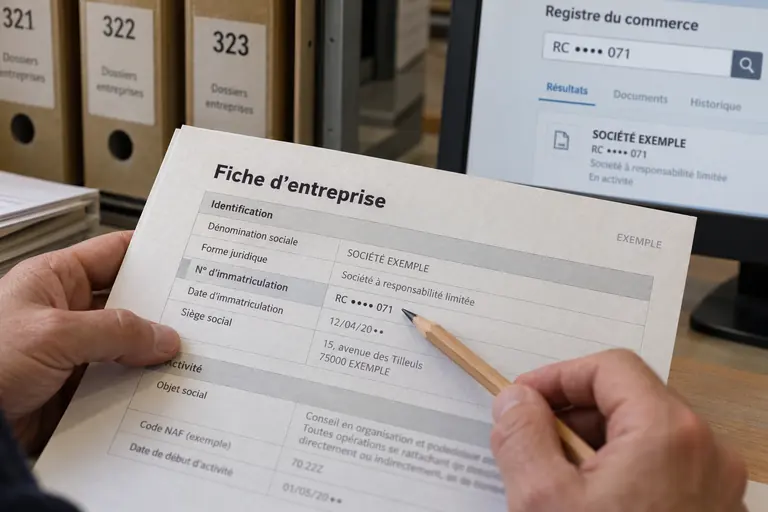
Castellón's commercial register is where company records for the northern province of the Valencian Community are kept and consulted. Each business whose registered office is in the province has a sheet that begins at incorporation and grows with every later act, all after a registrar's careful legal review of the deed. Entries cover names, capital, directors, powers and later changes, ordered by date. They give no data on turnover or profit, and they say nothing about product quality, customer satisfaction or reputation.
A provincial office in the Valencian Community
Castellón is the northernmost of the three provinces of the Valencian Community. Each province has its own commercial register, so a company based in Castelló de la Plana, Vila-real or Benicarló is entered in the Castellón office, while one headquartered in Valencia or Alicante is not. The test is the statutory seat in the articles. The registrar is a state official qualified by public examination and is responsible for checking each deed's legality before entering it. When a defect can be corrected, the person who presented the deed is told in writing and given time to put it right.
The Valencian regional government supports business through development bodies, but it does not keep the commercial register or issue company certificates. The legal rules applied in Castellón are the same national rules applied everywhere in Spain. The Central Commercial Register in Madrid reserves company names and coordinates the national gazette, so that a name cleared there is not granted twice. Chambers of commerce in the province offer advice to new entrepreneurs on formalities and funding, which many people use before visiting a notary. They do not enter or certify anything on the register, so their orientation should be treated as practical help and not as official proof of any legal fact.
Tiles, citrus and port-linked trade
The province is well known for its ceramic tile industry, which has generated a large chain of suppliers of clays, glazes, machinery and logistics. Citrus growing, food processing, chemicals and port services complete a varied picture. These activities appear in the stated purposes of the companies on the register. Because the tile sector is made up of large groups and small specialised firms, a reader meets very different sheets. Some show a single administrator and little capital, while others show boards, several powers of attorney and a record of transformations. Agricultural cooperatives, which are common in citrus areas, are entered in their own registers.
A negative result in the commercial register for such an entity is therefore not a sign that it does not exist. Export-oriented companies often need extracts for foreign customers and banks. In this sector, document packages for buyers abroad are common, and a recent certificate is a regular item among them. A tile manufacturer's sheet might show a long corporate purpose that includes production, sale, import and export of ceramic products and related materials. Such wording is normal and reflects the wish to leave room for growth. It describes legal scope, not what the company actually does on a given day.
Valencian and Spanish in names and addresses
The Valencian Community has two official languages, Valencian and Spanish. Documents may use either, and place names often exist in both forms, such as Castelló de la Plana and Castellón de la Plana. A registered address may use one or the other, so a second attempt with the alternative form is advisable. The corporate name appears in the entry exactly as chosen by the founders. A name in Valencian should not be translated when searching, and accents and apostrophes should be reproduced as written. Small differences can produce a different result.
Certificates are generally issued in Spanish, and the recipient abroad decides whether a translation or an apostille is needed. Asking before ordering prevents wasted effort. The tax number, which does not change with language, is the most robust search key when names are spelled in different ways. Another quirk of the Valencian setting is that a municipality may have an official bilingual name or a single Valencian form. Documents from different periods can show different versions, so a researcher tracing a company through older papers should note every variant found and try each in turn.
Ordering information step by step
The usual route is the registrars' online platform. The user selects the Castellón office, identifies the company by exact name or NIF and chooses between a simple note and a certificate. Payment is online, and the document is delivered as a signed digital file. The simple note is convenient for checks before negotiating, as it shows the current data and pending items. The certificate is the document to use when a bank, a court or a tender requires proof. Stating the intended use when ordering helps ensure the right wording. Check the date, the company's identity and the list of administrators with their powers.
An older extract may omit a recent change, which can matter when you are about to sign. Fees follow an official schedule that can be updated, and delivery times vary with workload. Confirm both with the official channels when you order, especially if a deadline depends on the document. Single-member companies, which are common among family businesses in the tile supply chain, carry a note that one person owns all the capital. That detail matters when contracts are signed between the owner and the company, because such deals must be recorded in writing in accordance with the law.
Accounts, books and the gazette
Capital companies deposit approved annual accounts every year. The registrar checks that the file is complete and well presented but does not audit the figures. When elements are missing, the filing is held up, and a long default can close the sheet to new entries. Accounts help to see how a company is structured financially, though they show only what it chose to declare for the period. Check whether an audit report is attached and read the notes for guarantees, disputes and related-party dealings. The register gazette publishes extracts of acts from every province.
It is useful for following new directors, mergers and dissolutions of Castellón firms. It is not a full legal source, since it does not reproduce complete deeds. Corporate books are presented to the register for legalisation. That recognises their form, not the truth of what they contain. Reading three or more consecutive sets of accounts is more informative than reading one. Trends in debt, equity and results reveal how the company has coped with changes in demand, energy costs or exchange rates, which strongly influence export-oriented sectors like ceramics.
Using the register with caution
A sheet shows that a company exists in law. It does not show whether it trades or pays suppliers. Dormant companies often stay on the register, and some are in liquidation while still listed, so the later entries deserve as much attention as the first. Timing gaps are another trap. A decision takes effect when adopted, but it appears on the register only after entry, so a recently appointed administrator may be acting before the sheet shows it. For significant transactions, ask the company for its latest deed. Personal data on sheets are protected, and use of the information must have a legitimate purpose.
This text is general information and does not replace advice from a lawyer, a notary or the registrar. Cross-check important facts with a second source, such as the company's own deeds, its tax number on invoices and a direct conversation with its administrator, before committing money. If the registered office has moved out of the province, the Castellón sheet closes with a note and the company continues in the register of its new seat. A search that ends there should be repeated in the new province to find the current entries.
Frequently asked questions
Is Castelló de la Plana the same place as Castellón de la Plana?
Yes. The first is the Valencian form and the second the Spanish form of the provincial capital's name. A registered address may use either, so try both when a search returns nothing. The commercial register that serves the province is the same office in both cases.
Will a company based in Valencia appear in the Castellón register?
No. Each province of the Valencian Community has its own commercial register, and a company is entered where its statutory seat lies. A firm with a plant in Castellón but a seat in Valencia has its sheet in the Valencia office.
Why would an exporter need a register certificate?
Foreign customers and banks often ask for proof of legal existence, directors and signing powers before accepting orders or financing. A recent certificate, with an apostille and translation if the destination country asks for them, provides that proof from an official source.