
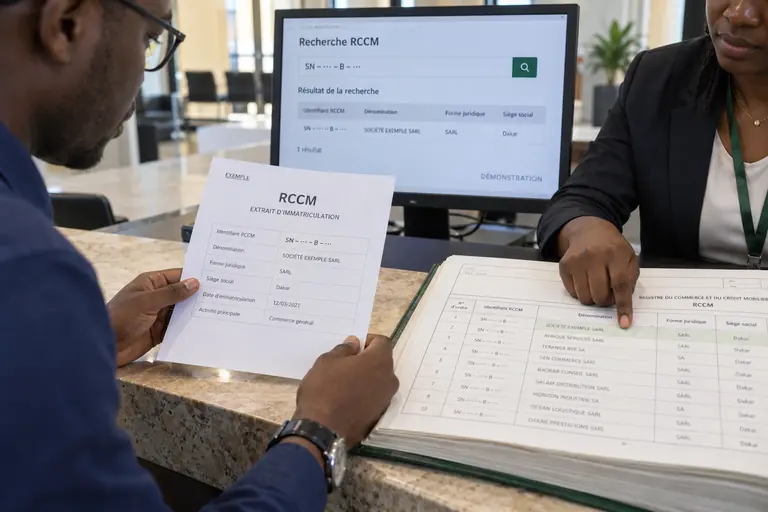
The OHADA RCCM company register extract is the standard proof, across West and Central Africa, that a business is entered in the Trade and Personal Property Credit Register of a member state. The register follows common rules laid down in the uniform law of the organisation for the harmonisation of business law in Africa, but each country applies them through its own court registry or one-stop office. The extract identifies the enterprise, its legal form, its address, its manager and any security rights recorded against its assets.
A shared legal framework across many states
OHADA is the Organisation for the Harmonisation of Business Law in Africa, a treaty framework that groups a large number of mostly francophone states, with a few others, under common commercial legislation. Its uniform acts cover company law, security interests, insolvency and general commercial law. The register of trade and personal property credit, known by the initials RCCM, is one of the institutions they organise. Having common rules does not mean having a single central file.
Each state keeps its own register, operated locally by a court registry or by an administrative body designated by national law. A business registered in Abidjan, Dakar, Douala or Libreville therefore has a record in its country's system, and the extract is issued by that country's competent office. For a foreign partner, the benefit of the framework is predictability. The structure of the document, the vocabulary and the meaning of the main entries are broadly similar from one member state to another, so a reader who understands one extract can interpret others with little effort, even though layouts and procedures differ.
Since the uniform acts also regulate how security interests over movable assets are published, the register serves two purposes at once. It identifies traders, and it gives lenders a place to learn whether equipment, stock or receivables of a business are already pledged. That second function explains why a careful financier asks for an extract before granting a loan, even to a long-standing client.
Decoding the registration number
The RCCM number is more than a serial. In the practice of member states, it combines a code for the country, a code for the place of registration, a letter or mark indicating the year and type of the registration, and a sequence number. Reading it correctly tells you where the entry was made and roughly when. The exact format varies by country and has changed over time, so do not assume that two numbers should look alike.
A number issued in one capital may carry a different locality code from one issued in a secondary city, and older registrations may follow earlier conventions that were later harmonised. When requesting an extract, always copy the number exactly as printed on the company's documents, with every prefix, hyphen and letter. A small transcription error can lead the registry to a different entity, or to none at all. Where the number is unknown, search by name and by the place of the registered office instead.
Where to request the extract
In most member states the competent office is the registry of the commercial or first-instance court in the jurisdiction where the business is registered. In others, registration and the issue of extracts are handled by a business formalities centre or a one-stop agency established to simplify company creation. The location of the registered office decides which one is relevant. Some countries have developed online services for ordering extracts, while many still rely on counter requests or authorised representatives.
If you are abroad, a local lawyer, an agent or the company itself can often collect the document on your behalf. Ask the registry how it identifies the requester and whether it accepts mandates. For businesses with several establishments or branches, remember that the registration may exist in more than one place. The head office entry is usually the reference, but a secondary establishment can have its own file.
Specify in the request which entry you want, to avoid receiving an extract that does not match your purpose. Online access is growing but uneven across the region. A few states publish search tools and allow certain documents to be ordered from a distance, whereas others still require a visit and a handwritten request. Before travelling or hiring an agent, call or write to the registry and ask which channel it actually uses today, since websites are not always updated.
Documents and conditions that vary by country
The conditions for obtaining an extract differ from state to state. Many registries issue it to any person who asks, since the register is public, while others require an identification document, a power of attorney from the business or proof of a legitimate interest. Some set a short validity period after which the copy must be renewed. Charges, delays and formats also vary, which is why advice from a neighbouring country does not always apply.
Official fees are fixed by national regulation, and the means of payment may include stamps, bank deposits or electronic payment. Ask for the current official tariff in writing, and keep the receipt as part of your file. If the extract is needed urgently, explain this to the registry and find out whether an express route exists. Be careful with unofficial intermediaries who promise rapid delivery.
Use the registry or its recognised agents, and verify that the final document carries the signature, stamp and registration reference that official copies usually bear. Companies that already hold an extract sometimes assume it is valid indefinitely. In reality, banks and tender committees in the region commonly set their own limits on the age of the copy, and some refuse extracts that are not recent. Plan the order so that the date of issue falls close to the date of submission.
Reading the extract methodically
Begin with the identity block: corporate name, trade name, legal form, registration number and date of registration. Then check the address, the stated activity and the capital where mentioned. Compare these items with the contract or invoice you hold. Differences in a name or a legal form often reveal that you are dealing with a different entity from the one you expected. Next, look at the persons: the manager, the directors and any partners with unlimited liability, depending on the legal form.
The extract tells you who is entitled to represent the company. If a signature on a contract belongs to someone not named, ask for the document that gave that person authority before relying on the agreement. Finally, check the entries relating to personal property security. The register can record pledges and other security interests, and these affect the creditworthiness of the business.
Any reference to an insolvency procedure, a suspension or a deregistration deserves immediate attention, as it changes the risk profile of any transaction with the company. Pay attention to the legal form, because it determines liability. In a limited liability company, the partners are normally not personally liable beyond their contributions, while in a general partnership they can be. The extract states the form, and misreading it can lead a creditor to expect a personal guarantee that does not exist.
Using the extract abroad and its limits
A foreign authority, bank or partner may ask for a recent extract, a translation and some form of authentication. Depending on the destination, this can mean an apostille where the relevant convention applies, or a chain of legalisation through the foreign ministry and the consulate. Confirm the exact requirement with the recipient before starting. Language is a practical point. Most extracts are issued in French, with some countries in the region using English or Portuguese for official documents.
A certified translation is often needed for use elsewhere. Order it from a translator accepted by the receiving authority, since some bodies refuse translations made by unaccredited persons. Remember what an extract cannot do. It proves registration, not solvency, not the quality of management and not the absence of unregistered liabilities. Because it reflects the register on the day of issue, request a fresh copy for important operations, and complete the check with tax and social contribution certificates where the counterpart can supply them.
Frequently asked questions
What is an RCCM extract?
It is an official document drawn from the Trade and Personal Property Credit Register of an OHADA member state. It identifies a business, its legal form, address, registration details and the people authorised to manage it, and it can mention security interests recorded against the company's assets.
Is the RCCM number the same in every OHADA country?
The structure is similar, usually combining a country code, a place code, a year or type mark and a sequence number, but formats vary by state and have changed over time. Always copy the number exactly as written on the company's documents when requesting an extract.
Can I use an RCCM extract outside the country that issued it?
Usually yes, but the destination may require a recent date, a certified translation and an apostille or legalisation. Requirements differ from one authority to another, so ask the receiving body what it expects and request authentication early to avoid delays in a cross-border transaction or tender.