
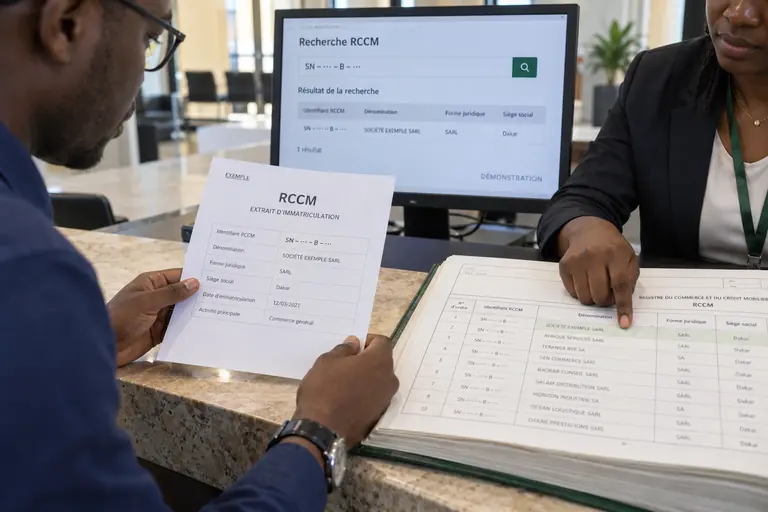
Côte d’Ivoire’s RCCM company register and business records form the official memory of who trades legally in the country. The register of commerce and personal property credit, administered under OHADA law, receives each trader and company, gives commercial companies their legal personality and publishes security interests over movable property. Its entries show names, legal forms, addresses, activities and managers. In the commercial hub of Abidjan and in other towns, partners, banks and public buyers request extracts from it as proof that a business exists.
Why Abidjan matters to the OHADA register
Côte d’Ivoire has a special place in the OHADA system because the common court of justice and arbitration has its seat in Abidjan. That court interprets the uniform acts for all member states, and the regional file of the commercial register is also hosted there. The country is therefore both a user of the system and a home for its central institutions.
The economy of the country is broad, with agriculture, cocoa, ports, construction and services. Many transactions involve companies registered in Abidjan, so understanding the register is a daily concern for importers, exporters and lenders. A buyer of cocoa or a supplier of equipment will usually want an extract before signing.
Because of this concentration of trade, the commercial court of Abidjan handles a large share of filings. That does not mean companies elsewhere are outside the system; other towns have registries that cover their own areas. The principle stays the same: a business is registered where it is established, and the entry follows it through its life.
For a foreign reader, a useful way to picture the system is a three-part chain. The business declares its details, the court registry checks and records them, and the information is then made available to anyone who has a reason to know it. The chain works well when each link is accurate, which is why errors in the original declaration create long-lasting problems.
The one-stop formalities centre and who it serves
New enterprises are directed to the investment promotion centre, which runs a one-stop formalities desk. The aim is to reduce trips between offices by letting the founder submit one dossier covering registration, tax identification and social declarations. The centre works with the registry but does not replace it; the registration number still comes from the register.
The documents asked for depend on the legal form and the activity. Articles of association, identification of the partners, proof of a registered office and a declaration of the activity are typical examples. Some founders use a lawyer or notary to prepare the file, since errors in the statutes may cause rejection or later disputes among partners.
Foreign-owned businesses may establish a subsidiary or register a branch of the foreign parent. The two options carry different consequences, because a branch has no separate legal personality and its parent answers for its commitments. Early advice on the best structure is more useful than a quick fix after the registration is complete.
Cocoa exporters, building firms and logistics companies often ask a new counterpart for proof of registration as a matter of routine. A supplier that answers quickly with a recent extract, a taxpayer number and the identity of its signatory gives a favourable first impression. Reluctance to provide these basic papers deserves attention and a polite insistence.
Understanding an Ivorian registration entry
The entry begins with the trader’s or company’s name and, for a company, the legal form: a limited liability company, a simplified joint-stock company, a public limited company or another recognised type. The registered office and the main activity follow. These details allow a reader to match the entity with a contract, an invoice or a trade licence.
People who manage the company are recorded, along with the limits of their authority. A managing director may be able to commit the company alone, while another structure might require two signatures. The capital and the length of the company’s existence also appear, as do notes on later events such as a change of manager or a transfer of the head office.
Tax identification in the country uses a taxpayer account number given by the revenue administration. It is separate from the RCCM number, and invoices frequently show both. When a supplier provides only one of them, ask for the other. Gaps in the paperwork are not proof of wrongdoing, yet they justify a further look.
Names deserve special care. A company may have a corporate name, a trade name and a sign, and invoices sometimes mention only the commercial label. Matching each label to the entry avoids paying an account held by a different entity. Compare the name on the bank account, the contract and the extract line by line.
How to search and what an extract delivers
A useful search starts with the registration number if it is known. Failing that, the exact company name and the town allow the registry to locate the file. Because many businesses use similar names, adding the manager’s name or the activity helps to avoid confusion between two entities that look alike.
The registry delivers an extract summarising the current entries. This document says what the register holds on the day of issue and nothing more. Lenders and tender bodies often require a recent date, so an old extract kept in a drawer may be refused. Delivery times and any digital request options are best confirmed by contacting the registry.
Persons living outside the country can ask a local agent, a law firm or a chamber of commerce to obtain the extract. Written authority from the requester may be needed. Once received, the document should be checked for the name, number, address and signatory, and compared with the other papers supplied by the business.
Changes, closures and the life of an entry
A registration is not frozen. When a manager leaves, the capital rises, a branch opens or the company changes its name, an amending entry is made so that the file stays current. A reader who looks only at the original entry might miss these developments, which is why the date of the latest extract is so important.
At the end of its life a company is dissolved and liquidated before being removed from the register. A deleted entry means that the company no longer exists for the future, though earlier obligations may survive. Distinguishing an active company from a dormant one or one in liquidation is among the main reasons to consult the register.
The same logic applies to individual traders. A person who stops trading should declare the cessation, otherwise the entry may remain in the file and cause confusion. Supervisory authorities and banks sometimes find old entries that no longer reflect reality, which explains why corroboration is advised.
Practical caution for investors and suppliers
The register proves that a business has been declared, not that it is profitable, solvent or honest. Combine the extract with a bank reference, a check of tax compliance and, where possible, a visit to the premises. For goods or services of high value, a local legal adviser can interpret the file and spot irregularities.
Sectors such as mining, banking, insurance, telecoms and energy require specific licences from ministries or regulators. Registration at the commercial register does not replace them. Ask for the permit that matches the activity and verify it with the issuing authority, rather than relying only on the company’s own statements.
These notes give general information about how the system works. Procedures, offices and digital services evolve, and some details vary between jurisdictions. Anyone about to commit funds should confirm the current rules with the registry or a qualified Ivorian professional, and keep a record of every document received.
A last point concerns dates. An extract is a snapshot, and the situation of a business can alter within days after a sale of shares or a change of manager. Professionals therefore ask for a document issued shortly before signing and keep a copy in the file. This simple habit protects both sides if a later dispute arises.
Frequently asked questions
Why is Abidjan so important for the RCCM?
Abidjan hosts the common court of justice and arbitration of OHADA, which also holds the regional file of the register. It is also the main business centre of the country, so its commercial court handles many filings. Other towns still have registries for their own areas.
Is the extract enough to trust a partner?
It is a good first check, but not a complete one. An extract shows legal existence, form, address and representatives on the day of issue. It does not show solvency or reputation, so add bank references, tax documents and licence checks when the deal is important.
Do I need a local agent to get an extract?
Not always, but it can help, especially from abroad. A lawyer, agent or chamber of commerce can submit the request and collect the document. Written authority from you may be required, and you should confirm with the registry how requests are accepted at present.