
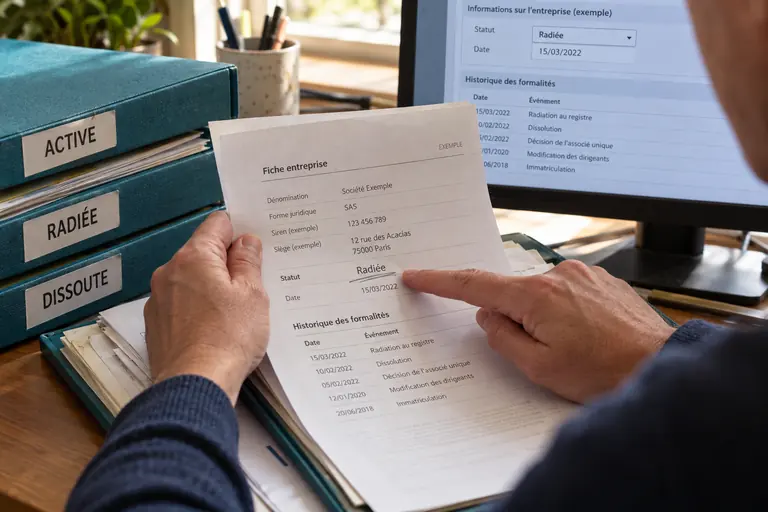
Morocco's commercial register application forms are the standard models on which traders and companies declare facts that the law requires to be public. Separate models exist for first registration, for later amendments and for deregistration, and for natural persons as opposed to companies. They are published by the institutions that keep the register, chiefly the central property office and the court registries. A form creates no right of its own; it carries a declaration, which takes effect against third parties once the registry enters it.
Why standard models run the Moroccan register
Declarations to the Moroccan commercial register are made on models set by the administration. The system standardises the information requested: the identity of the operator, the legal form, the activity, the address and the managers. This lets the court registries process files in a uniform way and allows the central office to build a coherent national file out of thousands of local entries.
The forms are tied to the legal duty that obliges traders and companies to register. They do not generate rights by themselves. They serve as the vehicle for declaring facts that the law requires to be made public, and a declaration, once entered, produces effects against third parties. The paper or screen is therefore only as reliable as the facts it contains.
For this reason the models are published by the bodies that keep the register. The national industrial and commercial property office offers many documents on its portal, while court registries hold those they require locally. As a result the same family of forms can be found at several official sources, and a careful applicant compares them with what the competent registry actually asks for.
A practical consequence is that two applicants in different cities should expect similar paperwork. The principle of uniform models means a trader in Casablanca and one in a smaller town fill in comparable documents, although local registries may add expectations about attachments or presentation. Asking the registry for its checklist before the first visit is the surest way to learn those local habits.
The families of forms by formality
Models fall into a few families. The first group concerns initial registration, with a split between natural persons and legal entities. The second covers amendments, meaning any change after the entry. The third relates to deregistration, which ends the entry. Knowing which family applies is the first filter, and it prevents the common error of downloading the nearest-looking document.
Beyond the three main groups, forms exist for special situations: the sale or lease of a business, a pledge over the business, the opening of a branch or secondary establishment, and the transfer of the seat into the area of another court. Each of these events has its own mandatory content, which is why the closest resemblance is not always the right form.
Numbered references of models should not be memorised loosely. Numbers and titles may change after a reform, and only the version published by the registry at the time of the formality is authoritative. Downloading the model from the official source on the day of the filing, instead of reusing a copy saved long ago, is a habit that avoids rejection for an outdated format.
Some formalities involve more than one model at once. Selling a business that has a branch, for example, can require a declaration for the sale, another for the branch and an amendment for the manager's address. Treating each event separately, in the right order, keeps the register coherent and avoids a situation where one entry contradicts another.
Registration forms for individuals and companies
The form for a natural person collects the identity of the trader, nationality, home address, trade name, nature of activity and address of the establishment. It is accompanied by identity papers and proof of the premises, and the trader certifies by signature that the information is accurate. A small shop owner, a craftsman-trader or an independent consultant using this route should keep copies of every attached paper.
The model for legal entities repeats the characteristics of the company: name, form, capital, seat, purpose, duration, managers and their powers. It is completed by the articles, the name certificate and the proof of seat. A foreign company opening a branch uses an adapted model, and the file should show the link with the parent company and the person appointed to run the Moroccan branch.
In both cases, consistency between the form and the supporting papers is essential. An address spelled differently, a capital figure entered wrongly or a manager designated imprecisely are routine reasons for a file to be sent back. Reading every field against the originals before signing takes minutes and avoids a second visit to the registry. The same discipline applies to individuals and legal entities.
Signatures need attention too. The person who signs must be the one entitled to do so: the trader for an individual file, the legal representative for a company. If a manager delegates the task to an employee or an adviser, a written power of attorney should accompany the form, and the registry may ask for the identity papers of the representative as well.
Amendment and deregistration models
When a registered fact changes, the register must be updated by an amending declaration. A change of name, address, manager or activity is filed on the model designed for amendments, along with documents proving the change, such as minutes of a meeting, revised articles, a lease or an identity document. Filing too late can leave the register out of line with reality.
Deregistration has its own model. It follows the end of a trader's activity, the closing of a company's liquidation or the death of an individual operator. The file contains evidence of the cessation, which differs from case to case, and sometimes tax certificates. A company cannot simply be removed; it normally passes through dissolution and liquidation before the deregistration request is admissible.
Choosing the correct form depends on the formality and on the status of the entity. Models meant for companies are unsuitable for an individual trader, and the reverse is also true. Newcomers often make this mistake. The applicant should therefore ask the registry which model fits the situation when in doubt, and keep a record of the answer in the file.
Timing is a related point. Legal deadlines run from the event that changes the entry, such as a decision of the partners or the end of the activity, and not from the date a form is prepared. Declaring promptly keeps the register accurate, whereas a long delay can lead to difficulties with banks or administrations that rely on the public record.
Where to find, complete and keep the forms
Models are available on the portal of the national office, on the sites of regional investment centres and at court registries. Some online services guide users and produce pre-filled documents. Which services exist and how they work evolves, so the functions on offer should be verified on the official site at the moment of the formality, and users should not assume that an earlier procedure is still valid.
Filling in requires care. Fields should be completed legibly, without crossings out, with information that matches identity documents and the articles. Forms are in Arabic or French depending on the model, and annexes must respect the registry's translation requirements. A tidy folder holding every declaration and its supporting papers is a sensible habit for any trader.
Keep a copy of each form lodged and the receipt issued by the registry. These papers prove the date of the formality if a dispute arises. Note that sector licences may be required in addition, and that registration charges follow the scale in force. This text is general information, not personalised legal advice, and the applicant should consult official models and the competent registry or a qualified professional.
Bilingual presentation sometimes causes questions. A document drafted in a language other than Arabic or French, such as a foreign parent's resolution, normally needs a translation by a sworn translator, and the registry may refuse the file without it. Ordering the translation at the same moment as the form saves a delay between the first and second visit.
Frequently asked questions
Which form do I use to register a new business in Morocco?
It depends on whether you register as an individual trader or as a company. Natural persons use the registration model for individuals, and companies use the one for legal entities, together with articles, a name certificate and proof of seat. Download the current model from the official source and ask the registry if unsure.
Can I use an old copy of a form?
It is risky. Models, numbers and titles can change after a reform, and only the version published by the registry at the time of the formality counts. Downloading the model again from the official source before every filing avoids rejection for using an outdated format.
What should I keep after filing?
Keep a copy of every form you submitted and the receipt the registry gave you. These documents prove the date and content of the formality if a dispute or an audit arises. File them with the supporting papers, such as the articles, identity documents and proof of address.