Jersey company registry: how the Jersey Registry works
The Jersey company registry is the Registry operated by the Jersey Financial Services Commission, which records Jersey companies, partnerships, foundations, business names and security interests. A public search confirms the identity and standing of an entity before anyone relies on it.
A registry run inside the financial services regulator
The Jersey company registry is part of the Jersey Financial Services Commission, usually shortened to JFSC. The Commission is the island’s financial services regulator, and it also keeps the public registers of legal entities. The two functions are distinct, so a company that appears in the Registry is not necessarily a regulated business, and its entry does not prove that it holds a licence.
Jersey is a Crown Dependency with its own legislation and courts, and it is not part of the United Kingdom or the European Union. Company law is found mainly in the Companies (Jersey) Law 1991. A reader who knows Companies House in London should be careful with the Jersey company registry, because forms, deadlines and public content in Jersey follow local rules and differ from British practice in important respects.
The Registry is open to the public, and its website explains how to search, how to file and how to contact the staff. Filings by companies are generally made online by the company or by its service provider. The Jersey company registry therefore reflects what has been submitted and accepted, and it moves at the pace of those filings.
The registers kept by the Jersey Registry
The JFSC describes its Registry as holding several separate registers. Companies are the largest category, but the Jersey company registry also records limited partnerships, limited liability partnerships, incorporated limited partnerships, separate limited partnerships and foundations. Business names are registered as well, together with security interests over certain intangible assets.
A search that does not find a name in one register may succeed in another. Entities that look like companies in everyday language can be partnerships or foundations in law, and the register type tells the reader which statute applies. Jersey also allows cell company structures, which are used mainly in funds and insurance, and their records should be read with their special features in mind.
Security interests deserve a short explanation. Jersey has a statutory register for security interests over intangible movable property, such as shares and receivables, and a registered interest can be searched by a lender who wants to know whether an asset is already pledged. It is distinct from the company file and has its own search function.
What a Jersey company search can show
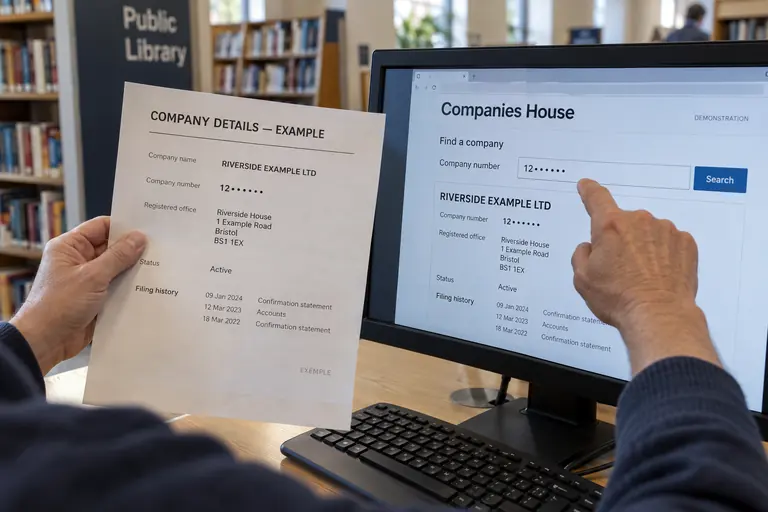
The public search offered by the Registry lets a user look for an entity by name or by registration number. The result typically gives the name, the number, the entity type, the status and the registered office. Where a user selects the option for former names, the result can also include earlier names under which the entity traded, which helps with older contracts.
Further documents may be available for some entity types, depending on what the law requires to be filed and made public. A Jersey company search is most useful as an identity check, because it ties a name to a number and a status. It is less suited to answering questions about financial performance, since private companies are generally not required to place their accounts on the open file.
Registration dates are helpful in a due diligence review. A very recent date for a company that claims a long trading history calls for an explanation, such as a reorganisation or a continuation from another jurisdiction. The Jersey company registry shows the legal birth date of the entity, not the start of the business that it may have taken over.
Registered offices, directors and service providers
Jersey companies must have a registered office on the island. In practice, many use the address of a corporate service provider, which is a firm licensed and supervised by the Commission. These providers often act as company secretary, administer the company and handle its filings with the Registry.
For a reader, this means that the Jersey registered companies in a search frequently share an address with dozens of others. The address shows where documents can be served, and it does not show where the business operates. Officer details and the identity of the people behind the company should be confirmed from the contract documents, and the service provider can sometimes explain who controls the structure.
A change of registered office or of service provider is recorded in the file and can be a sign of a restructuring. It is not an alarm in itself, since many groups move their entities between administrators for commercial reasons. Even so, the date of the change should match what the counterparty says about its own history.
Annual confirmation, status and dissolution
Jersey companies are required to confirm their details to the Registry each year through an annual confirmation statement. The date and the regularity of this filing give some indication of how well a company is administered. A company that falls behind may be liable to penalties and, if the failure continues, to being struck off the register.
The status in a Jersey company registry result can show whether an entity is active, in winding up or dissolved. Winding up in Jersey is carried out under the Companies (Jersey) Law, either voluntarily by members or creditors or by order of the Royal Court. The Jersey Registry shows the change of status, while the court decisions and liquidator notices carry the substance of the process.
Continuation is a Jersey feature that readers sometimes overlook. A company may move its incorporation into Jersey from another country, or out of Jersey to another country, and the registry record then reflects the new position. A company that has left Jersey is no longer governed by Jersey law, and the foreign register becomes the main source.
Ownership information and its limits
Jersey requires companies to hold information on their beneficial owners and controllers, and the Registry keeps ownership and control information in a register that is not open to the general public. Access is reserved for authorities and for persons who meet legal conditions. A reader should therefore not expect an ordinary search to reveal the individuals behind a Jersey vehicle.
A counterparty that wishes to prove its ownership can supply its own documents, such as a register of members or a certified structure chart, and a lawyer can advise on how much weight to place on them. Where a significant person is named in a public record, the information describes a legal role as recorded and should be read with care. Names alone do not prove control.
Practical checks before relying on Jersey registered companies
A prudent check of the Jersey company registry starts with the exact legal name and the registration number, matched against the contract and the invoice. The next step is to confirm the status and the entity type, and to look at former names if the business has changed its identity. The reader then compares the registered office and the service provider with the details given by the counterparty.
If the counterparty says that it carries on a regulated activity, such as fund administration, trust business or banking, the licence should be checked with the Commission’s own lists and not assumed from the company entry. The Jersey company registry is a public record of existence and basic standing. It is not a credit report, and it gives no assurance about the conduct of the business.