
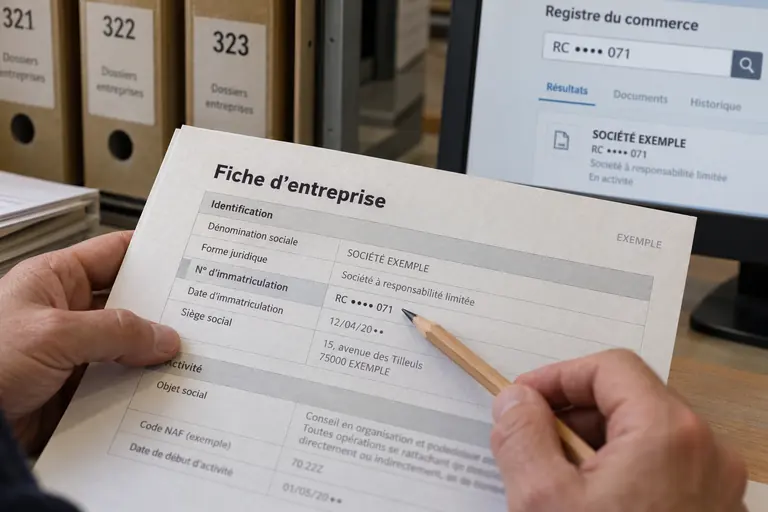
Spain online access to company register documents covers a range of electronic services, not one single screen: some help locate a company and read basic data, others deliver documents with informative or evidential value, and others verify official publications. The professional body of registrars runs a portal with an electronic office, a commercial register section and a directory of provincial offices. What you receive depends on the document ordered, because legal value follows the type of document and never the channel used to obtain it.
What digital consultation covers
Electronic consultation of commercial documents refers to a set of very different services. Some let you find a company and learn its basic details. Others deliver documents with informative or probative value, and still others help you check official publications. There is no single screen that solves everything. Because of that variety, the first task is to decide what you actually need. Curiosity about a supplier requires something different from the proof demanded by a bank or a court, and the right service follows from that objective.
People often arrive expecting a single download button that returns the whole file of a company. The register does not work like that: it issues specific documents, each with its own content and legal effect. Keeping this in mind avoids ordering the wrong item and then having to pay twice. A useful way to sort the services is by question. Who is this company, and where is it registered? What has been entered about it? Has an official notice been published? Can I check that a document in my hands is genuine? Each of these questions has its own tool, and mixing them up wastes time.
Where to consult the commercial register online
The Association of Registrars maintains a portal that includes an electronic office, a section devoted to the commercial register and a directory of provincial offices. From there users are guided to the available services and to the office that corresponds to each company. Appointment booking and auxiliary tools are also offered. Besides the portal of the profession, the Central Commercial Register has its own online services, among them verification of documents it issues. The official bulletin of the register can be read openly. Each source answers a different question, and none of them reproduces the others.
Provincial offices keep the books of the companies in their area. If an online service does not offer what you need, the office responsible for the company's registered address can usually explain the alternatives and the data to provide. Start from the website of the profession, as it normally leads you to the right channel for your case. Many users start from a search engine and land on commercial sites that charge for the same public material. The professional portal and the Central Commercial Register are the primary sources, and comparing what a reseller offers with what the primary source delivers usually shows whether the extra cost buys anything useful.
Kinds of documents that can be obtained online
The simplest product is the informative note, a summary of what is registered that arrives quickly and serves for orientation. Stronger is the certificate, issued by the registrar with an electronic signature and used when the content of the entries must be formally proved. Between the two there are differences in value worth remembering when choosing. Some services also provide copies of deposited documents, such as accounts filed by companies. Availability depends on the company and on the period concerned. The price, format and delivery time are shown by each service before the order is confirmed.
The note is designed for quick checks, for example before negotiating with a supplier. The certificate is designed for procedures where an authority, a notary or a counterparty needs evidence that carries legal weight. Ask the recipient which one they accept before paying for either. The content of a note or certificate typically includes the denomination, tax number, registered address, corporate purpose, the administrators, the share capital and registered modifications. Which items appear and how fully depends on what was requested and on the entries that exist for that company, so read the heading of each section carefully.
Steps for an electronic consultation
The first step is to identify the company: full denomination, tax number or at least the province of its registered address. With those data you reach the suitable service, choose the type of document and complete the fields requested by the form. The more exact the identification, the lower the chance of obtaining another company's document. Next comes the payment where applicable and the delivery of the document, which is normally received electronically. Save the file in its original form rather than copying its text elsewhere, since the original may carry a signature or a verification code.
Read the document immediately, comparing the name, address and tax number with those you used in the request. A mismatch is better caught at once, while the order can still be corrected. If you act for someone else, keep in mind that some services require proof of identity or of a legitimate interest. Companies with several branches or activities may have more than one office involved, and a request sent to the wrong province will simply be returned. The registered address in the articles, not the shop you visited, determines the competent office, which is a detail that catches many first-time requesters.
Validity and limits of digital access
The validity of a document obtained online depends on its type, not on the channel. A certificate electronically signed by the registrar has the evidential value of a certificate even if it never existed on paper. An informative note remains informative, however modern the platform from which it was downloaded. Digital access is also limited by the information the register holds. It shows what has been entered, not what happened in the company in the meantime. Events not yet entered, pending filings and facts that the law does not require to be registered will not appear.
The situation recorded changes with every new entry, so a document reflects only the moment of its issue. For decisions that depend on current facts, ask for a recent document and check the issue date. Personal data is protected, so access to some content can be limited or require a justification. Evidential value also has a practical side. A bank, a notary or a foreign authority may ask for a certificate with a verification code, and they will check that code online. A plain screenshot, however clear, does not meet that standard and is likely to be refused when a formal document is required.
Good practice and common errors
A good practice is to note the date of the query and to keep the original downloaded document. The register changes with each entry, and the file received reflects only its moment of issue. Someone who must decide on that information will be glad to prove what the register showed on that day. Frequent errors include ordering the wrong document type, typing the denomination loosely so that a similar company is returned, and relying on an old copy. Another is paying a third party that resells public information at a markup without adding anything.
Check that the site is the one run by the profession or by the Central Commercial Register before entering payment data, and compare any unexpected request for extra details with the instructions on the official portal. Treat this general information as orientation and not as legal advice; for a specific filing, check the current instructions of the registry. Finally, think about storage. Documents downloaded in electronic form should be saved in a folder with the company name, tax number and date of consultation in the file name. Months later you will be able to see at once which version you hold and whether it is time to request a fresh one.
Frequently asked questions
What is the difference between a simple note and a certificate?
A simple note is informative: it summarises what is registered and suits quick checks. A certificate is issued by the registrar, usually with an electronic signature, and serves to prove the content of entries formally. Choose according to what the recipient accepts.
Does a document downloaded online have less value than a paper one?
No, validity depends on the type of document and not on how you obtained it. An electronically signed certificate keeps its evidential value, while an informative note stays informative whether it arrives on screen or on paper.
What do I need to start an online request?
The exact denomination of the company, its tax number or at least the province of its registered address. The more precise these data are, the lower the risk of obtaining the document of a similar company. Read the result as soon as it arrives.