
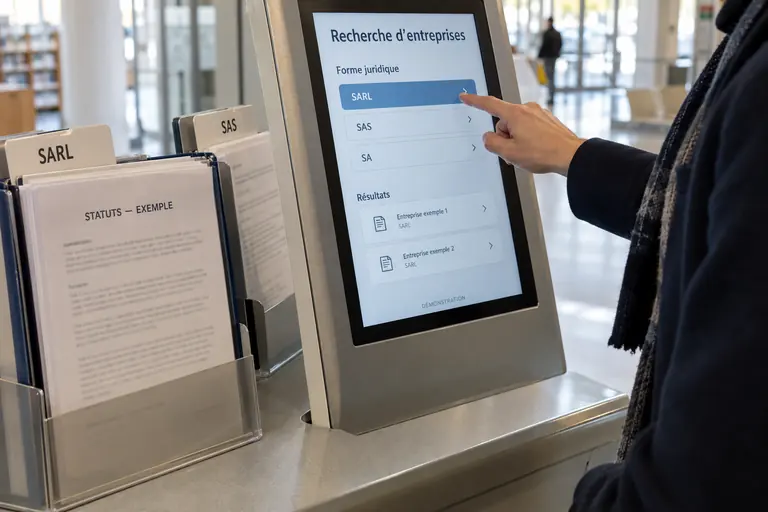
Ourense is a Galician province whose businesses are inscribed in a provincial mercantile registry, and Ourense commercial register company records are the result. Each file shows a firm's legal name, form, registered address, corporate purpose, administrators and deposited accounts, once a registrar has examined the deeds. The records give a dependable answer to basic questions of identity and authority. They stay silent about trading performance, private debts and personal data that the law keeps out of commercial publicity, so they serve as a foundation for checks rather than a final verdict.
Inland Galicia and its business landscape
Ourense lies in the interior of Galicia, away from the coastal ports that dominate the region's trade. Its economy mixes wine production in the Ribeiro and Valdeorras areas, granite and slate extraction, timber, thermal tourism and a logistics sector linked to road and rail connections. The companies you find in the registry reflect that mix, with many small and medium enterprises and a few large industrial names. Because family businesses are widespread, ownership and administration are often concentrated in a few people.
This can make the administrator entry especially informative: it tells you quickly who is legally responsible, which may differ from the person you deal with every day, such as a sales manager or a foreman. Rural localities also mean that registered addresses may be modest, sometimes a house in a village rather than an industrial estate. That is not suspicious in itself. What counts is whether the address in the file matches the one on invoices and contracts, and whether you can reach the company there.
Thermal spas and rural hotels are another visible part of the local economy, and their operating companies are inscribed like any other, although the springs themselves fall under a different legal regime. Ourense also has a notable number of entrepreneurs who return from abroad after working in other countries, and some of them set up companies using savings brought home. Their files tend to be recent and small, and the sheet is useful mostly to confirm that the legal entity matches the person you meet in the shop or workshop.
Galician names and how to search them
Galician is co-official in the autonomous community. Place names usually have an official Galician form, and many company names include Galician words. A search for Orense, the traditional Spanish spelling, may behave differently from one for Ourense, which is the official name today. When a query returns nothing, change the spelling before concluding that the company is missing. Personal surnames add another layer. Galician and Spanish spellings of the same family name can differ in small ways, and accents or the letter x in place of j are frequent.
Rather than relying on a single spelling, collect the tax number from an invoice, because it is unique and unaffected by orthography. Documents may be drafted in either language, and the registry handles both. For use abroad, ask the destination institution which translation it expects. A bilingual text in Spanish and Galician is not the same thing as a sworn translation into English or German, and mixing the two up is a common source of delay.
Ordering a note, a certificate or filed accounts
There are two routine documents. The informative note condenses the registry sheet and works when you want an overview. The certificate is the formal version, issued under the registrar's responsibility, for courts, banks, public contracts and foreign procedures. Choose according to who will receive the document, not according to which one costs less. You can apply in person, by post or online through the registrars' electronic services. Provide the tax number or the exact name, and if you know the registered address, add it to help identify the entity. Consider asking at the same time for the latest deposited accounts, if the company is a capital company and you need financial information.
Every document is a snapshot. A note issued today will not show an appointment signed tomorrow. If you are completing an acquisition or releasing funds, ask for a fresh paper shortly before closing, and compare it with the deed that the seller provides, which should describe the same situation. If you have to explain the paper to a foreign colleague, it helps to describe it as an official extract: not a reference letter, not an audit and not a credit report, but a statement of what the registrar has formally recorded about the company up to a specific day.
Incorporation and changes through the registry
A company is formed through a name check, a notarial deed and inscription. Simplified electronic procedures can shorten some steps for certain limited companies, although conditions change and should be verified before use. In Ourense, as elsewhere, the registrar reviews the deed and can request corrections, so allow room for a back-and-forth. Over time, companies change. They appoint and replace administrators, raise capital, adjust their purpose and relocate. Each of these events normally requires a deed and an inscription. By reading the sheet in sequence, you can follow that history and notice patterns such as frequent turnover or repeated changes of address.
At the end of its life, the company goes through dissolution and liquidation, and finally its sheet is cancelled. A dissolved company with outstanding obligations may still be pursued by creditors under the rules on liquidation. If you are owed money by a firm in that situation, seek legal advice quickly rather than waiting for the process to conclude. Creditors who follow a debtor company through its end stages can read the sequence of entries to understand at which point a claim should have been lodged.
Limits and prudent habits in verification
The registry confirms legal facts, not business quality. It will not tell you whether a winery delivers on time or a quarry keeps to its safety obligations. For those questions you need site visits, references from other buyers, certifications and possibly sector bodies. The record's strength lies in its reliability on formal matters. Be aware, too, of the difference between a company and the person behind it. Individual entrepreneurs are not always inscribed, and the register does not hold their personal assets. When dealing with a self-employed supplier, ask for identification and for evidence of the activity, and use other channels to evaluate risk.
Lastly, handle personal data responsibly. The names of administrators belong to commercial publicity, but anything beyond what the law allows should be left alone. Use what you obtain for the legitimate reason that justified the request, and keep your copies secure. If you are unsure about a legal consequence, a local gestor or lawyer can give targeted advice. Whenever a document appears to contradict what you know about the company, do not simply assume that the registry is wrong. Often the explanation is that a deed has not yet been presented, or that you are looking at an older version of the entity's name or address.
Wine, stone and timber: sector clues in company files
Ourense's wine districts, slate quarries and timber yards give the registry a distinctive set of clients. A winery may belong to a limited company that buys grapes from many growers, while the vineyards themselves are owned by individuals. The sheet describes the company, not the land, so a buyer of bottled wine learns who sells it but not where each vine is planted. Quarry and sawmill businesses tend to be capital intensive, and their accounts, when deposited, reveal heavy machinery and long-term loans.
Reading the notes to the accounts shows how those assets are financed. A young company with high debt and few reserves is a different counterpart from an established one that has built up equity over time. Timber and wine traders often deal across borders, particularly with Portugal, which lies close to the southern edge of the province. Cross-border partners should confirm that the Spanish company's authority and address match their contract, and they should arrange translations early if their own authorities require them.
Frequently asked questions
Should I search for Orense or Ourense?
Try both, although the official form today is Ourense. Older documents or informal references may use the traditional Spanish spelling, and the company's own records depend on how the deed was written. If neither spelling brings results, use the tax number or the exact company name with its legal-form ending.
Can the register confirm who may sign for a company?
Yes, in most cases. Administrators and attorneys with powers are inscribed, often with the way in which they must act, either alone or jointly. Checking this before signing a contract is wise, since a signature by someone without sufficient authority can create disputes about whether the company is bound.
Do small rural businesses appear in the register?
Only if they are inscribed. Companies of a mercantile type are, but many sole traders and cooperative or agrarian bodies are not recorded there. If you cannot find a small business, ask what legal form it has and which registry would hold it before assuming that it does not exist.