
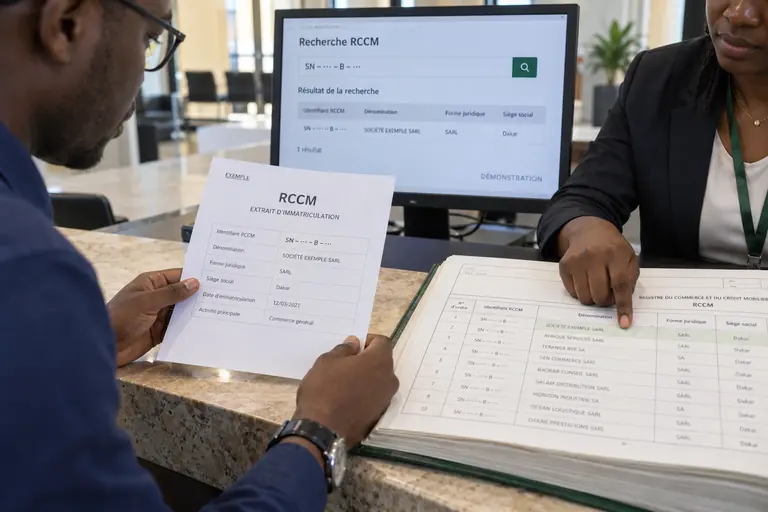
Cameroon's commercial register RCCM drives business registration for traders and companies alike. Formally the register of commerce and personal property security, it records who runs a business, under what name and in which legal form. Because Cameroon belongs to OHADA, the uniform commercial law shared by many African states frames the rules, while a court registry keeps the file locally. Entry produces a registration number that identifies the business toward banks, tax offices, customers and public buyers, and it makes the facts recorded enforceable against third parties.
The legal frame: OHADA and the RCCM
Cameroon applies the business law of OHADA, an organisation that unifies commercial rules across a large group of African states. Its uniform act on general commercial law defines the traders' register, who must enter it and what the entry changes. National texts then add practical detail, so the framework is shared while local procedure still matters when someone prepares a file.
The register covers more than names. It holds the identity of the merchant or company, the legal form, the registered office, the activity and the people entitled to act, and it also records certain security interests over movable property. That second function explains the longer official title and why lenders consult the register before accepting collateral from a borrower.
Entry is not a mere courtesy. A trader who carries on business without being registered can face penalties, and an unregistered company may find it hard to sign contracts, open an account or take part in tenders. For a founder, the first question is therefore not whether to register but which legal form to register and through which channel.
Readers who compare African registers will notice that the OHADA design makes cross-border checks easier than in many regions. A trader dealing with a partner in another member state can expect a register with comparable content, even if the local offices, languages and procedures differ in everyday practice.
Who handles the file and where
Several actors meet in a typical creation. A notary often prepares or receives the articles of association, a bank holds funds paid in for the capital when the chosen form requires it, and the registry attached to the first-instance court keeps the register itself. Tax and social bodies receive their share of the data once the entry exists.
To spare founders a tour of separate offices, Cameroon set up business formalities centres known as CFCE. They act as a one-stop shop, receiving the documents, passing them to each administration concerned and returning the outputs, such as proof of registration and the taxpayer identification. Centres operate in the main cities, and the exact scope of services can change over time.
Anyone preparing a file should first ask the centre in their own city which documents it expects and in what format. Cameroon is officially bilingual, so a file may be drafted in French or English, yet the registry and the notary can have their own habits about translations and certified copies, which are worth clarifying before anything is signed.
Choosing between a sole trader and a company
A natural person starting alone registers as an individual trader. The file stays light: identity papers, proof of address, a declaration of the activity and the premises used. This route suits small shops, craftspeople and service providers, but the owner answers for debts with personal assets, which is the main drawback compared with a company.
A company requires articles of association and a defined structure. Founders in Cameroon commonly choose a limited liability company for small ventures and a public limited company for larger projects, while partnerships remain possible. The form decides the minimum content of the statutes, the need for a managing director or board and the formalities for contributions in cash or in kind.
Foreign investors can use the same register. They should check whether their activity is regulated, whether a licence or an authorisation precedes registration and how nationality or residence of managers affects the file. Those points are decided by sector rules, not by the register itself, so an early conversation with a notary or adviser saves delay later.
One more point concerns spouses and families. Where a business is run with a relative, the roles must be written down clearly, since the register will show who may sign. Informal arrangements that work at home can create real difficulty when a bank asks who has authority.
From signed statutes to the registry entry
Once the statutes are signed and, where required, the capital is deposited, the file is lodged with the CFCE or directly with the registry. A clerk checks that the declaration is complete, that the signatures match the documents and that the name does not clash with an existing business. Missing papers are the most common reason for a file to stall.
After acceptance the registry assigns the registration number and issues proof of entry, often called an extract or a registration certificate. Alongside it come the taxpayer card and other identifiers handled by the centre. Founders should keep the originals together, because banks, insurers and public buyers regularly ask for a recent copy before concluding a contract.
Publication is another step. Certain facts about companies must appear in a legal announcement medium so that third parties can learn of them. The details of that notice, who pays for it and when it must appear depend on the form of the business and on current practice, so it is wise to ask the centre for the current checklist.
Keeping the entry accurate and finding a record
Registration does not end with the first certificate. A change of address, name, activity, manager or capital must be declared, and the register is only reliable if businesses keep it up to date. When a trader stops working or a company is wound up, the entry is closed through a separate deregistration formality rather than simply forgotten.
Searching a record is easiest with the registration number or the exact business name. Access to the information varies: some data can be consulted at the registry, other extracts are obtained on request, and electronic access is not uniform across the country. Where no online search exists, a written request or a visit to the registry is the normal route.
Because the register serves many readers, it helps to treat any copy as a snapshot. A certificate shows the situation on the day it was issued. Before relying on one for a loan, a tender or a purchase, ask the counterparty for a recent extract and compare the name, the number and the managers' details with the contract.
Practical advice for a first-time founder
Start with the activity, not the paperwork. Decide what the business will sell, where it will operate and who will carry the risk, then pick the legal form that matches those answers. A clear plan makes the declaration to the registry coherent, and it reduces the chance of having to amend the entry soon after it is made.
Keep a single folder, paper or digital, containing every signed document, every receipt and every certificate issued along the way. Banks, tax offices and partners regularly ask for them, and a founder who can produce a registration certificate quickly gains credibility at the moment when trust is still being built.
Be careful with intermediaries. Helpful advisers exist, yet some people promise shortcuts that do not exist. Ask who will sign, what is paid to whom and which documents you will receive at the end. Never hand over original identity papers without a clear acknowledgement, and always check the final certificate against what you declared.
Finally, remember that registration is the start of a regime of obligations: accounting, tax filings, social contributions and updates to the register. Planning a calendar for these duties during the first months prevents penalties and keeps the entry in line with reality, which is exactly what the register is meant to ensure.
Frequently asked questions
What is the RCCM in Cameroon?
The RCCM is the register of commerce and personal property security. It records traders and commercial companies, the facts that identify them and certain security interests over movable assets. It is kept locally at the court registry under OHADA rules, and registration gives the business an identifying number.
Do I need a notary to register a company?
For most companies a notary is involved in drafting or receiving the statutes, and the registry expects them in the required form. A sole trader usually needs no articles of association. Ask the formalities centre which papers apply to your chosen legal form before you sign anything.
What is the role of the CFCE?
The CFCE is the business formalities centre acting as a one-stop shop. It collects the file, forwards it to the registry, tax and social bodies, and returns the outputs such as proof of registration. Its scope and locations can evolve, so confirm services with the centre in your city.