
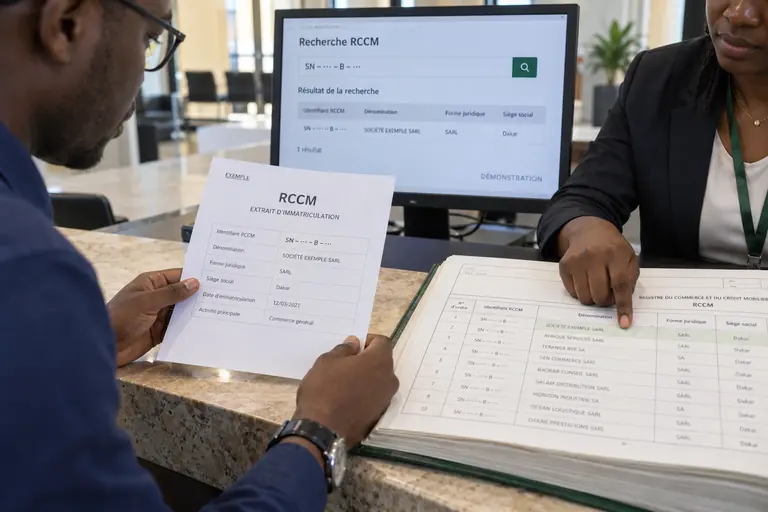
Guinea’s RCCM company register and business records give traders and companies a public legal identity. The register of commerce and personal property credit is the OHADA instrument through which a business declares its name, form, address, activity and managers, and through which later changes are made visible. In Guinea, where mining, trade and agriculture drive the economy, partners, banks and officials ask for an extract from the register as first evidence that a company exists and that the person signing may legally commit it.
How Guinea joined a common commercial framework
Guinea is a member of OHADA, the organisation that sets common business law for many African states. Joining meant that the register of commerce followed the uniform act on general commercial law, replacing a patchwork of earlier national practices. A foreign lawyer used to the OHADA model will find the same ideas of trader status, company personality and security publicity.
The register is organised around three tasks. It identifies those who trade professionally, it confirms the legal birth of companies from their registration, and it provides publicity for guarantees over movable property such as equipment, vehicles or stock. Each task matters to creditors, who rely on the register to know what has already been pledged.
Because the framework is shared, comparisons with Senegal, Mali or Côte d’Ivoire help a reader grasp the notions. Yet they must remain a guide to vocabulary, not a substitute for local verification. Guinean offices have their own forms, counters, working methods and reforms, which are best confirmed directly with the registry.
Many foreign investors enter Guinea through a joint venture with a local partner. In that case, the register helps each side to check the other’s status before a shareholders’ agreement is drawn up. Verifying names, powers and addresses at that early stage costs little and prevents a disagreement over who really owns or controls the local entity.
Where records are kept and who can read them
The register is held by the registry of the competent court, and the capital, Conakry, concentrates most commercial files. A business is registered in the area of its main establishment, so companies operating in regions such as Kankan, Boké or N’Zérékoré may fall under other courts. The registry clerk receives the application, checks it and issues the registration.
As in other OHADA countries, local files feed a national file, and a regional file is kept at the common court of justice and arbitration in Abidjan. These central records exist to avoid duplicate identities and to support broader searches. Whether a request can use them in practice depends on the services available at the time.
Information in the register is generally open to people with a legitimate interest, often through a copy or an extract delivered by the registry. Some data may be limited by law or by data protection rules. Ask the clerk what can be consulted and in what form, rather than assuming that everything is shown on a public website.
Because the country is large and communications can be slow, a request filed in a regional town may take longer than one in the capital. Planning extra time, and starting early when a deadline looms, is wise. A local representative who can visit the registry in person often speeds up the process.
Reading an entry: names, forms and managers
A Guinean entry normally identifies the business name, the legal form and the address of the main establishment. For companies the entry also states the activity, the capital and the identity of managers or directors. Taken together, these details let a counterparty check whether a contract is being signed by a real entity and by someone entitled to commit it.
Different legal forms carry different risks. A sole trader answers with his or her personal assets, a limited liability company limits the partners’ exposure to their contributions, and a branch of a foreign firm leaves the parent liable. Reading the form shown in the register therefore helps a creditor to know whose assets stand behind a debt.
Tax identification is separate. Guinea’s revenue administration assigns its own number, and professional invoices often display both. If the names or addresses differ between the register and tax paperwork, request an explanation. Differences are often harmless, for example after a move, but they should not remain unexplained when significant funds are at stake.
One more point concerns spelling. French names with accents, hyphens or abbreviations may be entered in slightly different ways across documents. A search that fails under one spelling may succeed under another, so try variants and keep the registration number, which remains the most reliable key to the right file.
Forming a company with the investment promotion agency
New businesses may start with the public agency that promotes private investment, which operates a one-stop service for creation formalities. The purpose is to bring together the administrations involved and spare founders from repeated visits. The agency guides the process, while the legal registration itself is recorded by the competent registry.
A usual dossier includes the articles of association, identification documents for all partners, a statement of the registered office and an indication of the activity. The detailed list varies with the chosen form and with sector rules. Because lists and counters are revised from time to time, ask for the current version before gathering papers.
Guinea’s mining and energy sectors require special licences that no commercial register can grant. A company may be perfectly registered and still lack the right to extract, process or export a resource. Investors should therefore keep the two layers apart: registration for legal existence, and permits for the regulated activity itself.
Obtaining an extract and using it abroad
To obtain an extract, provide the registration number if known, or the precise company name and place of establishment. The registry will locate the file and issue a document restating the entries as they stand that day. Abroad, banks and ministries typically ask for one issued recently, so ordering ahead of a deadline is prudent.
French is the working language of official documents in Guinea. A document used in an English-speaking or Arabic-speaking country may require a sworn translation and, depending on the destination, a legalisation. Check what the receiving authority expects, since requirements differ widely between countries and an incorrect format can delay a transaction.
A local lawyer, notary or chamber of commerce can take care of requests for people outside the country. Provide a written mandate if requested and identify the business precisely. When the extract arrives, compare the name, number, address and signatory against your contract draft and keep a dated copy for your records.
Companies using the register for a bank account opening should expect the bank to request more than the extract. Identity documents of the managers, proof of address and the articles of association are typically added to the file. Preparing them together saves repeated visits and shows the bank an organised and transparent business.
Prudence with data and the limits of the register
The register gives legal facts, not a verdict on quality. A company may be registered but inactive, deeply indebted or in dispute with its partners without this appearing in its entry. Deals involving prepayment or large deliveries call for further checks, such as bank references, site visits and enquiries with previous clients.
Records can also lag behind reality. A manager might have changed without the registry being informed, or a business may have moved premises. The date of the latest entry is therefore a vital clue; the older it is, the more reason to ask for confirmation that nothing has changed since.
These remarks are general, intended to help a reader understand how the register works. They are not legal advice for a specific case, and procedures can change. Before relying on any document in a significant transaction, verify the position with the registry or a qualified Guinean practitioner.
Frequently asked questions
Is Guinea part of OHADA?
Yes. Guinea applies the OHADA uniform acts, including the rules on the register of commerce and personal property credit. That gives its register a structure similar to those of other member states, although local offices, forms and practices remain specific to Guinea and should be confirmed with the registry.
Who can ask for information from the register?
Generally, people with a legitimate interest can request copies or extracts from the registry. The scope of what is released can depend on the law and on data protection. The clerk can explain what is available, in what form and what identification the applicant should present.
Does an RCCM entry allow a company to mine or export?
No. The entry shows legal registration as a trader or company. Mining, energy, export and similar activities require separate licences from competent authorities. Ask to see those permits and verify them with the issuing body if the activity is regulated.