
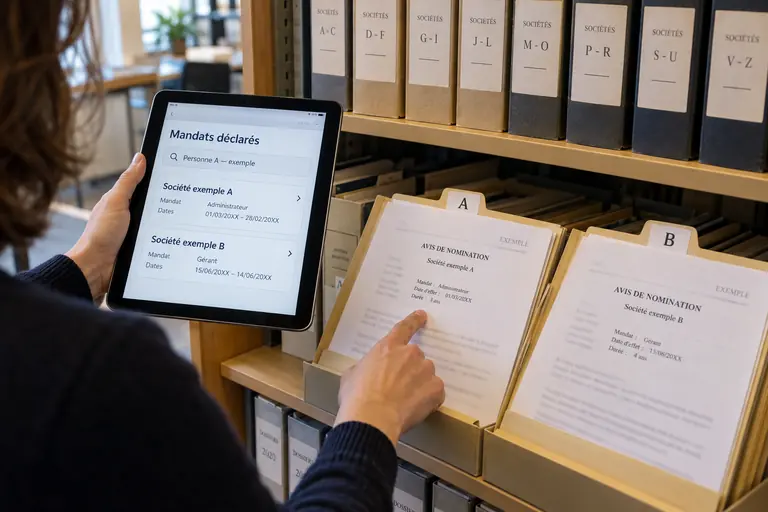
A company register certificate of registration is the registry's written confirmation that an entity has been entered on the public record, under which name and number, and from which date. It is what a business usually holds to prove it exists. Countries label it differently, as an incorporation certificate, an extract or a registration notice, yet the idea is shared. It certifies the entry, not the health of the business, and it reflects the register only on the day it is issued.
A document with many names
Few documents travel under as many labels as the proof that a company has been entered on a public register. In the United Kingdom, a certificate of incorporation is issued when a company is formed. French businesses rely on the Kbis extract, German firms on the Handelsregisterauszug, and Italian ones on the visura camerale. Each is a different instrument, but each answers the question a bank or partner is really asking: is this entity on the record?
Because of this variety, requests from foreign counterparties can be confusing. A lender in one country may ask for a certificate of registration when it means a recent extract showing current directors, while a tender document may mean only the original founding certificate. The safest course is to ask which facts the recipient wishes to see, and then pick the document of the home register that contains them.
The common core is simple. Whatever its local title, a company register certificate of registration identifies the entity by name, legal form and registration number, and records that the registry accepted the entry. Many also show the registered office and the date of entry. What they add beyond that depends on national practice, and some say nothing about directors or capital at all.
Who issues it and who may ask for it
The certificate is produced by the body that keeps the register: a registrar of companies, a commercial court registry, a chamber of commerce or a registrar attached to a ministry, depending on the country. In Spain, the commercial registrar of the province where the company has its seat issues certifications. In Germany, the local court that manages the register is responsible for its content, even though extracts are retrieved online.
Access rules differ as well. Commercial registers are public in most legal systems, so any interested person can usually obtain a document about a company, whether or not they are a shareholder or director. The applicant normally has to identify themselves, and the registry may restrict some personal data under data protection law. Where a certificate is needed urgently, it helps to know whether the registry offers an electronic version.
Intermediaries are common. Lawyers, notaries, accountants and company service providers regularly order certificates on behalf of clients. This convenience does not change the origin of the document, because the final paper or file still comes from the registry. It does mean that the person ordering should receive a clear instruction describing the exact type of document needed, the language required and the date by which it must arrive.
Timing can also depend on the channel. Online ordering through a registry portal often returns a signed file within minutes, whereas a paper request sent to a court registry may take noticeably longer, particularly when the office is small. Anyone facing a deadline should check which channels the registry currently accepts and whether urgent handling exists, instead of assuming that every office works at the same speed.
Certificate, extract and incorporation papers: telling them apart
Confusion often arises between a certificate that proves registration and a full extract of the entry. The first confirms that the company is on the register. The second reproduces the current data fields, such as address, business purpose, managers and the person authorised to sign. Many banks need the second, since they must confirm who can bind the company, not merely that it exists.
A further distinction concerns the certificate of good standing, offered in several systems. It goes beyond bare registration by stating that the entity is current in its filing duties and has not been struck off or placed in liquidation. Where an overseas authority asks for proof of status, this document may be what is really intended, and offering only a founding certificate could lead to a rejection.
Finally, registration documents should not be mixed up with tax or social security attestations. A tax identification certificate comes from the revenue authority, and a social security clearance from the relevant institution. None of these replaces the registry's own document, and none can be obtained from the register. A bundle prepared for a cross-border contract often contains all of them, each issued by a different office.
Language raises another snag. Registers issue documents in their official language, and an authority in another country may insist on a sworn translation. Some European registries provide multilingual forms or standard translations of the key fields, which can spare the applicant extra expense. It is worth asking the recipient whether a plain translation is enough or whether a certified one is expected.
Situations where proof of registration is requested
Banks are the most frequent requesters. Opening an account, arranging a loan or issuing a guarantee for a company all involve checks of identity and authority, and recent registry documents are the standard evidence. Compliance departments also use them for periodic reviews of existing customers, so a company may be asked to renew its file even without any new transaction.
Public procurement and grant schemes form a second group. Bidders usually need to show that they exist legally and that no dissolution is recorded. Each call states the maximum age of the document it accepts, so a certificate that was perfectly valid last season may now be considered too old. Reading the tender conditions carefully avoids disqualification on a purely formal ground.
International contracts, foreign branches and cross-border litigation complete the list. A court abroad may require a registry document to accept that a company has standing to sue, and a foreign authority may demand legalisation or an apostille on top. Rules depend on the destination country and any treaty between the states, so the receiving authority should be asked about its requirements before the order is placed.
Corporate groups meet these requests constantly. A parent company opening subsidiaries in several markets must assemble a registration document for each entity, and each local rule on age, form and legalisation can differ. Keeping an organised file with the date each document was issued helps the legal team plan renewals before a bank or authority asks for them again.
Reading the certificate and knowing its limits
On receiving the document, the first task is to match the name, the registration number and the address with what is known about the company. A tiny mismatch can reveal that a namesake was picked by mistake. Next comes the issue date, because the certificate reflects the register only up to that moment, and later events such as a change of director or a liquidation will not appear.
The certificate proves the entry, not the quality of the business. It does not show whether the company is solvent, whether its accounts have been filed on time or whether it is trading. Those questions call for other sources: filed financial statements, insolvency registers, credit reports and, where relevant, the company's own records. Presenting a bare registration paper as evidence of good financial health misreads what it says.
Where the stakes are high, it is wise to verify authenticity. Many registries add a secure code or a digital signature that the recipient can check on the issuing authority's portal. Forgeries of paper certificates do circulate, and an unverifiable photocopy is weak evidence. This text is general information, not legal advice, and rules vary by country and by registry, so the competent registry should confirm the details.
Frequently asked questions
Is a certificate of registration the same as a company extract?
Not always. A certificate of registration confirms that the entity has been entered on the register, while an extract reproduces current data such as the address, managers and powers. Banks and authorities often want the extract. Before ordering, ask the recipient which facts it needs and check how the home registry names its documents.
How recent must the document be?
There is no universal answer. The party asking for it sets the limit, and calls for tenders or banks often accept only documents issued within a short period. Since the certificate reflects the register as of its issue date, ask the recipient for the maximum age before ordering, and order with some margin.
Can anyone order a certificate about a company?
In most countries commercial registers are public, so an interested person can generally obtain certificates about registered companies after identifying themselves. Some personal data may be withheld under data protection rules, and a few registries offer certain documents only to the company or its representatives. The registry's own conditions apply.