
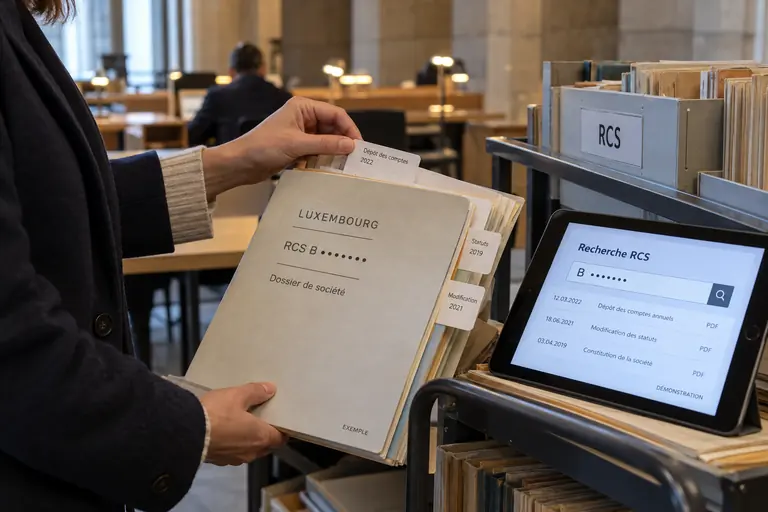
Luxembourg's company search by RCS number begins with the identifier given by the trade and companies register, a letter followed by digits such as B123456. Run by Luxembourg Business Registers, the register records traders, commercial companies and branches of foreign firms, and its information is public within data protection limits. The letter shows the category of registrant, while the number stays the same through changes of name or address. Entering both, exactly as printed, is the most reliable way to reach the correct file and avoid namesakes.
The register behind the number
The trade and companies register, abbreviated RCS or RCSL, is the official register in which traders, commercial companies and some other entities are recorded in the Grand Duchy. Its management is entrusted to Luxembourg Business Registers, an economic interest grouping formed by the State and the Chamber of Commerce. It should not be confused with the register of beneficial owners, which the same body manages for a different purpose. Nor does it replace business establishment authorisations, which come from another administration. For an internet user, the register is the natural point of departure for any research into a Luxembourg company.
Information held in it is public, with limits set by data protection rules. Some services are free to browse, while certified or bulk documents may carry a charge, so read the conditions shown before ordering anything. The register's mission is publicity: letting third parties know that an entity exists, who may bind it and what its basic legal facts are. That explains why the same body offers search tools, document ordering and notices, all of which depend on entering the correct registration number to land on one file.
Understanding the letter and the digits
A Luxembourg RCS number consists of a letter followed by digits. For commercial companies the letter is a B, as in B123456, while other letters mark other categories of registrants, for instance individual traders or branches of foreign companies. The letter is a useful clue to the kind of entity you are dealing with. This registration number is distinct from the national identification number used in dealings with administrations, and from the Luxembourg VAT number. It stays stable for the whole life of the entry, even when the company changes name or head office, so entering it correctly with its letter is the surest path to the right file.
A frequent confusion is to leave out the letter or replace it with another sign. The same digits without their letter may match nothing or, worse, another type of registrant. When a document gives only digits, search by company name as well to confirm the match. Searching by number has a second benefit for professionals. Lawyers, accountants and fiduciaries keep the number in their client files, so that updates and filings are tied to the right entry even when a group contains several companies with nearly identical names and overlapping boards.
Running the search
A search may be made by number, by name or by other criteria offered by the register's online interface. The number is the most dependable, because it removes namesakes and very similar names. When searching by name, try several spellings, with and without the legal form. The portal usually returns a record showing the name, head office, legal form and status of the entry. Depending on the type of company and the services chosen, access to linked documents may be free or paid. Check the conditions displayed by the register before placing any order.
Struck-off companies can still be consulted under their own rules, which allows their history to be reconstructed. A record showing a company in liquidation tells you that its legal life has not ended, since liquidation comes before closure, so always read the status before drawing conclusions. It helps to run more than one query. A name search might show several results, from active companies to those in liquidation or struck off. Compare each result's number, address and legal form with the documents in your hand before you accept a match, and write down which entry you finally chose.
Deeds and documents on file
A company file may contain its articles, their successive amendments, the appointment and departure deeds of directors or managers, and the filed annual accounts. These items are available as scanned documents, sometimes in several languages. In Luxembourg, deeds are commonly drawn up in French, German or Luxembourgish. Annual accounts lodged with the register are subject to obligations that depend on legal form and size. Small companies may use simplified presentations. The content and level of detail of a filing therefore differ greatly from one company to another.
When you read accounts, look at both the closing date of the financial year and the date of filing. Filing can be late, and an old year may remain the latest available for a while. These are filed documents, not an analysis of the company's financial health. Where a company has filed in more than one language, check which version is the original. A translation can be attached for convenience, but the signed text is the one that counts, and small differences in wording may matter if a clause is later interpreted or challenged.
Official notices and publication
Deeds and significant changes are published in the electronic compendium of companies and associations, known as RESA. This publication has legal force and lets you trace key events such as incorporation, amendment of articles, dissolution or liquidation. It complements the entry in the register. The date of publication is not always the date of the event itself. A notarial deed signed on one day may be filed and published later. To rebuild a timeline, compare the date of the deed, the date of filing and the date of publication.
Notices can be searched by company name or number. They answer precise questions, such as the identity of a liquidator or the date of a dissolution meeting, though reading them sometimes requires some familiarity with the notarial and commercial vocabulary used in the country. Readers who work in finance sometimes expect notices to include figures, yet most of them concern legal events, not trading results. Annual accounts, when filed, are a separate item in the record, and they follow their own deadlines and exemptions, so do not look for them in the compendium.
Particular features and precautions
Luxembourg hosts many international structures, holding companies and subsidiaries of foreign groups. A company on the register may thus have shareholders or managers based elsewhere, which can steer research towards other registers. Common forms include the public limited company, the private limited company and several partnership types. Registers of several European countries are linked at Union level, so a Luxembourg company can be searched from common portals, although presentation and scope remain those that each state transmits. For an official extract, go to the Luxembourg register itself. Branches of foreign companies are entered too and point back to a parent company in its own register, so a full search consults both.
A file reflects filed formalities, not live economic reality. A company can be entered without trading, or have stopped in fact before being struck off. Read the status, check the date of the latest documents and look for dissolution notices. Names of Luxembourg companies are often close to those of subsidiaries, so only the number reliably separates them. A last habit worth adopting is to store the number, the date of the search and a copy of what you saw. If the position changes, you can show what the register displayed when you relied on it, which is useful for internal compliance files and for explaining a decision to colleagues.
Frequently asked questions
What does the letter in an RCS number mean?
It shows the category of registrant. A B is used for commercial companies, while other letters designate categories such as individual traders or branches of foreign companies. Always type the letter with the digits, because the same digits alone may match a different type of entry.
Is the RCS the same as the register of beneficial owners?
No. Both are managed by the same body, but the trade and companies register records the existence, status and filings of an entity, while the beneficial owners register serves another purpose. Access rules differ, so consult each under its own conditions.
Where do I read about changes such as dissolution?
Look at the status on the register entry and at the official electronic compendium of companies and associations, where deeds and important changes are published. Compare the dates of the deed, the filing and the publication, since they often differ.