
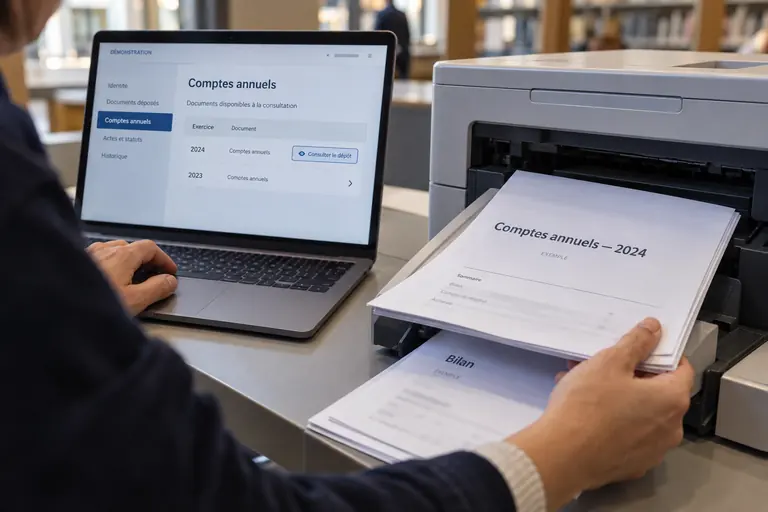
In Spain, company balance sheets and annual accounts are the yearly financial statements that a business must approve and deposit with the Mercantile Registry of its registered office. They normally comprise a balance sheet, a profit and loss account, notes and, for larger entities, further statements, together with a directors' report and an audit report where one is required. Once deposited, the documents become part of the public record and can be requested by anyone who needs to assess a company's solvency, history or reliability as a business partner.
What the annual accounts contain
Spanish annual accounts, known locally as cuentas anuales, are a bundle of documents rather than a single sheet. The core is the balance sheet, which lists assets, liabilities and equity on the closing day, and the profit and loss account, which summarises income and expenses over the financial year. Notes to the accounts, called the memoria, explain the accounting policies and break down the main items, so they are often the most informative part for a careful reader.
Companies above certain size thresholds must add a statement of changes in equity and a cash flow statement. Each of these answers a different question: the first shows how reserves, capital and results moved, while the second shows how cash really came in and went out. Smaller businesses may use abbreviated models that leave these statements out, which is why two filings from two firms can look very different in length.
The accounts are usually accompanied by a management report, the informe de gestión, which describes the business, its position and the risks it faces. Where the law requires an audit, the auditor's report is attached as well. Reading the auditor's opinion first is a good habit, because a qualified opinion or an emphasis of matter paragraph tells you quickly whether the figures deserve extra caution.
Who has to approve and file them
Capital companies such as the sociedad limitada and the sociedad anónima must close their books after each financial year and prepare their accounts through the directors. The shareholders then approve them at the general meeting, normally within the first half of the following year. Approval is a legal step, not a formality, because the deposit can only be made on the basis of accounts that the meeting has actually adopted. After approval, the person responsible certifies the decisions and the accounts are lodged with the Mercantile Registry of the province where the company has its registered office.
The law sets a short window for this deposit, and the registrar checks that the documents are complete, that the signatures are present and that the approved figures match the ones presented. Missing pieces lead to a defect notice rather than an acceptance. Sole traders and many individual entrepreneurs are in a different position, since they are not generally obliged to publish annual accounts unless they hold specific status or register voluntarily. Certain other entities, including cooperatives and some foundations, follow their own registers. When you search for the accounts of a business, it is worth checking its legal form first, because the form decides whether anything was ever deposited.
Size categories and simplified formats
Spanish accounting rules let businesses choose between full, abbreviated and, for very small units, simplified models. The choice depends on measurable criteria such as total assets, annual turnover and the average number of employees, and a company must stay below the limits for consecutive years before the lighter regime applies. These thresholds explain why a micro company may file only a few pages. The abbreviated model combines some items and reduces the notes. A large group, by contrast, may publish consolidated accounts alongside the individual ones of the parent company, with a longer set of notes.
When comparing competitors, check that you are looking at the same format, since a figure shown on one line in a short balance sheet may be split across several lines elsewhere. Another point is the accounting framework itself. Most Spanish companies apply the General Accounting Plan, and there is a version tailored to small and medium businesses. Listed groups apply international standards in their consolidated statements. Noticing which framework was used helps you interpret terms such as provisions, deferred income or goodwill, which may be treated slightly differently from one framework to another.
How to obtain the deposited accounts
The accounts deposited at a Mercantile Registry can be requested by the public, because commercial publicity is the very purpose of the deposit. A requester normally identifies the company by its tax number or name, chooses the financial year and asks for the registry's information service to supply the filed documents. Requests may be made at the registry counter, through the profession's online service or via an authorised intermediary. The documents are provided either as an informative copy or, when a formal proof is needed, as a certified version signed by the registrar.
For routine due diligence, the informative version is usually enough. For a court, a tender or a bank that insists on official evidence, the certified version carries the weight that a simple copy lacks, so it is worth asking the recipient which kind it expects. Businesses that need many reports sometimes use commercial information providers, which compile data from the registers into ready-made summaries. Such summaries are convenient, but they remain secondary sources. When a decision depends on a specific number, go back to the filed accounts themselves, and note the date of deposit so you know exactly which version you consulted.
Missing, late or restricted accounts
It is common to search for a Spanish company and find nothing for the latest year. The reasons vary: the accounts may not yet have been approved, the registrar may have rejected the deposit for defects, or the firm may simply have failed to file. A long gap deserves attention, since persistent non-filing can be a sign of disorganisation or financial difficulty. The law attaches real consequences to non-compliance. A company that does not deposit its accounts can see its registry page closed to new filings, which blocks most further registrations until the situation is regularised, and fines may also apply.
Outsiders should therefore treat a closed registry sheet as a warning sign when evaluating a counterparty. Some information is limited by design. Personal data of individuals is protected, and certain small entities benefit from lighter disclosure. The accounts also describe the past: they are historical statements prepared months after year-end. They cannot reveal a customer dispute that arose last week, so combine them with other checks before extending credit.
Reading the figures with care
A balance sheet is only a snapshot of a single day, and a company can look healthy on that date while facing pressure a few weeks later. Compare at least two consecutive years, which Spanish filings usually present side by side, and look at trends in equity, debt and cash instead of isolated totals. A sudden jump in receivables or a falling equity base deserves a closer look. Check the equity position against the share capital, because Spanish company law has rules for firms whose equity drops far below capital.
Look also at the notes on related-party transactions, guarantees and post-balance-sheet events. These sections often reveal commitments that do not appear in the headline figures but matter greatly to a lender or a supplier. Finally, remember what the filing does not prove. Deposited accounts show that a company reported certain numbers, and the registrar checks form rather than economic truth. For high-value deals, ask for recent management information, review the auditor's opinion and, where practical, use independent advice. Registry accounts are a strong starting point, but rarely the final word.
Frequently asked questions
Are the annual accounts of Spanish companies public?
Yes, for the entities that must file them. Once the accounts are deposited at the Mercantile Registry, any interested person can request a copy through the registry's information channels. Sole traders and some small or special entities may not have anything on file, so first confirm the legal form of the business before searching.
Why can't I find accounts for the most recent year?
The company may not have held its general meeting yet, the registrar may have suspended the deposit because of defects, or the business may have failed to comply. Try the previous year, check whether the registry page is closed to filings, and consider that a repeated gap is itself useful information.
Is a copy of the accounts enough as official proof?
An informative copy is fine for ordinary research, but it is not formal evidence. If a court, a public tender or a foreign authority demands proof, request a certificate signed by the registrar. Ask the receiving body which format it accepts before ordering, so you pay for the right document once.