
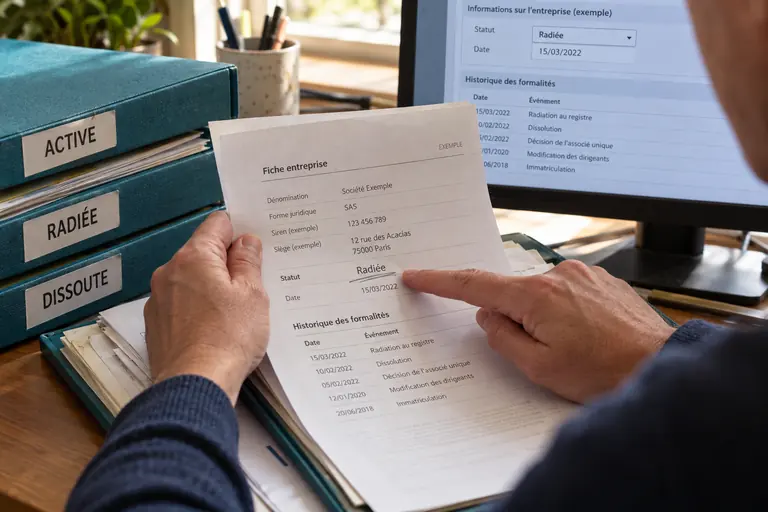
Algeria's commercial register deregistration, called radiation in French, is the formal act that strikes a trader or a company off the file, ending the legal capacity to trade that registration once gave. It is not a deletion of history: the record of the business remains, but it is marked as closed from a stated date. The national commercial register centre keeps the file through its local branches, and the request usually goes to the branch covering the place of business. Individuals, heirs and company representatives can all be involved, depending on why the activity stopped.
What closing a registration actually changes
Registration in the commercial register is what gives a trader the status that allows regular commercial activity in Algeria. Removing that registration takes the status away for the activity concerned, from the date written in the entry. It does not wipe out the past of the business, and it does not cancel the obligations that arose while the activity was running. In practice the entry is best seen as a record whose last chapter is being written.
For a sole trader, closure marks the end of trading under his or her own name. For a company, it follows the legal end of the entity, which requires a dissolution and a liquidation first. Debts and the rights of third parties do not disappear automatically, so liquidators, former partners or heirs can still be answerable under the applicable rules. Anyone planning a closure should check who carries those continuing duties.
Outsiders read the register too. A bank, a supplier or a customer who checks a trader will see whether the entry is active or closed, which is why the date of closure should match the real end of activity. A date that is too early or too late can create disputes over invoices, contracts and tax periods. Matching the date to reality protects everybody involved.
Foreign partners who deal with Algerian traders pay particular attention to this point. Before signing a supply contract or granting credit, they often ask for a recent extract, and a closed entry on it tells them at once that the counterparty is no longer entitled to trade in that capacity. Many banks apply the same habit when a long-standing customer asks to renew a facility or to move funds.
Situations that lead to a request
The most common case is a voluntary stop. The trader decides to cease business, declares it and asks for the entry to be cancelled. The administration will expect proof that tax and social obligations have been settled, or at least regularised in the way its offices require. A trader who leaves this too late often finds the file blocked. Sorting out these accounts early is normally the sensible order of work.
Death is a second case. Heirs or other persons entitled can ask for cancellation by producing the death certificate and papers showing their standing. In some situations they choose to continue the activity instead, which means a fresh registration in their own names rather than a transfer of the old one. The choice between stopping and continuing is therefore a real decision for the family, not a formality.
Other triggers include the sale or definitive closure of an establishment, a change of legal form and the end of a company. Whatever the reason, the request rests on a document proving the event: a declaration of cessation, a sale deed, a dissolution decision or a certificate of death. An oral statement at the counter is never enough. The agent will also look for coherence between the dates on each document.
Documents should be dated, signed and consistent with each other. An agent who finds two different addresses or two spellings of a name in the papers will ask for a correction, and the closing date cannot be entered until the file tells one coherent story. Keeping photocopies of every page, together with the receipt given at filing, makes it much easier to answer any later question from the branch.
Winding up a company before the file is closed
A company cannot simply ask to disappear. Its partners decide on dissolution, or a cause set by law or by the articles brings it about, such as the end of its term or the loss of its purpose. The decision is recorded in a written act, drawn up before a notary where the legal form requires it. The notary or the partners' own lawyer can say which acts must be notarised in a given case.
A liquidator is then appointed to collect the assets, pay the creditors and share what remains between the partners. The liquidator's task ends with a final account and the closing of the liquidation. These steps are made public so that creditors have an opportunity to assert their claims before the entity vanishes. Publication also protects the liquidator, who can show that the proper notices were issued.
Only at the end of this sequence does the register entry get cancelled. Asking too early, before the liquidation is closed, would be irregular and may be refused. Waiting too long has its own cost, because the company keeps its reporting duties as long as it is registered. Bankruptcy follows separate collective procedures before the competent court. A company in difficulty should therefore take legal advice before choosing which route to follow.
Preparing the file and dealing with the branch
The applicant normally presents a written request together with the current register extract and identity papers. A company adds the document naming its representative. Proof of regularisation with the tax offices and social bodies is added, and the exact list depends on the case, so it is wise to ask the branch for its current checklist before filling anything in. Bringing originals and copies is a simple habit that avoids a second trip.
Tax and social clearance is often the hardest part. A late return or an unpaid contribution can stop the process, so the trader should settle these points with the usual offices before going to the register. Gathering the clearance papers first saves repeated visits and keeps the closing date from slipping. A short list of every office contacted, with dates, helps if a question arises later.
After filing, the agent checks that the file is complete and records the cancellation. A document confirming it may be handed over, and it is useful for closing bank accounts or ending contracts. Charges and timing are set by regulation and change over time, so they should be confirmed with the centre rather than taken from older notes. Keeping the receipt of every payment is equally important for the later record.
Cancellation initiated by the administration
The authorities can also cancel an entry without any request, when the conditions for registration are no longer met. This may concern old files, traders who cannot be found, activities that no longer exist or entries that were never brought up to date. Such operations are part of periodic clean-ups of the register. The notice of such a measure, where one is sent, deserves to be read and answered promptly.
A trader hit by this measure may be surprised, particularly if a mandatory update of the entry was ignored. Trading regularly is not possible again until the situation is put right. Depending on the facts, a new registration or a challenge to the decision may be available, within the limits set by the legislation. Acting quickly matters, because the longer an irregular situation lasts, the harder it is to explain.
The practical lesson is to check from time to time that the entry is current and that its details match the real business. An outdated address or an unreported change invites trouble, often discovered at the worst moment, such as a loan application or a public tender. Asking the branch for the precise reason of the decision is the first useful step.
Legal advice can be valuable at this stage. A lawyer can tell whether the better route is a fresh registration or a formal challenge, and can explain which documents will support either choice before any deadline for appeal has passed. A professional can also check that the reasons given by the authorities are legally sound. Early advice usually costs far less than a later dispute.
After the entry is cancelled
Once the entry is closed, going on with trade under the old registration becomes irregular. Invoices, contracts and bank accounts need to be brought in line with the new situation, and accounting and commercial records must still be kept for the period required by law, even though the business has stopped. Employees, landlords and insurers should be told of the closure so that nothing continues in the old name.
Creditors keep their rights and can act under the applicable rules, in some cases against partners or liquidators. A former trader should therefore never treat closure as the end of all debts. Pending disputes are better settled before the cancellation is requested, not afterwards. A written list of open matters, kept with the closing papers, makes that task much easier. Nothing is gained by leaving them open.
Someone who wishes to trade again later has to make a complete new application. The earlier trade name may sometimes be reused, subject to the rights of others and to current rules. This text is general information and cannot replace the advice of a notary or lawyer who has seen the actual documents. For a precise case, only an adviser who has read the file can say what is actually required.
Frequently asked questions
Who can ask for a cancellation in Algeria's commercial register?
The trader or the company's representative normally files the request. After a death, heirs or other entitled persons can do so by presenting the death certificate and proof of their status. The administration can also act alone when an entry no longer meets the conditions, which is known as cancellation on its own initiative.
Can a company be struck off without a liquidation?
In principle no. A company first has to be dissolved and liquidated, and the closing of the liquidation is recorded and published. Only then is the register entry cancelled. Asking earlier would be irregular and could be refused, so the order of the steps matters more than the speed of the request.
Does closing the entry cancel the debts of the business?
No. Cancellation ends the right to trade under that entry, but creditors keep their rights, and liquidators, partners or heirs may remain answerable according to the rules that apply. Accounting records must also be kept for the legal period. Disputes should be settled before the file is closed.