
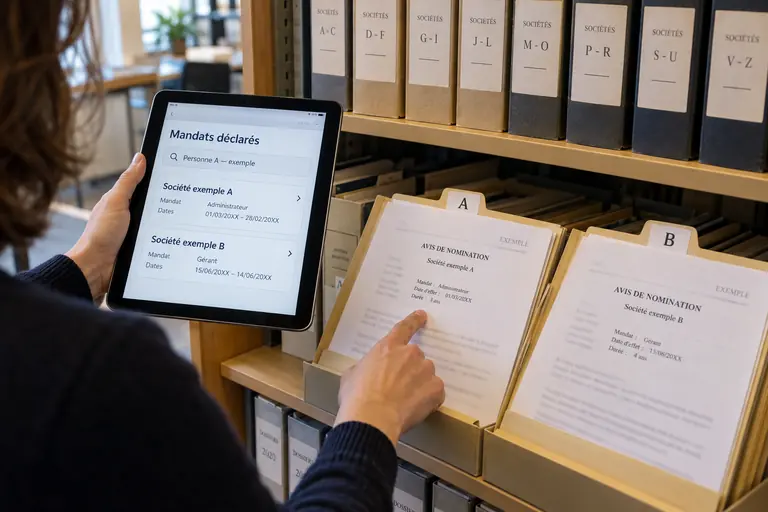
Santiago de Compostela's commercial register and company records are, formally, those of the provincial office serving A Coruña, so the firms of the Galician capital sit in that office's books. A registrar examines each deed before entry, and every company with its registered address in the province has a sheet showing its name, purpose, capital, administrators and later changes. The records are public for people with a legitimate interest and are presumed accurate toward third parties, which makes them the standard proof of a company's legal status.
Why the provincial office serves the city
Spanish mercantile registries are organised by province, and Santiago de Compostela, although it is the capital of Galicia, lies in the province of A Coruña. A company with its registered seat in the historic centre, in Milladoiro or in Ames is therefore recorded in the provincial registry and not in a separate city office. That surprises people who expect one office in each large city.
Today most procedures are completed electronically, so the distance between the two cities is hardly an obstacle. Notaries and lawyers in Santiago send deeds by electronic means, and applicants who need information can request it without travelling. What matters is to know that the office responsible is the provincial one and to use that name when searching.
The registrar who runs the office is a legal professional who reviews each deed, checking the law, the statutes and the existing entries. Defective documents are suspended or refused until corrected. That control is the reason why the register is accepted as a trusted source by banks, courts and public bodies across the country.
Do not confuse it with other registries
The city has a property registry, a civil registry and registries for associations and foundations. Each has a different purpose. The property registry deals with land and buildings, the civil registry with persons and the others with non-profit bodies. Only the mercantile registry holds the legal file of companies, which explains why queries about firms must be sent there.
The chamber of commerce is another institution that people mix up with the registry. It is a corporation that offers services to businesses, such as training, networking and certain certificates, but it does not keep the books that prove a company's existence and management. Treat it as a useful partner for entrepreneurs and the registry as the legal source.
University and pilgrimage life also shape the local economy, and entrepreneurs there sometimes use associations, foundations or cooperatives. When you meet such an entity, check its legal form first. A cooperative or an association will not be in the mercantile files, and searching in the wrong register leads to a false conclusion that nothing exists.
Companies of the Compostela area
The local economy rests on public administration, the university, tourism linked to the pilgrim routes, hospitality, retail, technology and services, together with food and timber businesses in the surrounding countryside. Many companies are small limited firms with a few partners, and some are branches of larger groups from other Spanish regions or other countries.
Pilgrim-related business is particularly varied. Hostels, travel agencies, guided tours, shops and restaurants may operate as companies, partnerships or sole traders. A traveller who books through a company can check its legal name and tax number, while an operator wishing to confirm a partner's status can ask for a note. The brand on a door is not a reliable guide to the contracting entity.
Technology and research spin-offs connected to the university form another group. They are often limited companies with specific objects and sometimes with institutional partners. The sheet shows their capital, administrators and corporate purpose, which helps investors and collaborators judge who is behind a venture and what it is legally allowed to do.
Retail and hospitality around the old town are worth a word. Cafés, shops and hotels there often occupy leased premises and may change operator when a lease ends. The sign above the door can stay while the legal entity behind it changes, so a supplier granting credit should check which company currently holds the business and whether its sheet shows recent changes of administrators.
What a sheet contains
The first entry records incorporation, setting the denomination, legal form, registered office, corporate purpose and capital. Later entries are added in order to show appointments, resignations, powers of attorney, transfers of the registered office, capital operations and structural changes. Dates make it possible to place each fact in time and to see which information it replaced.
The sheet specifies how administrators act, whether alone, jointly or as a board. Check this before relying on a contract, because a signature by only one of two joint administrators may not bind the company. Foreign counterparties used to systems that give wide authority to a single director often overlook this detail.
Annual accounts are deposited in the same office and can be requested separately. They allow a comparison of years, within the limits of the reporting regime of each company. If a deposit is missing, ask the company for an explanation rather than assuming wrongdoing, since delay, exemption or an administrative issue are possible causes.
A last point about the sheet concerns the registered address. Companies sometimes use the office of an adviser as their legal seat, so the address on the sheet may differ from the place where the business actually works. That is not necessarily a problem, but it is a reason to visit or call the operating premises when the commitment is large.
How to obtain notes and certificates
The simple note is an informational summary of the current content, and it is the quickest way to learn who administers a company. The certificate is signed by the registrar and certifies the books, so it is the version to use for a bank, a notary, a court or a public tender. Ask the recipient which version it accepts.
Searching works best with the tax identification number, which is unique and appears on invoices. Names can be repeated across Galicia, and a company with the word Compostela in its name may have no link to another with the same word. Comparing the number, the registered address and the date of incorporation confirms that you are looking at the right entity.
Requests can be made electronically, in person or by post. Fees, formats and delivery times depend on the product and are revised periodically, so verify them on the official service before ordering. For use abroad, ask the receiving authority about translation and legalisation, and plan the timetable accordingly.
People who need documents quickly should remember that the registrar must still review any pending filing, so a recent change may take time to appear. Asking the company for its deed and then ordering an updated note shortly before closing is the safest way to avoid acting on outdated information.
Interpreting results and their limits
A sheet is a legal statement. It confirms existence, address, capital and management but does not assess profitability or payment behaviour. Combine it with accounts, insolvency notices and references. For a partner you intend to rely on for a long time, a conversation and a visit complement the written evidence in ways that no document can.
If your search shows nothing, consider the alternatives: a sole trader, a company seated in another province, an entity recorded in a different register or a name spelled differently in the legal documents. Working through that list is quicker than repeating the same search and usually leads to the correct source.
Finally, keep a dated copy of each document. The register changes as companies move, merge or close, and your copy shows what the information was when you made your decision. If you need the situation at a later date, ask for a new note instead of relying on the old one.
Frequently asked questions
Is there a separate commercial register for the city of Santiago?
No. Spanish mercantile registries are provincial, so companies with a registered address in Santiago de Compostela are recorded in the office that serves the province of A Coruña. Searches should therefore refer to that provincial registry, even though most requests are made electronically and the distance between the two cities is rarely an issue.
Can I check a pilgrim hostel or tour operator in the register?
If the business is a company, yes: ask for its legal name and tax number, then request a simple note. If it is run by an individual, a cooperative or an association, it will probably not appear in the mercantile register, and you should look for its tax and sector registrations instead.
Which document should I give to a foreign authority?
Usually a certificate signed by the registrar, since it formally certifies the content of the books. The foreign authority may also require a sworn translation and an apostille or similar legalisation. Ask it exactly what it accepts before ordering, and confirm charges and delivery times on the official service.