
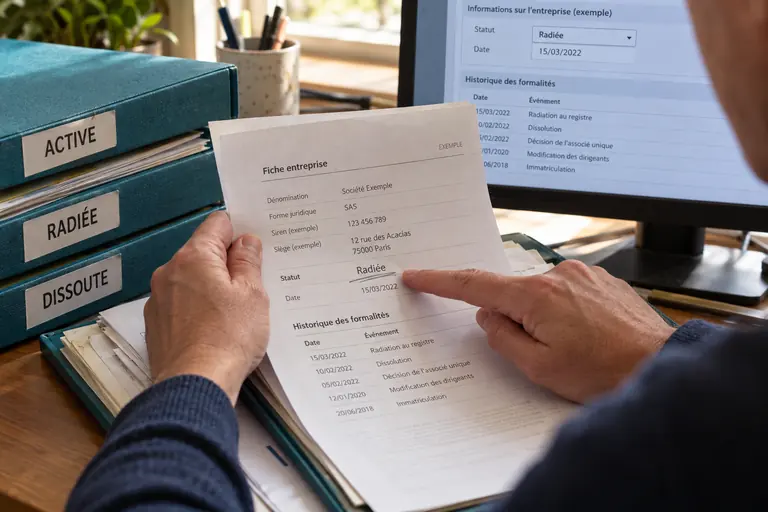
What are Córdoba commercial register company records? They are the official legal files of businesses domiciled in the province, maintained by a registrar who checks each deed before entering it. A record names the company, its legal form, registered address, corporate purpose and administrators, then logs later changes such as capital increases or dissolution. The register concentrates on trading companies and registered individual traders, so cooperatives, real estate and security interests over movable goods sit elsewhere, and the information describes legal standing instead of profitability or day-to-day performance.
Several registers, one province
Anyone researching businesses around Córdoba soon discovers that no single archive holds everything. The commercial register deals with companies and registered traders, the property register records land and buildings, a separate register covers movable assets such as machinery and vehicles that are pledged or sold with retained title, and a national insolvency register publishes information on bankruptcy-type proceedings. Knowing which archive holds which piece saves considerable effort.
Each register answers a different question. If you want to know who administers a limited company, you consult the commercial files. If you want to know whether an olive mill stands on land burdened by a mortgage, you turn to the property register. Mixing them up produces confusing results, which is why professionals begin every inquiry by deciding exactly what they need to prove.
The distinction matters in a province where agriculture is strong. A farmer may own land personally, farm it through a family company and sell the harvest to a cooperative, so three different legal frameworks can touch a single business. A thorough review therefore lists every entity involved before any register is searched. The commercial register covers only one slice of that picture, and researchers should plan to read it alongside the others.
Cooperatives and the olive oil economy
Córdoba's countryside is dominated by olive groves, and a large share of the oil is pressed and sold by cooperatives. These entities are not ordinary commercial companies. In Andalusia they are inscribed in a regional cooperative register, which means a search of the commercial files will usually return nothing for them, even when the mill is large and long established. Such mills may nonetheless be solid, regulated organisations.
Some cooperatives also create commercial subsidiaries to bottle, export or distribute their products, and those subsidiaries do appear in the commercial register. Tracing the chain from the farmers' cooperative to a limited company that exports to foreign supermarkets therefore requires moving between two systems and noting the relationships declared in each of them. Skipping this step is a frequent reason why buyers believe they have identified the right counterparty when they have only found its trading arm.
A similar logic applies to the wines of the Montilla-Moriles area, where family bodegas, cooperatives and larger firms coexist. Designations of origin and regulatory councils are not company registers either. They certify the product and its territory, not the legal status of the producer, so a bodega's legal existence still has to be verified in the register of its own legal form. The same caution applies to producers who sell under a prestigious label but are legally separate from the firm that owns it.
What a registered company file tells you
A company file in the commercial register begins with identity details: corporate name, legal form, date of incorporation and registered address. It continues with the corporate purpose and the list of administrators together with their powers. Anyone wishing to know who may sign a contract on the company's behalf can read the answer directly in the appointments, including whether two signatories must act jointly. Such details are decisive when a contract is signed by someone whose authority is later disputed.
The file also records structural events. Capital increases, reductions, mergers, demergers, changes of registered address and amendments of the articles all leave a trace. Reading these entries in order shows whether a company has grown steadily, been restructured repeatedly or moved its seat often, and that history often says more about a business than its present profile. A company that changed its seat and its corporate purpose several times within a short period deserves closer questions than a stable one.
Difficult phases are noted too. Dissolution, liquidation and insolvency procedures appear when they are formally declared, and a firm that has been reactivated after dissolution carries that fact in its file. For a creditor or a prospective partner, these entries are an early warning that should prompt direct questions before any commitment is made. Spotting a liquidation notice after signing, rather than before, is a costly lesson for suppliers.
Ordering documents from the registrar
The simplest way to consult the register is a simple extract, which summarises the current registered data. It is ideal for routine checks: verifying a supplier, confirming that a client exists, or preparing a loan application. The request needs the company name or its tax identification number, and it is normally handled online through the professional registrars' services. Results arrive in electronic form, which is convenient for filing.
Where an authority, a bank or a counterparty demands formal proof, the registrar's certificate is the appropriate tool, because the registrar personally vouches for its contents. Certificates come in several forms, and the one requested must match the purpose, whether it is to prove the existence of an entry, to reproduce it in full or to show that nothing is registered. Misreading these differences is the most common cause of documents being refused by the receiving party.
Charges and waiting times vary according to the service chosen and can change, so they should be checked in the registrars' official channels when the order is placed. Applicants should also expect to identify themselves and give a legitimate reason, since the information is open to those with a genuine interest, not to anyone for any purpose. A clear and honest statement of purpose speeds up the process and avoids requests being questioned.
Reading the information with caution
A registered file is a legal statement, not a financial rating. It cannot tell you whether the company settles invoices promptly, whether it faces claims that have not been recorded or whether its premises are active. Where money is at stake, combine the registry data with trade references, financial analysis and, if appropriate, a visit to the business. Even a short conversation with a former customer can reveal more about reliability than a page of legal entries.
The deposited annual accounts add detail, because they let readers follow turnover trends and equity over time. Remember, though, that the registrar checks them only formally. Interpreting the figures properly requires accounting knowledge, and a loan officer or an independent adviser will often spot warning signs that a casual reader would miss. This is why lenders rarely rely on the raw filing alone.
Namesakes are another trap. Córdoba is also a large city in Argentina and a place name elsewhere, so searches that rely on the city alone can return unrelated entities. Always verify the legal name, the tax identification number and the Spanish registered address before ordering a document or drawing any conclusion about a business. A mistaken match is easy to make with common surnames.
A short routine before relying on a record
Begin by writing down the exact legal name and tax identification number of the business, taking them from an invoice, a contract or an official notice rather than from advertising. Trade names are poor search keys, because several unrelated firms may use similar wording, and the registry sheet is attached to the legal entity rather than to a brand or a shop sign.
Next, confirm the registered address. If it lies in the province, the commercial register for Córdoba is the right place to ask. If it lies elsewhere, the request belongs to the register of that territory, whatever the company's local activity may be, and ordering the wrong document wastes both time and money. Checking the address first is cheap insurance. A quick look at the invoice header usually settles it.
Then decide what you need to prove. A quick overview calls for a simple extract, whereas a formal act, such as opening a bank account or signing a deed, may require a certificate. State the purpose clearly when ordering, and keep a copy of what you receive together with the date, since the register changes constantly. An outdated copy can mislead as badly as none at all.
Finally, take note of anything unusual: a recent change of administrators, a closed sheet, a liquidation entry or a very recent incorporation. None of these facts is conclusive on its own, but each justifies one more question to the company before you place trust, extend credit or share confidential information with it. Patience at this stage is far cheaper than recovery later.
Frequently asked questions
Why can't I find an olive cooperative in the commercial register?
Cooperatives generally belong to a regional cooperative register instead of the commercial one. Their absence from commercial searches does not mean they do not exist. Check the register for cooperatives of the relevant autonomous community, and remember that a cooperative's commercial subsidiaries, if any, may still be recorded in the commercial files.
What is the difference between an extract and a certificate?
A simple extract is an informative summary of the current data and is meant for ordinary checks. A certificate is issued by the registrar and attests to the contents of the register, so it can be used as formal proof before banks, authorities or courts. Pick the one that matches the use you have in mind.
Does the register show if a firm is in financial trouble?
Only partly. It records formal events such as dissolution, liquidation and insolvency declarations, and it may show a closed sheet when annual accounts are overdue. It does not measure solvency or payment behaviour, so a careful check also needs accounts, references and, in serious cases, professional advice.