
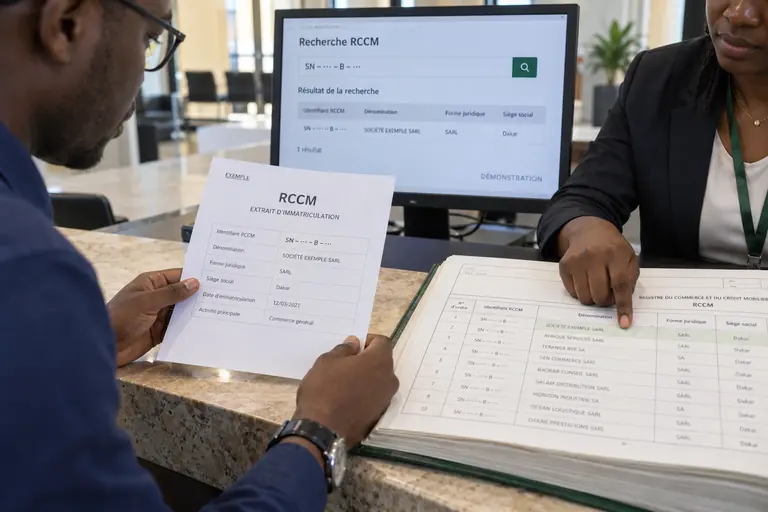
Chad’s RCCM company register and business records are the formal proof that a trader or firm is recorded under OHADA law. The register of commerce and personal property credit names each business, its legal form, its address, its activity and its managers, and it keeps track of later amendments. In a country linked by trade to Cameroon, Nigeria, Niger, Sudan and Libya, banks, oil-sector suppliers, transporters and public buyers use extracts from it to confirm who they are dealing with and who may sign.
Chad within the OHADA and CEMAC landscape
Chad belongs both to OHADA, which provides common commercial law, and to CEMAC, the Central African monetary and economic community. The first sets the framework for traders, companies and the register, the second shapes currency and banking matters. A foreign investor needs to understand both layers to see how a Chadian business fits in a wider regional system.
The OHADA uniform act on general commercial law defines the register, its content and its legal effects. It establishes that registration gives a person the status of trader, that a company acquires legal personality when registered, and that security rights over movable property can be made public. These notions apply from N’Djamena to Moundou.
Chad is a landlocked country, so many goods arrive through neighbouring ports and cross long overland routes. Importers, transporters and brokers therefore deal with partners in several jurisdictions at once. Being able to read a Chadian register entry and compare it with documents from Cameroon or Nigeria helps these operators manage counterparty risk.
Oil exports and cross-border trade shape much of Chad’s modern economy, but a large part of daily commerce remains informal and small-scale. Not every trader appears in the register, which is why a missing entry does not always prove wrongdoing. It does mean, however, that the buyer has fewer documents on which to rely.
Registry courts and where to file
Registrations are handled by the registry of the competent court. The capital, N’Djamena, is the main hub for commerce, with a commercial court registry that deals with a major part of filings. Other regional towns, including Moundou, Sarh and Abéché, serve businesses established within their areas.
A company is registered where its principal establishment is located. Branches and secondary sites are declared and may appear in the file of the head office. When a business moves between regions, its record must be updated or transferred, which is a frequent reason why a search under an old address leads nowhere.
As elsewhere in OHADA, local files contribute to a national file and to a regional file hosted by the common court of justice and arbitration. These layers help to avoid duplicate registrations. Whether a user can access them directly is a practical matter to raise with the clerk or with a Chadian lawyer.
The size of the country and the long distances between towns affect how quickly requests are handled. A national investment agency or a local lawyer in the capital can often obtain documents on behalf of clients in other regions. Make sure the mandate is written and names the business precisely.
Reading a Chadian entry with care
The entry shows the corporate or trading name, the legal form and the main address. A short statement of activity tells the reader whether the business trades in goods, offers services or works in construction, transport or oil-related supply. Company entries add the capital and the people who manage the business.
Powers of representation deserve special attention. A manager might be able to sign alone for small purchases but require a co-signatory for loans or property transfers. Matching the person who signs with the register avoids disputes over unauthorised commitments, which are hard to repair once money has been paid.
The tax administration issues its own identification number, and invoices usually carry both that number and the register number. A counterparty who gives only one of them can be asked politely for the other. Comparing names and addresses across all documents is a basic step before signing, and it takes only a few minutes.
A contract that names the wrong legal entity can be difficult to enforce. Check that the corporate name in the contract exactly matches the entry, including the form and any abbreviations. If a group of companies shares a brand, confirm which member of the group is actually signing and which one will deliver.
Setting up a business through the national investment agency
Founders can turn to the national agency for investment and exports, which operates a one-stop service for business creation. The goal is to reduce the number of separate offices to visit, grouping registration, tax recognition and other declarations. The service accompanies the founder, and the register entry itself is made by the competent registry.
A typical file includes articles of association that respect OHADA rules, identity documents for the partners and proof of a registered office. Evidence of capital contributions may be asked for. Because the list varies with the legal form and can be updated, confirm it with the one-stop service or with a notary before preparing copies.
The oil, mining, banking, transport and telecom sectors require specific approvals. These approvals are independent from registration, and a company may hold one without the other. When evaluating a supplier, ask for the registration extract and the relevant permit, and verify both with the issuing offices when the contract is significant.
Asking for an extract and managing language
A search begins with the registration number when known. Otherwise supply the exact name, the town and the manager’s name. Spellings of French and Arabic-derived names can vary between documents, so try more than one version if the first search yields nothing. Keep the legal form attached to the name.
The registry issues an extract that restates the entries on the day of issue. Banks and public buyers often want a recent one, so it is wise to order close to signature. Fees, delays and online options evolve; ask the registry or a local representative for the current position instead of relying on older information.
Arabic and French are the official languages of Chad. Registers and official documents are mainly in French, and a partner abroad might need a translation into English, Arabic or another language. Legalisation requirements vary by destination, so ask the receiving authority before ordering several copies.
Foreign visitors should keep in mind the multilingual context. Names of persons and places written in Arabic script may be transliterated in different ways in French. Asking for the spelling used in the register and using the same form in your contract helps to avoid mismatches that banks might flag.
What an entry does not prove
The register does not show whether a business is profitable or reliable. An entry may remain after trading has stopped, and a new company may have no track record. Seeing a number on a form should not replace an assessment of the business, particularly when payment is made in advance.
Reasonable additional checks include a bank reference, proof of a physical address, tax compliance documents and conversations with former clients. In remote areas, a local representative who can visit the premises is a significant help. These routines are widely used by traders across the region and are not a sign of mistrust.
The explanations offered here are general and are not legal advice for a given case. Offices, procedures and tools change, and practice can differ from the written text. Verify the current position with the registry or a qualified Chadian professional, and keep dated copies of every document you receive.
The role of transport companies deserves a final mention. Haulage firms are frequently asked to prove their registration before carrying goods under customs control. Having a current extract, a tax number and insurance papers available at all times is a good practice for operators and for the shippers who hire them.
Frequently asked questions
Is Chad part of OHADA?
Yes. Chad applies the OHADA uniform acts, including the rules on the register of commerce and personal property credit. It is also a CEMAC member for monetary and banking purposes. The register therefore follows a common model, though local offices and practices are specific to Chad.
Which registry should I contact?
The registry of the competent court for the business’s main establishment. N’Djamena handles a large share of filings, and regional towns such as Moundou, Sarh or Abéché serve their own areas. The clerk can confirm which court covers a given address.
Does the extract show who may sign for a company?
Yes, in principle. The entry identifies the managers or directors and the extent of their powers. Compare the signatory’s name with the entry before signing, and ask for a recent extract, since a change of manager may have occurred since the older one was issued.