
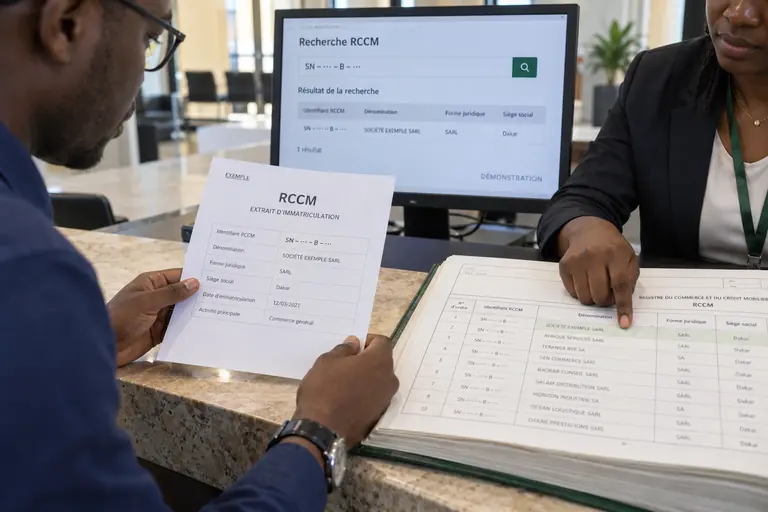
Burkina Faso's RCCM company register and business records are the public file that proves a trader or company legally exists. RCCM stands for the register of commerce and personal property credit, a tool shared by member states of the OHADA business-law system. Each entry names the business, its form, its address, its activity and its legal representatives, and it is updated whenever something important changes. Lenders, suppliers, buyers and officials rely on it to confirm who they are dealing with before money or contracts change hands.
Where the RCCM sits in Burkinabè commercial law
Burkina Faso belongs to the OHADA community, a group of mostly West and Central African states that agreed to apply the same commercial rules. As a result, the national trade register follows the Uniform Act on general commercial law rather than a purely domestic scheme. A reader who knows the system in another member state will recognise the vocabulary, the filing logic and the idea that registration gives a company its legal personality.
The register serves three purposes at once. It identifies traders, so that a person who carries on business as a profession can be recognised as such. It marks the legal birth of commercial companies, which acquire their own personality from the moment of registration. And it publishes certain security interests over movable property, which is where the words personal property credit come from in the name.
Because the framework is regional, rules on content and effects are broadly similar from one member country to another, while practice differs. Forms, counters, timelines and local habits belong to Burkina Faso itself. Anyone preparing a transaction should therefore treat the OHADA texts as the common backbone and the local court registry as the place where rules turn into actual paperwork.
Who keeps the file: courts, registries and national databases
The register is kept by the registry of the competent commercial jurisdiction. In Burkina Faso the main commercial courts are in Ouagadougou and Bobo-Dioulasso, and a business generally falls under the court covering the place where it is established. The registry clerk receives applications, checks that the documents are in order, enters the information and issues the numbered extracts that people later present to banks or partners.
OHADA law also describes a three-level structure. Local files remain with each court, a national file gathers the information of the whole country, and a regional file is held at the common court of justice and arbitration in Abidjan. The idea is that a business cannot easily be registered twice under different identities and that information can be traced beyond one courthouse.
For the user, this means that a search result is only as complete as the file consulted. A local extract proves what that registry holds, which is normally enough for a contract, while a deeper verification may require checking the national file or asking the clerk about related entries. Asking which file a document comes from is a sensible habit.
Two practical consequences follow from this layered design. A document issued by a local registry is an official source but may not reflect an entry made elsewhere, and a search that fails in one office does not always prove that the business does not exist. When a result looks surprising, widen the enquiry to the place of the previous registered office before drawing conclusions.
What an RCCM entry tells you about a business
A standard entry starts with the name of the trader or the company name and any trade name or sign. It continues with the legal form, such as a sole trader, a limited liability company or a public limited company, and with the address of the main establishment. A short description of the activity is added, so a reader can see whether the declared business matches what the company claims to do.
For companies, the file normally lists the managers or directors, together with the extent of their powers to bind the company. Share capital and duration of the company are also part of the picture. When a manager is replaced, a branch opens or the capital changes, a further entry must be made, so the history of the company can be followed step by step.
The registration number deserves attention. It identifies the entry in the register, but it is not the same as the tax identification number issued by the revenue authority. Partners who want a full picture usually ask for both, plus the identification papers of the person signing. Mixing the numbers up is a classic source of delays when a contract is being finalised.
Setting up a business and the one-stop formalities centre
Creating a company in Burkina Faso involves several administrations: the registry, the tax office, social security and sometimes sector authorities. To lighten this, the country has a business formalities centre, often presented as a one-stop shop, where founders can submit one file for several procedures. It is run through the business house and the national investment promotion bodies.
Founders usually prepare articles of association drafted in line with OHADA rules, identity documents of the partners and a proof of the registered office. The exact list depends on the legal form, and only the registry or the one-stop centre can confirm the current requirements. Once the file is accepted, the company receives its registration number and may start trading officially.
A registration is not an operating licence. Mining, banking, insurance, transport, health and many other fields need extra approvals from the relevant ministry or regulator. The RCCM entry proves that the business exists as a trader or company, not that it holds every permit for its sector. Checking both layers avoids unpleasant surprises with a partner who looks formally in order.
Searching for a company and requesting an extract
Anyone with a legitimate interest may ask for information about a registered business. In practice a search starts with the exact name, the registration number or the town where the business is established. Name spelling matters, since many companies share similar words, and a single missing accent or abbreviation may hide the entry you are looking for.
The usual output is an extract, a document that reproduces the entries as they stand on the day it is issued. Banks, tender offices, customs agents and foreign partners often ask for a recent one. Online access and the exact price of extracts evolve over time, so the safest approach is to confirm with the registry, the formalities centre or a local lawyer before travelling to request one.
Foreign readers should plan for language and formalities. Official documents are written in French, and a document intended for use abroad may need a certified translation or legalisation, depending on the receiving country. Keeping a note of the date and the source of every extract also helps if a dispute arises later about what the register said at a given moment.
Limits of the register and sensible due diligence
The register states legal facts declared by the business. It does not measure financial health, reputation or real activity. A company can remain registered after it has stopped trading in practice, and a very recent registration may not yet show everything a buyer wants to know. Treat the entry as a starting point rather than a seal of quality.
Cross-checking is therefore wise. A bank reference, a visit to the premises, a look at tax compliance documents and a conversation with existing customers add layers that the register cannot provide. Where the stakes are high, a local lawyer or accountant can interpret the entries, explain the powers of the signatory and detect inconsistencies between papers.
Neighbouring OHADA states, such as Mali, Niger or Côte d’Ivoire, use the same family of rules, which helps when a group operates across borders. Yet each registry has its own forms and customs. The explanations here are general information, not individual legal advice, and any real transaction deserves confirmation with the competent authority.
Frequently asked questions
What does RCCM mean in Burkina Faso?
RCCM stands for register of commerce and personal property credit. It is the public register where traders and companies are recorded under OHADA business law. An entry shows who the business is, what it does and who can act for it, and it also publishes certain security interests on movable assets.
Is an RCCM entry the same as a tax number?
No. The registration number identifies the entry in the commercial register, while the tax identification number comes from the revenue authority. They serve different purposes, and banks or partners often ask for both. Provide each one where it is required rather than substituting one for the other.
Does the register prove that a company is financially sound?
No. It confirms legal existence, form, address, activity and representatives as declared. It does not assess solvency, reputation or actual trading. For a significant deal, combine a recent extract with bank references, tax compliance documents and, if needed, advice from a local professional.