
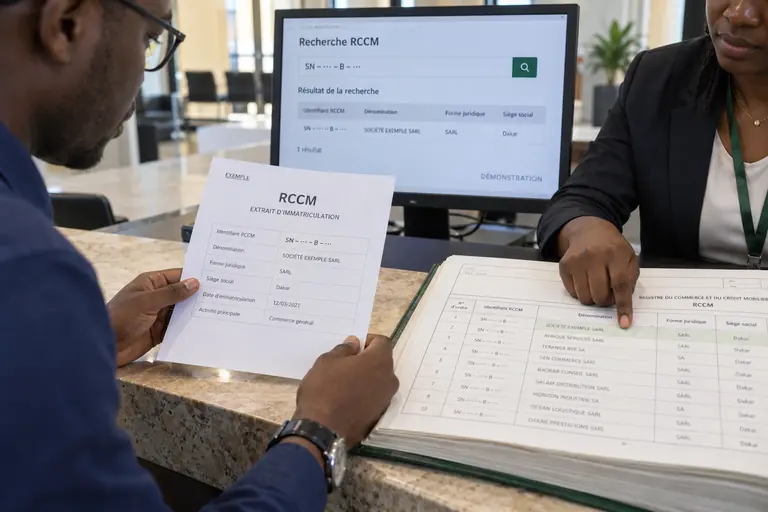
Senegal's commercial register RCCM and NINEA identification differences start with purpose: one is a legal registration that makes a trader or company visible to third parties, the other is an administrative number used to follow economic units in state records. The register is held at the registry of the competent court under OHADA rules, while the NINEA comes from the statistical and tax system. Entrepreneurs often quote them together on invoices, yet neither can stand in for the other, and a partner asking for one document will not accept the other as a substitute.
Two numbers, two jobs
Many business owners in Senegal talk about RCCM and NINEA as if the words meant the same thing. They do not. They belong to different institutions and answer different questions, and the confusion shows up whenever a form has two boxes that look alike. Reading each acronym correctly on a document avoids a great many misunderstandings with banks, tax offices and customers.
The RCCM, the register of commerce and personal property security, makes the existence of a trader or company enforceable against third parties. The NINEA is an identifier that lets state bodies track an enterprise or an association in their files. Both are requested when opening an account, answering a tender or completing a tax registration, which is why they travel together. Together they give a fuller portrait than either could alone.
Understanding the difference also prevents the wrong paper from being sent. A partner who asks for a register extract will not be satisfied by a NINEA certificate. Conversely, owning a registration number does not exempt an enterprise from obtaining the statistical identifier, so both items belong in the permanent folder of any serious business. A tidy folder with clearly labelled originals makes every later request easier to answer.
The commercial register in practice
Senegal applies the uniform business law of OHADA, so registration is handled by the registry of the competent court, which enters traders and companies according to its territorial area. Dakar has its own commercial court, and other regions rely on the registry of the local court. The place where the file is lodged follows the seat or main establishment declared by the applicant.
The entry makes public a set of facts about the business: its name, legal form, seat, activity and managers. It results in a registration number, which is repeated on every extract. Security interests over movable assets can also be recorded in the register, and this is exactly why the words personal property security appear in its title. That part of its work has no counterpart in the NINEA.
To create a business, founders usually go through the one-stop counter of the investment promotion agency, a body known for supporting company creation in Senegal. Specific requirements and charges should be requested from that counter directly, because they are set by the authorities and may be revised without much notice. In the meantime, a draft list of papers prepared in advance helps the discussion with the counter move faster.
The NINEA and what it identifies
The NINEA is the national identification number of enterprises and associations. The national statistics and demography agency includes it in its statistical directories, and the tax administration describes it on its own pages as the unique identifier under which a person or entity is entered in the taxpayer directory. In short, it belongs to the statistical and fiscal side of public administration.
It is not a commercial document in the sense that the register is. It proves neither that someone has the status of a trader nor that a company was lawfully formed. What it does is allow an enterprise or association to be recognised consistently in state records and in the returns it files over the years. Treating it as proof of trading status is therefore a mistake that can embarrass a business in front of a bank.
Associations are covered as well, which already separates it from the commercial register, since a non-profit body does not trade. On invoices and letterheads the two numbers appear side by side, but they serve different readers: the register number reassures a business partner, while the NINEA mostly interests tax and statistics departments. Each reader looks for a different thing, and giving them the right number saves everybody time.
A direct comparison
On legal nature, the RCCM is an entry in a legal register with the effect of public notice, and the NINEA is an administrative identification number. The first comes from commercial justice, the second from the statistical and fiscal apparatus. That single contrast explains most of the other differences. Seen this way, the contrast is less about paperwork than about who is responsible for the record.
On content, a register extract describes the legal situation of the business and names its managers, while a NINEA certificate simply gives the number assigned and identifies the unit it belongs to. When comparing the two, the question to ask is always what each document can prove to a reader who has to take a decision. A short written checklist helps a manager decide which one to produce for each request.
On use, a public tender, a loan application or the opening of a corporate account will often ask for both, but with different aims. The register extract establishes who the business is in law, and the NINEA lets an administration match it to its own file. Showing the wrong item at the wrong desk costs time and sometimes a missed deadline.
On duration, a register entry is changed whenever a manager, address or activity changes, and is closed by cancellation at the end of the business. An identification number is meant to stay attached to the structure while it keeps its identity, so the two follow different rhythms. Neither rhythm should be left to chance, because stale entries lead to avoidable questions from partners and officials.
Mistakes that come from mixing them up
A classic error is to copy the NINEA into the field meant for the registration number, or the reverse. Online forms and bank questionnaires may accept the entry, but a later check will flag the mismatch and slow the process. Owners should keep both numbers on a single sheet, each labelled in full, and copy from that sheet. Such a sheet can sit in the accounting file next to the bank details.
Another mistake is to rely on an old photocopy. Extracts of the register are snapshots, and recipients usually want a recent one. Identification certificates, in contrast, may stay valid for long, but names and details can change, so the information on them should be compared with the current state of the business before it is shared. A careful manager also notes the date of issue on each paper, so that nobody has to guess how current it is.
A last problem arises with intermediaries who sell packages without saying which official document will be delivered. Before paying, ask which office issues each item, what the document is called and what it will prove. A serious provider can answer in a few lines, and an evasive one is a signal to look elsewhere. Written answers from the provider can later be shown to the competent office.
Choosing the right source for the right question
If the question is whether a business exists legally and who manages it, the register is the source, and the safest evidence is an official extract from the registry. If the question concerns how the enterprise appears in tax or statistical files, the relevant authority is the one that manages the identification number. The two sources therefore complete each other instead of competing.
Some data is accessible online, but the range of what can be consulted differs between services and is not always complete. Public information is also limited by privacy rules, so not every detail about managers or partners is available to anyone. Where a decision carries real financial risk, an official document is better than a screen copy. Treat any figure found on an unofficial website as a lead to verify and never as a final answer.
The overview given here is general and cannot replace legal advice for a specific case. Rules change with administrative reforms and the digitalisation of registries. For any particular situation, a Senegalese lawyer, notary or chartered accountant can say which document is needed and which office delivers it. Asking the issuing office for a written reply also leaves a trace for later.
Frequently asked questions
Can I use the NINEA instead of an RCCM extract?
Usually not. A request for a register extract aims to establish legal existence, managers and the seat, which only the register can show. The NINEA certificate serves another purpose in administrative and statistical records. If a counterparty asks for both, provide each in its own right.
Which institution issues each number?
The registration number comes from the registry of the competent court that keeps the commercial register under OHADA rules. The NINEA is linked to the national statistics and demography agency and is used by the tax administration. Because different offices are involved, the paperwork for each runs on a separate track.
Do associations need an RCCM number?
Not as a rule, since an association does not carry on trade in the same way as a business. It can nevertheless hold a NINEA, because the identification number covers associations as well as enterprises. Specific obligations depend on the nature of its activity, so a local adviser should confirm the position.