
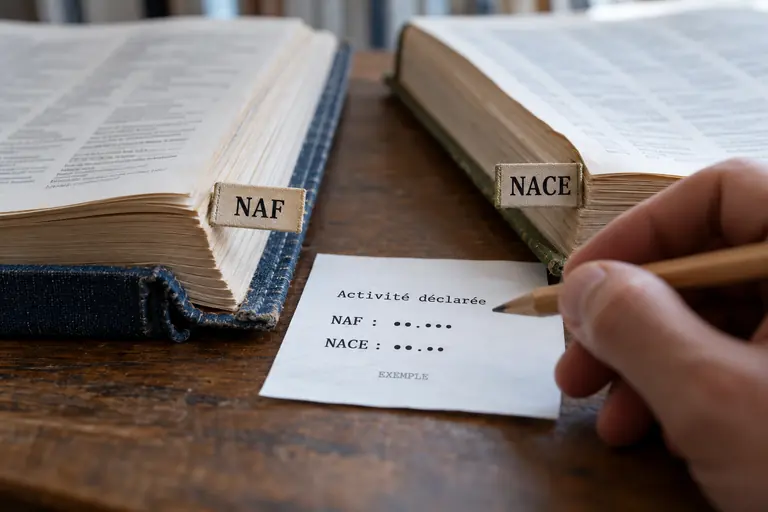
In France, company search by NAF and NACE codes means filtering firms by the activity code that the national statistics institute assigns to each of them, instead of looking for a name. The NAF is a five-character code such as 62.01Z, built on top of the European NACE classification: the first four digits follow NACE and the final letter is a French refinement. A code-based query lists businesses in one sector, perhaps within a town or department, which suits prospecting, market studies and competitor checks. The code records a declared main activity, never size, quality or present reality.
What the activity code is for
Every business registered in the French directory of enterprises and establishments receives a main activity code when its formalities are processed. The institute that runs the directory attributes it, and the same code is often called the APE code, short for main activity exercised. You will find it on status notices, on the entries of the national business register and on many commercial documents.
The practical value lies in grouping. A name search answers the question of who a particular firm is, while a code search answers the question of which firms operate in a given trade. Software developers, restaurants and road hauliers can each be listed in a chosen commune, which is far quicker than guessing keywords and hoping that company names reveal the trade. Public bodies, social security organisations and statisticians rely on the same codes to group firms by sector. That shared use explains why the code appears almost everywhere. It remains a statistical label, however, and tells you nothing about turnover, headcount, reputation or financial strength, so two companies with the same code can differ enormously.
Reading the structure of a NAF code
A NAF code combines four digits and one letter, with a dot after the second digit, as in 56.10A. The first two digits give the division, the next digit or two narrow it to a group and a class, and the closing letter is specific to France. That letter lets national authorities split certain classes more finely than the European standard does.
Above the divisions sit broad sections identified by a single letter, running from agriculture to household activities. The nesting makes the system easy to use at different depths: stay at section level for a general picture, or drop to the finest level to isolate one precise trade. The wording attached to each code always carries the real meaning, so read it in full.
Descriptions are deliberately neutral and often cover neighbouring trades. A restaurant class, for example, may separate traditional table service from fast food and other formats. Explanatory notes also state what is included and excluded, and skipping them is a classic way to pick a code that looks right but quietly leaves out the activity you had in mind. Reading the full wording takes only seconds and prevents most misclassification errors.
How NACE and the French classification connect
NACE is the statistical classification of economic activities used across the European Union and published by Eurostat. Member states adopt it as a common base and then adapt it to their own needs. The French NAF copies the NACE layout down to the fourth digit and adds only the extra letter, which is why conversion between the two is so simple.
In practice, removing the letter from a French code gives its NACE equivalent. That correspondence makes cross-border comparison possible, even though other countries use their own national versions, such as Germany's WZ, Spain's CNAE or Italy's ATECO. Titles look alike, but every country keeps some freedom to detail particular levels. The United Kingdom kept its own SIC codes after leaving the Union, yet these belong to the same family of international classifications. At the top of the pyramid stands the United Nations ISIC, which inspired NACE. This shared ancestry explains why the major headings can be matched from one country to the next.
Revisions that change the codes over time
Activity classifications are revised from time to time so that they follow changes in the economy, new technologies and emerging trades. The French statistics institute has announced a new NAF revision aligned on the latest NACE version, to apply after the current revision ends. Eurostat has meanwhile moved European statistics to NACE Rev. 2.1. One consequence is that the code of a given business may differ between an older and a newer record. Correspondence tables published by the institute and by Eurostat make it possible to translate one version into another. Anyone comparing firms across several years, or across several countries, should therefore check which version of the nomenclature each source uses.
This is more than a technicality. A query built on the old code list may miss firms that were reclassified, and a sector count compared across two revisions can look like growth or decline when it only reflects renamed categories. Noting the version beside every result keeps your analysis honest and reproducible. Statistics published by public bodies by sector are built on these codes, so their quality depends on the care taken in declarations. Aggregated figures for a sector say little about any single firm. A reader comparing companies should keep in mind the gap between a statistical classification and a commercial description of what a business sells.
Finding the code of a particular business
The most direct route is to query the Sirene directory with the SIREN or SIRET number of the business. The entry displays the main activity with its code and wording, together with the date of the latest change. A situation notice downloaded from the institute's service contains the same details in document form and can be filed as evidence. The reverse path starts from a code and returns the businesses that carry it, often with geographic filters. Researchers, sales teams and procurement staff use it to build target lists or to see how crowded a market is. Treat such lists as indicative, because they depend on how recently the database was refreshed and on dissemination rules.
For foreign companies the method is similar but the vocabulary changes. Each country's register or statistics office publishes activity codes in its own nomenclature, so you first need the local name of the classification and its version. European register interconnection portals do not always display these codes in a harmonised way. Keep the date of every extraction beside the list you build.
Why a code can differ from what a firm really does
The code reflects the main activity declared at registration. Years later the business may have moved on, added product lines or changed customers without updating its declaration. A diversified group may carry on several trades while the code retains only one, and the entry will simply mirror whatever was declared. The code should also be kept apart from the corporate purpose written into the articles and recorded in the register. The purpose is a legal text, usually wide, whereas the code is a statistical heading. Two firms sharing a code can pursue noticeably different trades, which is why the code works best as a first filter and not as the only search criterion.
Sole traders and micro-entrepreneurs often carry out secondary activities that never appear on their entry. If you need the full picture of what a person offers, reading their website, brochures or invoices usually adds what the code leaves out. When the code looks wrong, the business can ask for a correction by justifying its real main activity; the change corrects the statistical record without altering registration.
Some rules that depend on the trade, such as the choice of a collective agreement or membership of a professional body, refer to the activity of the business. The code alone never settles them, because they rest on what the company actually does. For a precise question, the competent administration or professional organisation is the right place to ask. Keeping a copy of any correction request helps if the code is questioned later.
Frequently asked questions
Is a NAF code the same as an APE code?
In everyday French usage the two terms refer to the same thing. APE stands for main activity exercised, and the NAF is the nomenclature from which the code is drawn. On a business entry you will usually see one code with a wording, which people call either the APE or the NAF code.
Can I convert a NAF code into a NACE code?
Generally yes. The first four digits of the French code follow the European NACE structure, so dropping the final letter gives the NACE heading. Always confirm which revision of each nomenclature you are using, since correspondence tables exist precisely because versions differ.
Does the code tell me what a company really sells?
Not reliably. It records the main activity declared at registration, which may be outdated or only one of several trades. Use it to shortlist firms, then confirm the real offer through the company's own documents, its published accounts or direct contact.