
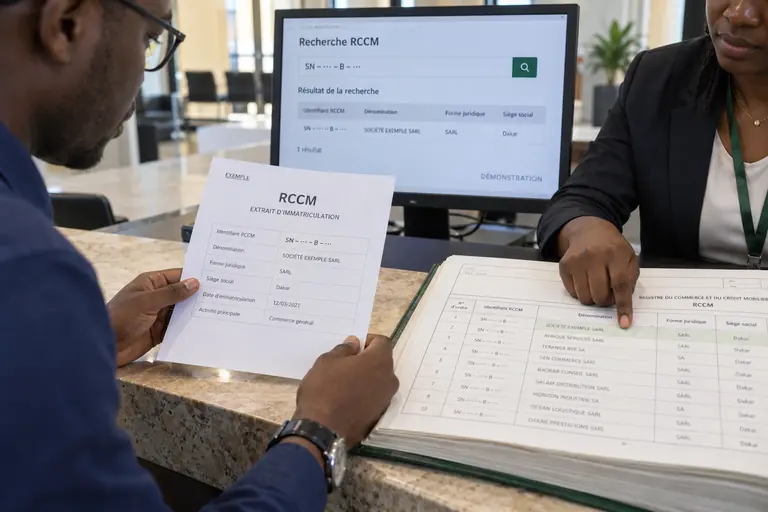
In the Democratic Republic of the Congo, the RCCM company register and business records are the legal starting point for dealing with any trader or firm. The initials stand for the register of commerce and personal property credit, which the country adopted when it joined the OHADA system. An entry gives the name, form, address, activity and managers of the business, notes later changes and publishes security interests on movable assets. Lenders, mining suppliers, shippers and public buyers ask for an extract to confirm existence and signing authority.
How OHADA membership changed the picture
The Democratic Republic of the Congo became part of OHADA after a long period in which commercial rules were national and sometimes hard to compare with those of neighbours. The adoption of the uniform acts brought a new common vocabulary for traders, companies and security rights. Foreign partners who already knew the system in Cameroon or Senegal gained a familiar reference.
The change did not erase local reality. The country is vast, with a dense capital, mining provinces, river ports and distant regions, and administrative capacity varies from one place to another. A uniform text does not always produce uniform practice, which is why local verification retains its importance even after harmonisation.
For businesses, the register has three effects. It confirms trader status, it gives commercial companies legal personality from registration and it publicises guarantees over movable property. Each effect benefits third parties who need to know whether they face a legitimate operator and what security has already been granted over its equipment or stock.
Readers should also remember that neighbouring systems differ. Angola, Zambia, Uganda and Burundi do not share the same commercial register model, so a company operating across those borders may hold several registrations under different laws, each with its own rules of access and evidence.
Registry courts and the geography of filings
Filing happens at the registry of the competent commercial court. In Kinshasa, filings are concentrated in the capital’s commercial court, whose seat gives its name to the Gombe area. Other major centres, such as Lubumbashi, Matadi, Goma and Kisangani, have their own jurisdictions or are served by courts empowered to handle commercial matters.
A business registers where it has its principal establishment, so a mining service company in Haut-Katanga is not usually filed in the same place as a trading house in the capital. Companies with several sites declare secondary establishments. A researcher who checks only one city may miss part of the picture.
OHADA law also provides for a national file and a regional file kept at the common court of justice and arbitration. They are meant to help prevent duplication and allow broader verification. The extent to which a given request can use them depends on how the services are organised at the moment, and the clerk is the best source of information.
Practical logistics deserve attention. Travel between provinces can be slow, and communication networks are uneven. Using a local representative who can visit the registry, collect the extract and photograph the office’s stamp can spare a foreign client time and cost, provided the representative’s mandate is clear and in writing.
Reading the entry and the other identifiers
The entry normally shows the name of the trader or the corporate name, the legal form, the main address and a description of the activity. For companies, the capital and the identity of the managers are included. Details about the powers of managers are especially useful, because a contract signed by an unauthorised person may later be contested.
A Congolese business may hold several different numbers. The commercial register number proves registration as a trader or company, a national identification number relates to administrative recognition, and a tax number is issued by the revenue authority. A prudent partner asks for each document and checks that names and addresses are consistent among them.
Differences between documents are not automatically suspicious. A company may have moved, changed its name or updated its management, and the paperwork may lag. What matters is that the explanation is given and, if needed, documented by an amended entry or a new extract before large sums are transferred.
When two companies have very similar names, the address and the manager often decide which one is meant. In the capital, repeated words such as Congo, Kivu or Katanga appear in many corporate names, so adding the activity and the registration number prevents confusion when ordering documents or drafting contracts.
Starting a company through the one-stop shop
Founders are encouraged to use the one-stop shop for business creation in Kinshasa, which gathers the administrations involved in registration, tax and other formalities. A national investment promotion agency also guides investors, though it does not itself keep the register. The point of the system is to replace a series of separate trips by a coordinated process.
A typical file includes articles of association drafted in line with OHADA law, identity papers for the partners and proof of a registered office. Documents showing capital contributions may be requested. As the exact list depends on the legal form and on reforms, a notary or the shop itself should confirm the up-to-date requirements.
Mining, hydrocarbons, banking, telecoms and transport require specific permits from competent authorities. These permits are separate from registration, and a company can have one without the other. Partners and lenders should check both, since the existence of a valid register entry says nothing about whether a licence has been granted, renewed or suspended.
A foreign investor will often ask whether to create a subsidiary or a branch. A subsidiary has its own legal personality and limits the parent’s exposure, while a branch is part of the foreign company. The choice influences taxation, reporting and liability, so advice from a local lawyer before registration is worth the cost.
Consulting the register and getting an extract
Consultation usually happens through the registry or authorised counters. The simplest search uses the registration number. If it is unknown, the exact company name, the town and the manager’s name help the clerk to find the right file. Because similar names are common, double-check the legal form that follows the name.
The result is a copy of the entries or an extract, which states the situation on the day it is issued. Banks and counterparties often require a recent date. Fees, timelines and any online options may change, so confirm them with the registry before making a trip, particularly if you are coming from another province.
French is the official language of the documents. Partners who read English, Portuguese or another language may need a translation, and documents used abroad can require legalisation. Ask the receiving institution which formalities it expects and keep proof of the date and place of issue of every extract you obtain.
Banks in the country often ask for a bundle of papers when a company opens an account or seeks credit. The extract is one of them, usually with the articles of association, identification of the managers and proof of address. Organising these documents together reduces repeated visits and unexpected requests.
Verification beyond the extract
The register records what a business has declared. It does not guarantee that the business is active, solvent or compliant with every rule. A company can remain registered after it has stopped operating, and information about actual activity may need to be gathered from other sources such as customers, banks and site visits.
In a country where distances are long and communications uneven, on-the-ground checks have particular value. A trusted local representative, a lawyer or a reputable chamber of commerce can confirm that an address exists and that the business is open. This is routine practice and is not meant to cast doubt on any particular partner.
The remarks above are general information, not legal advice for an individual situation. Rules, offices and services change, and practice may differ from the written text. Before signing a significant contract, confirm the position with the competent registry or with a qualified Congolese practitioner and keep dated copies of all documents.
Frequently asked questions
Does the DRC use the OHADA register?
Yes. The Democratic Republic of the Congo applies the OHADA uniform act on commercial law, so its register of commerce and personal property credit follows the common model. Local registries, forms and procedures remain specific to the country and should be confirmed directly.
Where do I request an extract?
From the registry of the competent commercial jurisdiction, often through authorised counters. In the capital this means the commercial court registry. Provide the registration number or exact company name, and check current procedures before travelling, since fees and services change.
Is the extract enough for a mining or transport deal?
No. It proves registration, not the right to carry out regulated activities. Mining, hydrocarbons, transport and similar fields require separate permits. Ask for them, confirm them with the issuing authority and add bank, tax and on-site checks before committing funds.