
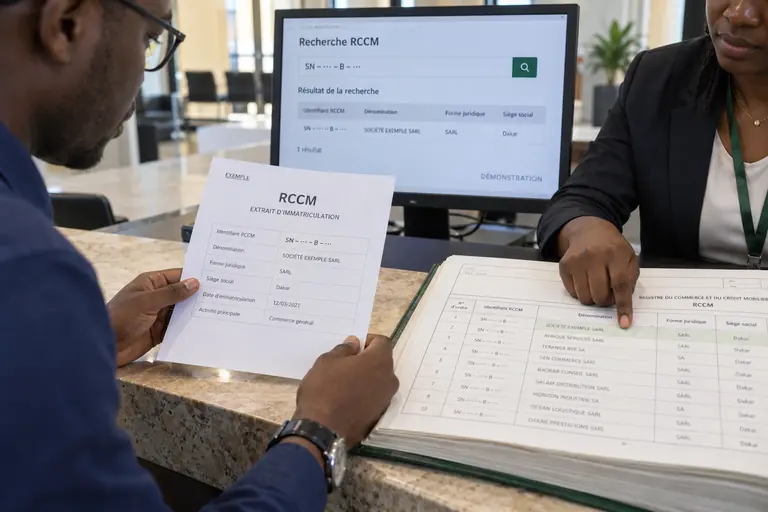
How do you run an OHADA company search by RCCM number? You start from the identifier that the Trade and Personal Property Credit Register gives to every trader and company registered in the member states of the organisation for the harmonisation of business law in Africa. The number reveals the country, the town of the clerk's office, the type of registrant and a serial number. Each state keeps its own files, so the search leads to a national clerk's office, not to a single central database, and the number proves registration rather than solvency.
What the RCCM number covers in OHADA states
OHADA brings together African states around common business rules called uniform acts. One of them, the Uniform Act on general commercial law, organises the Trade and Personal Property Credit Register, known by its French initials RCCM. Every trader, whether a natural person or a company, must be entered in it, and the entry produces a number. That number is the practical proof of legal existence for a business in the region. It appears on invoices, contracts and official documents, and banks and partners ask for it before dealing with an unfamiliar entity. The substantive rules are shared, but each country applies and organises its register in its own way.
An OHADA company search by RCCM number therefore starts with understanding that the code belongs to one national file. The shared legal framework gives the user a familiar structure from one country to another, while daily practice, forms and language of work remain local. Events in the life of a business produce amending entries: a new manager, a moved head office, a capital increase, the sale of a going concern. Cessation of activity and dissolution are also recorded, and striking off closes the file. Only a dated extract proves that the number still matches a trading entity.
How to decode the number
The usual pattern places several elements side by side, separated by dashes or slashes. You can identify a country code, a code for the town where the clerk's office sits, the year of registration, a letter separating natural persons from legal entities and finally a serial number. Exact presentation differs between states and even between jurisdictions. This structure supplies useful clues. A number pointing to a clerk's office that does not exist in the stated country, a year later than the date of the document, or a letter inconsistent with the form of the business all call for checking. Numbers dictated by phone or copied by hand are especially prone to error.
The golden rule is to copy the number from a document and never from memory. Keep the original characters, separators and letters exactly as printed, because a single altered character can send the search to another business or to nothing at all. Where the register is held in several languages, note the spelling used on the original as well, because transliterations of names and towns can differ between documents.
Clerk's offices and the layers of files
Registration takes place at the registry of the competent court, which is a commercial court or a court of first instance depending on the country. That registry receives the declaration, the supporting documents and later amendments. It keeps the local file of the business, which any interested person may ask to consult. Data then moves up to a national file kept in each state and on to a regional file placed with the Common Court of Justice and Arbitration. The organisation's public website presents the regional file and describes work on computerising the register. The architecture is meant to give an overall picture of registered entities across the area.
For the searcher this means the real source of truth is the local clerk's office. National or regional databases can help to locate a business, yet a dated extract from the competent registry remains the document that others will accept as proof. Publicity is not uniform. Some registries are computerised while others still work largely on paper, and remote access depends on national equipment. Personal data of managers and partners is protected under domestic law, and rules evolve, so current practice should always be confirmed with the registry concerned.
Countries where the number applies
The organisation counts seventeen member states spread over West Africa, Central Africa and the Indian Ocean. They include Benin, Burkina Faso, Cameroon, Côte d'Ivoire, Gabon, Guinea, Mali, Niger, the Democratic Republic of the Congo, Senegal, Chad and Togo. All apply a common commercial law while keeping their national institutions. The result for users is a recognisable framework with distinct local practice. Delays, charges, forms, online portals and working languages vary. A number issued in Cameroon cannot be verified at the registry in Dakar, even though both follow the same uniform act, so every identifier stays tied to its state of origin.
Business people trading across borders in the region should therefore keep a short note of which authority answers for which country. Contacting the wrong registry wastes days and may lead to the false belief that a registration does not exist. A short list of the competent registries, kept up to date, saves time on every later check. Forged extracts and borrowed numbers exist. A document with approximate layout, an unreadable seal or a number that does not match the town of the clerk's office deserves scrutiny. Digital copies sent by messaging are not enough evidence to commit large sums, and homonyms are common within one city. If uncertainty remains, suspend payment until the registry confirms.
A step-by-step method for checking a number
First identify the country and the town of the clerk's office from the number itself. Next contact that registry, or use the national portal where one exists, and ask for confirmation of the registration or for an extract. The exact name of the business, its legal form and its address must match the file. A sensible practice is to ask the business for a recent extract and then control it with the issuing authority. Response times and request methods vary from one jurisdiction to another. For a significant counterparty, a local correspondent such as a lawyer or bailiff can carry out the step in person at the registry.
Record who you contacted, when and what they confirmed. That small file protects you if a dispute arises, and it makes repeat checks quicker because you already know which office holds the record. To know where a business stands today, a recent extract is essential. An old extract does not show later movements, and a number that was valid on a given date may lead months afterwards to an entity that is struck off or transformed. Insolvency proceedings are published elsewhere and must be consulted separately.
What the registration file contains
The file includes the identity of the trader or the name of the company, its legal form, the address of the head office, the declared activity and, for companies, the capital and managers. It states the date of registration and any later changes. Articles of association and certain deeds are deposited with the registry. The register also gives publicity to security interests over movable property through its credit side, which matters to lenders. Entries for pledges and privileges are accessible under rules that differ from country to country. These details complete the commercial identity of the business.
In short, the number opens the door to all these entries at the competent registry. It is the key, but access conditions, formats and the level of digitisation depend on the jurisdiction concerned. In member states the register number coexists with other references. A tax identifier is allocated by the revenue administration, and a statistical identifier may be issued by the national statistics body. The first proves commercial registration, while the others support administrative functions, and companies must often produce the full set when opening a bank account or tendering for a public contract.
Frequently asked questions
Is there one central database for every RCCM number?
No. The regional file exists and is presented by the organisation, but registration happens at national courts' registries. For a reliable answer you should go to the clerk's office or national portal of the country named in the number, and ask for a dated extract.
Does a valid number prove that a company is sound?
No. It proves that an entry exists or existed. It says nothing about solvency, honesty or current trading. Combine it with a recent extract, financial statements, banking references and local legal advice before committing significant funds.
How can I spot a forged extract?
Warn signs include rough layout, an illegible stamp, or a number that does not match the town of the clerk's office. Never rely on a scanned copy alone for large payments. Ask the issuing registry to confirm the document and compare name, address and activity.