
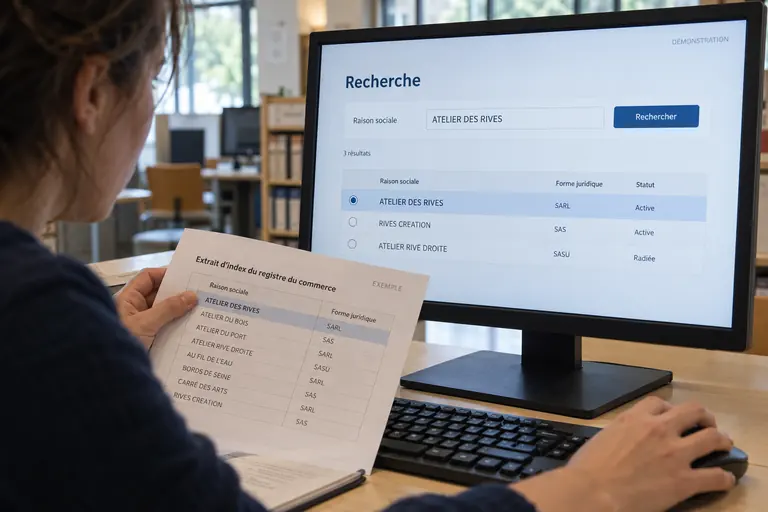
In Spain, the movable property register and the company register sit side by side and are easily mixed up, because they often share an office and the same registrar. The first publishes contracts and security interests affecting movable goods such as machinery, vehicles on finance or business assets; the second shows who a company is, who manages it and how it is structured. One concerns things, the other concerns legal persons. A clean company record therefore says nothing about whether the assets of that company are free of charges.
What the movable property register publishes
The movable property register is a legal register in which contracts and guarantees affecting transferable goods are entered. Its usefulness lies in publicity: whoever finances, sells or encumbers an asset can make that fact visible, so that a third party can learn whether a charge already weighs on it. It deals with information about things, not with the structure of a company or the people who direct it.
In Spain this register works together with the company register in each registration district, and it is run by professionals titled commercial and movable property registrars. Sharing an office does not mean the functions are identical. They are two separate books with different purposes that happen to be kept by the same staff and consulted at the same counter or through the same electronic channel.
Among the contracts that typically reach this type of register are instalment sales of movable goods, financial leases, retention-of-title clauses, movable mortgages and pledges without transfer of possession. Each of these has its own regulation and effects. An asset on which a guarantee is validly entered cannot simply be treated as free of charges by a buyer or a lender.
What the company register answers by contrast
The company register answers a different question: who is the business or the company? It records incorporation, articles of association, managers, powers of attorney, share capital and the corporate life of the entity, and it receives the deposit of annual accounts. Anyone wanting to know with whom they are contracting should read this book, not the movable property one, even when the deal concerns goods.
An example makes the difference concrete. A haulage firm appears in the company register with its name, registered office and directors. The lorries it financed under a contract with retention of title, however, would be listed, where applicable, in the movable property register. The same enterprise is therefore present in two books, with data of a different nature in each of them.
For that reason a company extract that does not mention any guarantee is no proof that the firm's assets are unencumbered. That verification calls for a search in the movable property register or in other files depending on the type of asset. Whoever skips this second step may face unpleasant surprises when buying a machine or a batch of vehicles from a seller who has already pledged them.
Property, company and movable property registers side by side
The land register deals with immovable property: plots, homes, premises and the rights attached to them, such as mortgages or easements. The movable property register does something comparable for certain goods that can be moved. The company register, for its part, concentrates on legal persons and entrepreneurs, not on things, which explains why three separate searches may be necessary in a single transaction.
The three-way division shows up in everyday enquiries. To learn who manages a company, go to the company register. To discover the charges on a shop unit, go to the land register. To find out whether a crane is financed with security, go to the movable property register. Mixing up the targets leads to answers that look reassuring but address the wrong question, and that can mislead even experienced buyers.
There are further specialist registers for particular goods, such as vehicles in the traffic register, aircraft or ships. Their scope and subject differ, and not every movable good passes through the movable property register. It pays to identify which specific register applies to the asset before starting any search, and to ask the registrar's office if the position is unclear.
Searching: what to bring and how to read the answer
A search in the movable property register usually starts from the identity of the owner or debtor, or from a description of the asset such as a serial number. The more precise the data, the more reliable the answer. A buyer should collect the seller's tax number, the exact name of the company and a description that matches the invoice or the machine plate.
The result may be a note stating the entries found, or a statement that none appear for the data used. A negative answer is only as good as the criteria searched, so a typing error or a former company name can lead to a false sense of safety. Checking spelling and history of names before ordering any information is a basic precaution that costs nothing and prevents many wrong results.
Official certificates have legal weight, whereas a simple information note is informative. If the outcome will be used in a purchase contract or before a court, ask for the form of document that suits that use. The registrar's office or a lawyer can say which one is appropriate, and electronic delivery is generally available for requests made online, usually with a secure verification code on the document.
How other countries publish security over movable goods
Many countries maintain systems for publicising security over movable assets, though names and structures differ. In some English-speaking systems a single filing office records liens against borrowers, while in other jurisdictions pledges are entered in the company register or in sector-specific files. The common aim is to let later lenders see earlier claims before they commit their own money to the same borrower.
Cross-border deals therefore require a mapping exercise before any money is advanced. A lender taking security over equipment in Spain should look at the Spanish book, not assume that the home country's system applies. Likewise, a Spanish buyer of goods located abroad should ask a local adviser which register publishes charges on them, and how far the answer can be trusted.
For readers comparing systems, the lesson is that a company register alone seldom reveals pledges over stock, machinery or receivables. Whatever the country, a complete check combines the company record, any security register and, for real estate, the land register. Skipping one of them leaves part of the picture hidden, and the hidden part is often the one that matters in a dispute.
Collateral rules also differ in how they treat future assets. Some systems allow a charge over stock that changes from month to month, while others need a precise description of each item. A reader who compares two countries should therefore look not only at the register but at the rules that decide what can be pledged, who ranks first and how a creditor enforces the security.
Practical habits for buyers, lenders and advisers
Before purchasing used equipment from a company, ask the seller for written confirmation that the asset is free of charges, then verify it in the appropriate register. A seller who hesitates to provide identification details for the asset is giving a signal worth noting. Delaying the payment until the search is complete costs little compared with disputing ownership afterwards, especially when the seller is abroad.
Lenders should schedule the search before releasing funds and again shortly before the final payment, because new entries can appear in between and change the ranking of claims. They should also record the exact date and time of each search, which proves what could be seen at that moment if a dispute about priority arises later, and which an auditor will also expect to find.
This overview is general and not legal advice for any particular case. The rules on which contracts can be entered, the effects of an entry and the procedure for obtaining information are set by law and may change, so a registrar or a lawyer should confirm the current position for any significant transaction involving movable assets, particularly when several countries are involved.
Advisers sometimes suggest a short checklist: confirm the legal identity in the company register, search the movable property register for the asset or the owner, look at the specialist register if the good is a vehicle, aircraft or ship, and ask for a declaration that nothing else is pledged. Each step answers a different question, and together they leave very little room for an unpleasant surprise.
Frequently asked questions
Does the company register show pledges on a company's assets?
Generally not. The company register records the entity, its managers, capital and corporate acts. Pledges and similar charges on movable goods are published in the movable property register, so a clean company extract does not prove that machinery or stock is free of encumbrances.
Who runs the movable property register in Spain?
It operates alongside the company register in each registration district and is attended by registrars who hold the combined title of commercial and movable property registrar. The shared office does not merge the functions: they remain two separate books with different purposes.
Do all movable goods appear in this register?
No. Some assets, such as vehicles, aircraft and ships, have their own specialist registers with a different scope. Before searching, identify the specific register that applies to the asset and, if unsure, ask the registrar's office which file is the relevant one.