
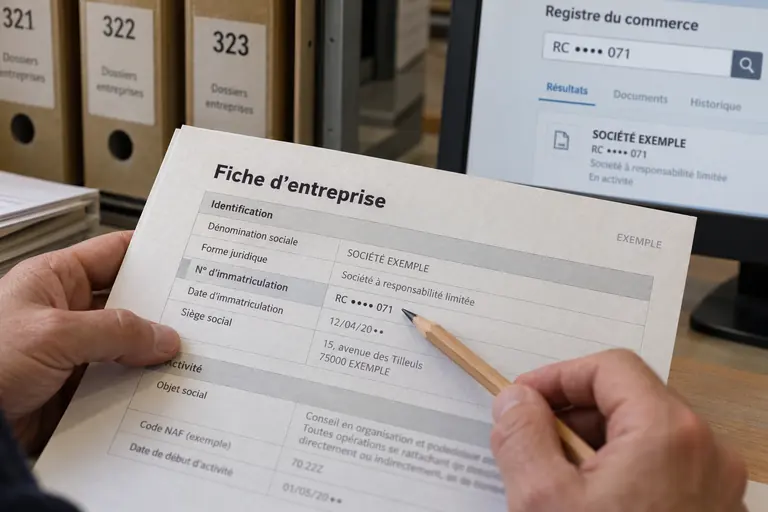
When facts change, Switzerland commercial register amendments to entries bring the public record back in line with reality. The register informs banks, partners and authorities, so a new name, a transferred seat, a departing director or an altered purpose must be reported to the cantonal office. The law expects prompt notice, and an unrecorded change may not be relied upon against third parties acting in good faith. Each amendment is examined, entered in the daily register and later published in the official gazette of commerce.
Why an outdated entry is a risk
The Swiss register works as a public notice board. Anyone dealing with a company may rely on what it says, and the entity is treated as having made its recorded facts known. If reality moves ahead of the register, the company may find the old state held against it, for example when a former manager still appears with signing power.
Practical consequences arrive quickly. A bank can refuse to accept a signature from a new director who is not yet recorded, a notary may hesitate to certify a transaction, and a counterparty checking the register may doubt a contract. Accurate entries therefore support credit, trust and smooth day-to-day dealings, far beyond the formal duty.
The duty to register changes rests on the persons responsible for the entity, and offices have means to remind those who delay. A business that treats the register as a living document, reviewed whenever it holds a board meeting or amends its statutes, rarely meets serious problems with the authority.
Entities should also remember that some changes are recorded at the initiative of the office itself, for example after a court decision or a notice from another authority. Even then, the company benefits from checking the resulting entry, because errors can creep in when information passes between bodies.
Facts that call for an amendment
Several categories of change recur. The first concerns identity: a new business name, a different registered seat, a move to another address within the same place and a modification of the corporate purpose. These facts define who the entity is and where it can be reached, so the register must show them correctly.
The second category concerns people. Entry or exit of directors, managers, auditors and persons holding signing authority, as well as a change in the way they sign, must be recorded. Switzerland distinguishes sole and joint signature, and the register shows which applies, so any shift in these powers needs a fresh entry and not just an internal note.
The third category covers the capital structure and corporate events. An increase or reduction of capital, a change in the nominal value of shares, a merger, a demerger or a conversion of the legal form each follow specific procedures, often with a notarial deed. Because such operations are complex, advisers usually coordinate the register step with the shareholder decisions that precede it.
A useful way to catch recordable facts is to compare the current register entry with the company's internal organisation chart once a year. Any person who signs contracts but is missing from the register, or who appears there but has left, signals work that remains to be done before the next audit or financing round.
Preparing the application for a change
The request is a written application signed by persons entitled to represent the entity. It names the facts to be amended and, when needed, quotes the new wording of the entry. Offices often supply forms, and following the cantonal model helps the examiner to see at once what is meant to change.
Supporting papers depend on the change. A new director normally accepts the post and proves identity, a change of purpose requires the decision of the general meeting and an updated version of the statutes, and a change of seat needs proof that the entity actually has premises or a domicile at the new place. The office will ask for whatever is missing.
Where a public deed is required, the notary prepares it and normally lodges the application. Even if the entity could technically file alone, involving the notary early reduces the risk of inconsistent wording. The wording of the new entry should match the deed, the statutes and the minutes, down to the spelling of names.
Where several changes happen together, for instance a new name, a new seat and a fresh board, they can usually be requested in a single application. Combining them saves correspondence, but each element must be supported by its own decision and paper, and the examiner will review them one by one.
Changes between cantons and cross-border cases
A transfer of the seat to another canton is a special case, because two offices are involved. The entity applies to the office of the new seat, which examines the request and informs the former office, and the entry is deleted from the old register when the new one is made. The business identification number stays with the entity.
Foreign shareholders or directors raise additional questions. Proof of identity, residence rules for persons who sign and the format of foreign documents may require attention. A foreign company with a Swiss branch also records changes at the branch, and the register has to reflect the foreign head office as well as the local representation.
Switzerland is multilingual, so wording in the entry follows the language of the canton. When a company moves from a German-speaking canton to a French-speaking one, the entry may be recorded in the new official language. Founders should expect the office to handle that adjustment and to propose consistent translations of the purpose.
Examination, entry and publication
After receiving the application, the office reviews its completeness and legality. It checks that the persons signing are authorised, that formalities were respected and that the new wording complies with the rules on names and purposes. Queries are sent in writing, and the entry is held back until the file satisfies the examiner.
Once approved, the amendment is written into the daily register and takes legal effect from that moment. Publication in the official gazette of commerce follows, and the information becomes available through the cantonal and central online search tools. The applicant can ask for a current extract to prove the new state to banks or partners.
Timing varies with the canton, the complexity of the act and the quality of the application. Nobody can promise a fixed duration, and urgent transactions such as signing a lease or opening an account should be scheduled with a safety margin. Keep a copy of the filing and of the confirmation as evidence of the date.
If the office rejects an application, it gives reasons and, in many cases, a chance to correct the defect. The decision can be challenged through the appeal routes of the canton, yet in practice most files are repaired by supplying the missing item or adjusting the wording of the request.
Good habits for companies and their advisers
A simple discipline helps: after every shareholder or board meeting, ask whether anything decided must appear in the register. Keeping a short checklist of recordable facts, such as names, seat, purpose, capital, managers and signing powers, makes it easier to spot changes that otherwise would be forgotten until a bank asks.
Whenever a person leaves the company, ensure that their departure is filed at once. Former managers have an interest in being removed from the register, and companies have an interest in not letting an outsider keep apparent authority. An entry that no longer matches reality can be a source of dispute and liability.
Finally, check the register entry after publication. Read it line by line and compare it with the deed and the application. If a mistake appears, report it promptly to the office, which can correct clerical errors. Careful reading after each change keeps the record dependable for the next transaction.
Frequently asked questions
How soon must a change be reported?
The law expects entities to request amendments without undue delay, and offices can remind those who wait. Until the change is entered, third parties acting in good faith may still rely on the old state of the register, which is why quick filing protects the company.
Who files the application for an amendment?
Persons entitled to represent the entity sign the application, and a notary lodges it where a public deed is needed. The cantonal office of the registered seat handles the request, checks authority and papers, and enters the change if everything is in order.
What happens when a company moves to another canton?
The application goes to the office of the new seat, which examines it and informs the former office. The entry is removed from the old register once the new one is made, and the business identification number remains the same throughout.