
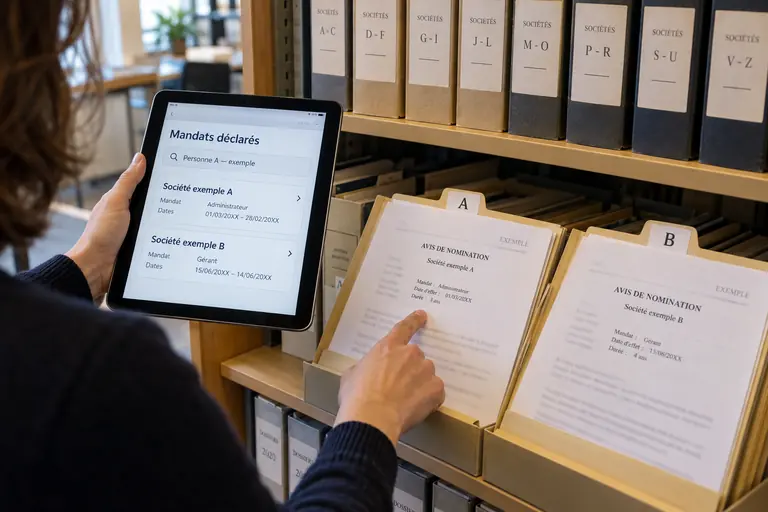
Las Palmas de Gran Canaria commercial register company records are the official file of every business entity whose registered office lies in the island province. A state-appointed registrar, a qualified lawyer, checks each deed before it is entered. Every company receives its own sheet, opened when it is incorporated and updated with later acts such as new directors, capital changes or dissolution. The entries carry legal weight, which is why banks, notaries and suppliers rely on them. They show legal status and representation, not sales, profits or reputation.
Which office covers the island province
The province of Las Palmas groups Gran Canaria with the eastern islands of Lanzarote and Fuerteventura, and the commercial register is organised on a provincial basis. A company belongs to the register that matches the registered office written in its articles, not to the place where its customers or warehouse happen to be. A firm headquartered in Telde or Maspalomas therefore depends on the same system as one in the capital. Because the archipelago has more than one province, a quick check of the registered office avoids wasted requests.
Tenerife, La Palma, La Gomera and El Hierro sit in the other Canarian province, so a business based there will not appear in Las Palmas at all. The address on a deed, invoice or website footer is usually enough to settle the question before any search begins. The office is run by a commercial registrar, who is a civil servant selected by public examination and not a company employee. Documents are written in Spanish, and the rules applied are the same national commercial code and register regulations that govern every Spanish province.
Practical details such as counter hours or electronic filing channels should be confirmed directly with the office. Local gestorías, which are administrative consultancies common across Spain, often act as intermediaries in this province and know which questions the registry staff will ask. Their help is practical for companies dealing from outside the islands, but the registrar's own conclusions, not the intermediary's opinion, are what carry legal effect once a document is issued.
What a company sheet contains
Each limited company or public limited company has an individual sheet that begins with the entry recording its incorporation. That first entry gives the corporate name, registered office, stated purpose, share capital and the identity of the founders. Later entries follow in date order and record appointments, resignations, powers of attorney, increases in capital, mergers and changes of address or name. Reading the sheet from top to bottom matters more than reading the first entry alone. A director who appears in an early entry may have been dismissed later, and a cancellation note shows that a position or act stopped producing effects.
The current picture is therefore the result of all entries combined, which is why a summary note is useful for a first look and a full copy for anything formal. Island economies such as this one are strongly tied to the port, logistics, tourism services, fishing and trade, and many corporate purposes reflect that. The register does not classify firms by sector or rank them, however. It describes one legal entity at a time, so anyone building a list of suppliers or competitors needs other directories and has to search company by company.
Searching by name or tax number
The most reliable route is to search by the exact corporate name or by the company's NIF, the tax identification number that every Spanish entity carries. The Spanish registrars' association runs an online portal where requests can be made for any provincial register, and a lawyer or local gestoría can file the request for clients abroad. Typing a full name with its legal suffix reduces false matches. Similar names are common, and nothing prevents two unrelated firms from sharing a trade name in different provinces.
Comparing the registered office, the founding date and the stated activity helps confirm that the result belongs to the right business. If the company is brand new, the search may come back empty because the deed has been signed but not yet entered. Entities that are not trading companies follow other paths. Associations, foundations and many cooperatives are held in separate registers, so a failed commercial search says nothing definite about them.
Before drawing any conclusion, ask the counterparty what legal form it uses and look in the register that matches that form. Searching by the name of a director is less straightforward. Spanish commercial registers are organised around the company and not around the individual, so the usual method is to start with the entity. Anyone who needs to trace the roles held by a person normally combines the gazette archive, company searches and professional help, within the limits that data protection rules set on that kind of enquiry.
Simple notes and certificates
Two kinds of document are usually requested. The simple note, called nota simple, is an informative summary of the current data on the sheet and is suited to quick checks before a deal. It does not carry the registrar's signature as proof and is not meant to be filed with a court or a tender authority. The certificate is signed by the registrar and attests what the register contains at a given moment. It can cover the whole sheet or one point, such as who holds the power to sign.
Banks, public tenders and legal proceedings ask for it because it has formal evidential value. State clearly what the document is for when ordering, so that the right type is issued. Documents meant for use abroad may need an apostille under the Hague Convention or other legalisation, and often a sworn translation as well. The foreign authority decides which formalities it demands, so asking it first is cheaper than correcting an unusable document later. Always read the issue date, since changes after that date will not appear.
Annual accounts and official announcements
Companies with share capital must deposit approved annual accounts with the register after the shareholders' meeting. The registrar checks that the filing is complete, that the meeting decision is attached and that the form is correct, but does not audit the figures. When an item is missing the filing is suspended until it is fixed. Persistent failure to deposit accounts can lead to the sheet being closed to new entries, which blocks many transactions until the default is cured. For a reader, a long gap in filings is a warning worth following up, though it can have ordinary explanations. Deposited accounts show what the company itself declared and offer a starting point for financial analysis.
The official commercial register gazette, known as BORME, publishes extracts of the main acts such as incorporations, new directors, mergers and dissolutions across all provinces. It is a handy way to follow a company between document requests. It contains summaries only, so the full text of a deed has to be obtained from the register or the notary. Books of minutes and of members are presented to the register to be legalised, which gives them formal standing without validating what was written inside. A legalised minute book therefore shows only that the company submitted it on a certain date. It does not prove that any particular meeting took place or that its decisions were carried out correctly.
Limits and prudent use
A registration proves that a company exists in law. It does not prove that it trades, pays on time or is financially sound. A firm can stay on the register for long periods while dormant, so signs of activity should come from other sources, such as recent accounts, references from trade partners and direct contact. There is also a time lag between a decision and its entry. A new administrator may be acting before the entry appears, and a resignation may not yet be recorded.
For an important contract, ask the company for the deed of the latest change and compare it with a fresh extract obtained shortly before signing. Personal data on the sheet is protected by data rules, and use of it must match a legitimate purpose. Material of this kind is general information and not tailored legal advice; a lawyer, notary or the registrar can answer questions about powers, representation or a specific company's status.
Frequently asked questions
Which register holds a company based in Telde or Maspalomas?
The registered office decides, not the town where staff or customers are found. A company whose articles place its seat in Telde, Maspalomas or the capital falls under the provincial commercial register of Las Palmas. Check the address on a deed or invoice first, because firms on Tenerife and the western islands belong to the other Canarian province.
Can a foreign buyer obtain a company extract remotely?
Yes, in most cases. Requests for a simple note or a certificate can be filed through the registrars' online portal or through a local gestoría or lawyer acting for the client. The foreign recipient may also require an apostille and a translation, so ask that authority which formalities it expects before ordering.
Does a register entry show whether a company is solvent?
No. The sheet records legal facts such as name, office, capital, directors and powers. It says nothing about turnover, profit or payment behaviour. Deposited annual accounts and any insolvency notes add some information, but a credit check or reference from partners is still needed for a judgement on financial strength.