
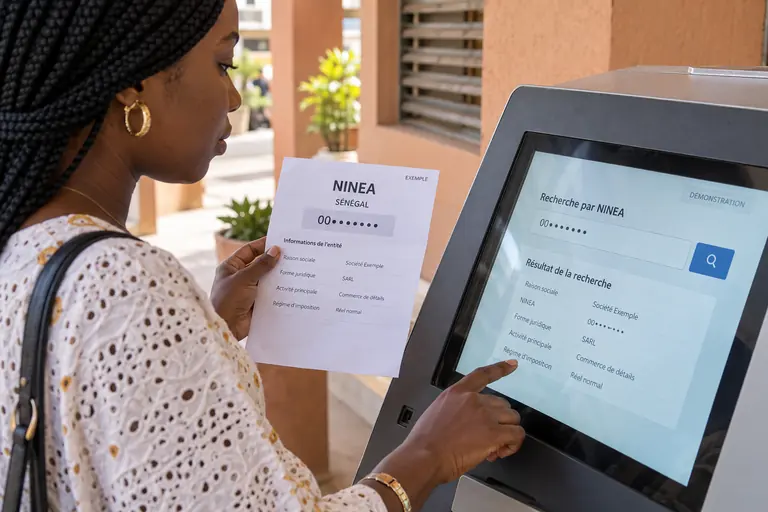
Senegal's NINEA identification number application requirements are the papers and statements an enterprise or association must supply in order to be assigned its national identification number. NINEA stands for national identification number of enterprises and associations, and it is attached to the country's statistical system under the national statistics and demography agency. The number is a reference for administrations, not a substitute for commercial registration. Individual traders, companies, economic interest groupings and associations may all be concerned, and the exact list of papers depends on the structure, its activity and its location.
What the NINEA is and who it concerns
The acronym NINEA means Numéro d'Identification National des Entreprises et Associations. It is managed within the national statistical system and gives every covered unit a stable reference that administrations can use when they recognise a structure and follow its declarations. It is therefore wider than a business tool, because associations and other organisations active in Senegal can hold it as well. Anyone reading a Senegalese document should treat each acronym as a separate piece of evidence.
The number does not replace registration in the commercial register. It plays another role, serving as a common reference between public bodies, so that a firm normally carries several identifiers at once and each answers a different need. Mixing them up is among the most frequent causes of rejected forms and delayed files. Knowing which office issued which number is the quickest way to avoid that trouble.
Sole traders, commercial companies, economic interest groupings and associations can fall within its scope. The exact list of structures required to obtain the number, and the conditions attached, are set by the texts and by the practice of the statistics agency. Before starting, it is sensible to check the position of the specific structure rather than assume that a general rule covers it.
Statistical use is another reason the number exists. Studies of how many enterprises are created or disappear rely on such identifiers, so the number also helps economic planning well beyond the day-to-day paperwork of a single business. Researchers, planners and public bodies draw on these records to understand how the private sector changes over time, which is why every unit is expected to carry a stable reference from its beginning, even a very small one that employs nobody.
How the number fits with other identifiers
Senegal's enterprise identification rests on several building blocks. The register of commerce and personal property security, held at the registry of the competent court, proves the legal existence of a trader or company. The NINEA then sits beside it as a statistical and administrative reference, and the two numbers have different formats and different issuers. In practice, each of these records is requested separately and kept in a different folder.
The tax administration deals with income tax and value added tax, and it uses the identifiers of the business in its returns. Social protection bodies, including pension and social security institutions, register employers as well. Each administration keeps its own procedures, yet the NINEA frequently acts as a bridge between them when they need to match records. Employers who take on staff soon discover how many of these offices must be informed.
Senegal also belongs to OHADA, which harmonises business law among its members. This explains why the commercial register follows a common framework with national touches, while the NINEA remains a purely Senegalese reference. A foreign partner used to a single company number in another country should therefore expect to see more than one number on Senegalese documents. Keeping a short table of each number, its issuer and the date received is a simple safeguard.
Steps for obtaining the number
Most entrepreneurs obtain the number through the national business-creation arrangement. The investment promotion agency runs a one-stop counter that groups several formalities, so a single file can serve procedures that once required visits to separate offices. This organisation saves time, but only if the file is complete when it is first handed over. Founders who arrive with complete papers rarely need to return.
The file usually includes the manager's identity document, the articles of association for a company, proof of the seat and the forms declaring the activity. Which items are needed depends on the legal form, the sector and the place of business. A foreign investor has to add documents about residence or legal status, normally with a translation into French, and should ask the counter which versions are accepted.
Obtaining the number is one step in a longer chain, never the end of the journey. Costs, delays and the way the number is handed over differ according to the route used and can change, so they should be confirmed with the counter or the agency itself. Every paper received along the way should be kept carefully, because later procedures will ask for it.
People who start from the diaspora or from abroad often meet more requirements and more translations. A local notary, accountant or business lawyer can reduce errors in the legal form and in the details of the file, and in the end that support is often cheaper than correcting a rejected application. Professional guidance is not compulsory, yet many founders find it worth the cost.
The link with commercial registration
Commercial registration is held at the registry of the competent court, for example the commercial court in Dakar for the capital. It follows the OHADA forms: a declaration, supporting documents and the issue of a registration number. That number is different from the NINEA and must never be written in the box meant for it. Reading both numbers side by side on a recent invoice shows the difference at once.
A trader who has no NINEA yet may be asked to obtain one before certain operations can be completed. In the opposite direction, holding a NINEA alone does not allow regular trading, because the legal registration required by law is still needed. The two procedures complement each other and are best planned together. Planning them together avoids a situation where one office is waiting for a paper that only the other can supply.
When someone wants to check a company, the sources need to be separated. The register supplies basic legal facts such as form, seat and managers, while the NINEA identifies the structure with the administration. Online availability of data varies and not everything is open to the public, so a registry extract remains the reference for formal proof. Anyone who must give formal evidence to a bank or court should ask for the official extract and treat any website listing as a first hint only.
Companies must publish certain acts in the manner OHADA law prescribes, and later changes such as a new manager are entered through an amending registration. The NINEA normally stays the same during these developments as long as the structure keeps its identity. Once an entity changes its name or legal form, a fresh assessment of its identifiers may be needed, so the manager should ask the competent offices what applies.
Where the number is used
The number is asked for in many moments of a business's life. It is needed when opening a professional bank account, in returns filed with the tax administration and in dealings with social bodies. It also appears on invoices and commercial documents wherever regulations make it compulsory. Anyone setting up a new operation should keep the number to hand from the very first day.
Public contracts and calls for tenders often require proof of identification. A bidder may have to provide certificates that quote the NINEA beside the registration details and the tax and social certificates. A wrong or outdated number can lead to rejection of a bid, so the exact figure should be copied from the official document and not from memory. A short check against the certificate before sending any bid is cheap insurance.
Banks and commercial partners use the number to match what they know about a company with the databases they hold. A manager is therefore wise to check from time to time that the figure printed on letterheads, invoices and contracts is accurate, and to ask the statistics agency for confirmation in case of doubt. This is also why the number should be given identically in every file.
Associations rely on it too, for example when dealing with donors and administrations that require proof of administrative existence. For a non-profit body, the number is a simple way to show that it is known to the system. Such organisations should keep a copy of the certificate with their statutes and minutes, so it can be shown quickly whenever a partner asks for it, and should verify that the name shown on it matches the name used on all their official letters, banking documents and funding agreements.
Common mistakes and sensible precautions
The first confusion is to believe that the NINEA and the registration number are identical. This leads people to write the wrong number in the wrong field, which costs time at checks. Reading the label of every box before copying anything is a small habit that prevents most of these errors. Slowing down for a minute at this point often saves several days later.
A second trap is the middleman who promises a number without following the official route. The steps must be taken with the competent bodies, and any sum requested should be justified in writing. Information on unofficial websites is often old and needs to be cross-checked with an institution before it is relied upon. A reputable adviser will welcome questions about what is being charged and why.
Finally, managers should report important changes, such as a move of the seat or the end of an activity, to the administrations concerned. Holding the number does not protect against a failure to declare, and each administration may ask for updates. This text is general information and does not replace advice from a local professional. Each administration may also have its own deadline, which the manager should note in advance.
Frequently asked questions
What does NINEA stand for in Senegal?
It stands for national identification number of enterprises and associations. The number is part of the national statistical system and is issued through the statistics and demography agency. It identifies businesses and also associations, and it is used by administrations when they follow declarations, though it is separate from commercial registration.
Does the NINEA replace registration in the commercial register?
No. Commercial registration gives a trader or company its legal standing and a register number, whereas the NINEA is an identification reference. A business normally has both. Having only the NINEA does not allow regular commercial activity, and the two numbers must not be confused on forms.
Where do I find the exact list of documents?
The one-stop business-creation counter or the statistics agency can give the current list for your legal form. The documents usually include identity papers, articles of association for companies, proof of the seat and activity forms. Costs and timing change, so ask for a dated, written answer.