
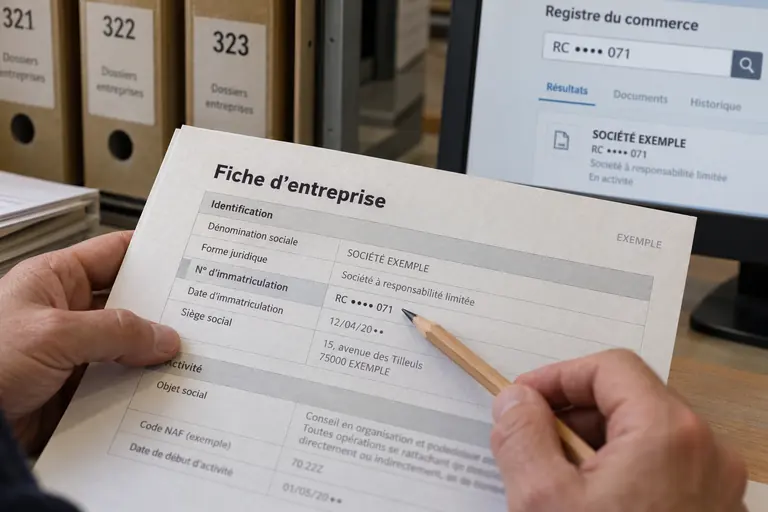
In Morocco, the OMPIC company register extract is the family of copies of commercial register records that can be obtained from the Moroccan trade registry system, in which local registers kept at the commercial courts are complemented by a central register managed by the Moroccan Industrial and Commercial Property Office. An extract states the identity of a merchant or company, its registration number, its legal form, its activity, its address and its managers. It provides the usual proof of legal existence when dealing with banks, customers and public bodies.
Two levels of register
Morocco organises its commercial register on two levels. The local register is kept by the clerk's office of each commercial court, or by the first-instance court where no specialised commercial court exists, and covers the merchants and companies registered in that jurisdiction. Registration begins there, with the clerk checking the application and entering it. Above this sits a central register, maintained by the Moroccan Industrial and Commercial Property Office, usually called OMPIC.
It gathers information from the local registers into a national database, and it also handles related functions such as certificates on company names and intellectual property filings. The central level is what makes nationwide searches possible. For users, the essential point is that the same business may be described by documents from either level. A court extract reflects the local file, whereas an OMPIC document draws on the central database.
Both can be valid, but their form, wording and acceptance by recipients may differ, so it is wise to ask which one is expected. Foreign investors sometimes ask why Morocco keeps two levels instead of a single database. The answer lies in history: the courts were the first custodians of the register, and the central office was added later to modernise access and give the system a national dimension, without removing the role of the clerks who verify and enter each application.
What the court registry issues
The clerk's office issues the extract of the commercial register for the merchant or company registered in its jurisdiction. It reproduces the main entries of the file: name or corporate name, legal form, registered office, activity, capital for companies, the identity of the legal representatives and the registration number. A recent extract is usually requested by banks and contracting authorities. Besides extracts, clerks can provide copies of certain documents deposited with the file, such as the articles of association or a record of an amendment, subject to the applicable rules.
A request for these copies normally needs to specify the document and the date of its filing, so identify those details beforehand if you can. Court registries operate in Arabic, and documents may carry French translations or bilingual presentation depending on practice. Keep this in mind if you need the document for a foreign recipient. A certified translation may be requested, and the court's own stamp and signature are what give the copy its official character.
A merchant who is a natural person is also registered, with a file that shows a trade name, the address of the establishment and the nature of the activity. When you need to deal with a sole trader, the extract is the way to confirm that the person is actually a registered merchant and to see in which jurisdiction the registration was made.
What OMPIC provides
OMPIC offers information services about registered businesses based on the central register. Users can look up an entity, obtain data about its registration and request documents issued in the name of the office. Online services have been developed in recent years, which makes it possible to order certain documents without travelling to a court. The office also issues certificates linked to company names, which entrepreneurs obtain before incorporating in order to secure the chosen denomination. Although such a certificate concerns a name rather than an existing company, it belongs to the same family of documents and is requested through the same institution.
In addition, the common business identifier assigned to enterprises, known as the ICE, appears on many commercial documents and helps match records across administrations. When you hold the ICE and the register number of a business, requests become much easier, because the correct entity can be identified immediately without ambiguity. A further advantage of the central level is cross-checking. When a name is already registered elsewhere, a national database can reveal the conflict, which would be hard to detect from a single court's file. For entrepreneurs, this reduces the risk of building a brand on a name that was already taken in another city.
Choosing the right document
Start from the purpose. A bank account opening, a public tender, a commercial contract, a visa file and a court case may each call for slightly different proofs. Ask the recipient whether it wants an extract of the register from the court, a document from the central register, or a recent certificate stating the absence of entries. Consider also the level of detail.
Some situations require a summary of the current entries, while others, such as a due diligence on a long-established firm, need the history or copies of the underlying deeds. Ordering a complete file when only a summary is needed wastes money, whereas ordering a summary when the deeds are required wastes time. Check the date requirements. Many Moroccan institutions accept only recent extracts, and a copy older than a few months may be rejected.
When in doubt, order a new one rather than reusing an old document, and make sure it carries the date of issue, the stamp and the signature of the issuing authority. Where the purpose is a cross-border contract, ask the foreign partner whether it prefers the extract from the court or the one from the central office, because some partners are familiar with one format and treat the other with suspicion. A short email beforehand usually removes the doubt and prevents a second order.
Consulting and receiving documents
Requests can often be made in person at the clerk's office, through an authorised representative or via the online services of the competent bodies. A person representing a company may need to show the identity card or a mandate. Third parties can usually ask for copies of public entries, in line with the public nature of the register. Allow for administrative steps. Payments are made through the official channels, with receipts that should be kept.
Delivery times depend on the office, the workload and whether the document is issued on the spot or after a check of the file. If you need it for a deadline, ask about timing at the outset. If a document seems to contain an error, ask the issuing office to explain it before using the copy. Mistakes in names, activity or addresses can arise from outdated entries or typographical errors, and it is far easier to have them corrected at the source than to explain the discrepancy to the recipient later.
Using Moroccan register copies abroad
Foreign authorities typically require the extract to be recent, translated and authenticated. For countries party to the apostille convention, a single apostille by the competent Moroccan authority may be sufficient, whereas other destinations expect the longer path through the foreign ministry and the consulate. Always check the rule applied by the destination country. Translation is nearly always needed, since Arabic and French documents may not be accepted as such. Use a sworn translator recognised by the receiving authority, and attach the translation to the original in the way the authority prescribes.
Keep scanned copies of everything, including stamps, so you can reproduce the file if one party asks for it again. Finally, recognise the limits of the document. A register copy confirms registration and declared data, not financial health or the absence of debts. It may not reveal unregistered obligations or disputes. For substantial transactions, add due diligence on taxes, social contributions and pending litigation, and obtain legal advice about what the register can and cannot establish.
Frequently asked questions
Who keeps the commercial register in Morocco?
Local registers are kept by the clerk's offices of the commercial courts, and a central register is maintained by the Moroccan Industrial and Commercial Property Office, OMPIC. Registration starts locally, while the central register gathers the data and supports nationwide information services and related certificates.
Which document should I give a bank or a public buyer?
Ask the recipient. Many institutions accept a recent extract of the commercial register issued by the competent registry, but some specify the origin, the date or an additional certificate. Order the document that matches the stated requirement, and make sure it carries the date, stamp and signature.
Can a Moroccan register extract be used in another country?
Yes, usually after translation and authentication. Depending on the destination, an apostille may be enough, or the document may need to pass through the foreign ministry and the consulate. Confirm with the receiving authority and start early, as translation and legalisation take time.