
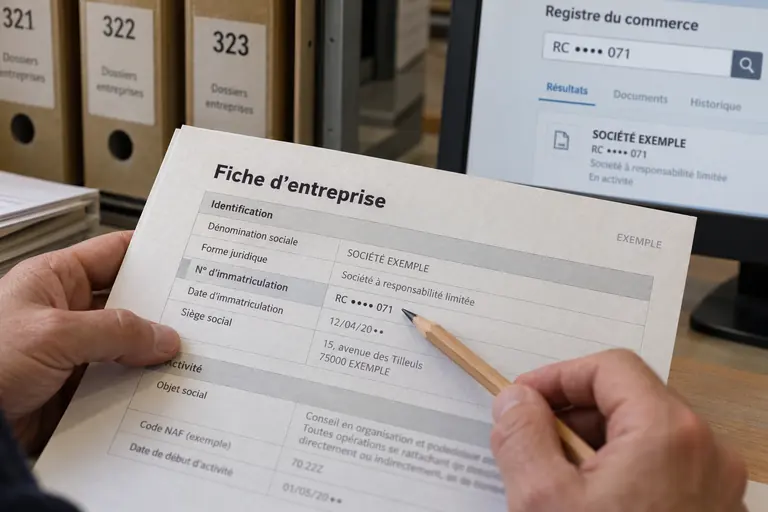
In Lugo, commercial register company records are the public entries that prove a business legally exists in the province: its name, registered address, corporate purpose, administrators and filed accounts. They are kept by the provincial mercantile registry, which a registrar runs and where every document is examined before it is inscribed. Each company has its own registry sheet, to which later changes are added in order. Anyone with a legitimate interest in a transaction may request this information, although private data and facts unrelated to the legal life of the company stay outside the entry.
What a registry sheet in Lugo contains
The registry sheet is the backbone of the file. It opens with the company's exact name, its legal form and the date it acquired legal personality, followed by the registered address and the description of its activity as written in the articles. Subsequent entries record who administers the company, who holds powers of attorney and any change in capital. Reading the sheet from top to bottom therefore tells the story of the company in the order things were formally recorded. Not everything a company does appears there. Day-to-day contracts, supplier invoices and internal disputes are absent, because the register only holds acts the law requires or allows to be inscribed.
A restaurant in Lugo city and a dairy cooperative in the countryside may both be real and busy, yet their trading history would not show in these records at all. Because entries accumulate, an old sheet can look dense. Cancelled acts remain visible so that the sequence of events is clear, and a recent entry replaces an earlier one only in effect, never by erasure. When reading such a sheet, look first for the most recent inscription on the matter you care about, such as the current administrator, and then read backwards if you need to understand how the company arrived there.
Who keeps the file and how the registrar's review works
The mercantile registry serving the province is headed by a registrar, a legally qualified public official who acts on his or her own responsibility. Documents submitted for inscription are examined for legality, and the registrar can reject or return them if they do not comply. This filter is why the information carries more weight than a simple database of declarations compiled by the companies themselves. A returned document is not a verdict on the business. Typical reasons include an inconsistent name, a missing signature, a capital figure that does not match the deed or a clause that conflicts with mandatory rules.
The applicant corrects the defect and presents the paper again, and the process may repeat before the inscription is finally made. Delays of that kind are routine, and they explain why a company can exist in practice for some days before its entry becomes visible. The registrar's role stops at legality. He or she does not audit the business, assess its prospects or vouch for the honesty of its owners. What the entry guarantees is that the formal requirements were met when the act was recorded, and that third parties may rely on what is published. For commercial judgement, the reader must look elsewhere.
Searching with a tax number or a company name
The most reliable way to locate a company is its tax identification number, known in Spain as the NIF. A company number of this kind is unique, so it avoids the confusion that arises with similar names. Companies sharing a surname or a place name are very common in Galicia, and a search by name alone can return several candidates that differ by one word or by the legal-form abbreviation at the end.
If you only have a name, copy it exactly as it appears on the contract or invoice, including abbreviations such as S.L. or S.A. Spelling differences between Galician and Spanish forms of place names can also affect the result, so a second attempt with the alternative spelling is sensible. Compare the registered address and activity with what you expect before deciding that you have found the right entity.
Searching can be done in person at the office, by post or through the electronic services offered through the registrars' professional bodies. Which route is quicker depends on the document you need and on how urgently you need it. Whatever the channel, the information reflects the state of the file on the day it is produced, so ask for it close to the moment when you will act on it.
Informative notes and certificates: choosing the right document
Two documents dominate everyday requests. The simple informative note summarises the content of the sheet and is enough for a preliminary check, such as confirming that a supplier exists and who administers it. It carries no formal evidentiary value on its own and is meant for orientation rather than proof in a legal dispute. The certificate is the stronger option. Issued under the registrar's responsibility, it is the document that a bank, a court, a public body or a foreign counterparty will normally accept as proof of what the register says.
If you are opening an account, bidding for a public contract or closing a significant purchase, ask which of the two the other party actually requires before paying for either. For use abroad, the certificate may need extra formalities such as legalisation or an apostille, and sometimes a sworn translation. Those steps depend on the destination country, so settle the requirements with the receiving institution first. Requesting everything in the wrong order is a frequent source of wasted effort for anyone trading across borders with Spanish companies.
Annual accounts, closed sheets and what they signal
Companies of a capital type must deposit approved annual accounts in the register of their registered address. For a business based in Lugo, the filing joins its file and can be requested separately from the main sheet. The numbers are those the company declared; the registrar checks that the filing is complete and formally correct rather than recalculating the figures. When a company fails to file for a prolonged period, the law foresees that its sheet can be closed to new inscriptions, with limited exceptions.
A closed sheet tells you something useful: the company has neglected a basic legal duty. It does not prove that the business has stopped trading, but it is a reason to look more closely before extending credit or signing a long contract. Accounts also show the shape of a business, such as whether it is a small family firm or a larger operation with many employees. Looking at several consecutive filings, where available, gives a better picture than a single snapshot. Even so, remember that the figures are historical and that small companies may publish abbreviated formats containing fewer details.
Practical limits when you verify a Lugo business
A clean record is not a certificate of good health. It cannot tell you whether the company pays suppliers on time, has pending lawsuits or holds enough cash. For those questions, commercial credit reports, references from other clients and direct conversations are more informative. Treat the register as the formal foundation, then build the rest of your assessment on additional evidence. There is also a gap between reality and registration. A new administrator may have been appointed but not yet inscribed, and a company may have moved without the register reflecting it yet.
If a decision depends on a very recent change, ask the counterparty for the deed and confirm that it has been submitted for inscription. Finally, remember the legal framework for personal data. Names of administrators are part of mercantile publicity, but other information about individuals is restricted. Use what you obtain only for the lawful purpose that justified your request, and consult a lawyer or a local gestor when the transaction is significant or the facts are unclear.
Frequently asked questions
Can I check a Lugo company without visiting an office?
Generally yes. Information from the mercantile registry can be requested by post or through electronic services provided by the registrars, so a trip is not normally necessary. You will need the company's tax number or its exact name. Delivery format and speed depend on the channel you choose, and the document reflects the file as it stands on the day it is issued.
Is the information in the register always up to date?
It is accurate for what has been inscribed, but inscription can lag behind real events. A change of administrator or address may exist in a deed before it appears in the sheet. When timing matters, ask for a document issued shortly before your decision and confirm any very recent change directly with the company.
What if my search finds nothing for a business I know exists?
Check the exact name, the legal-form abbreviation and the province of the registered address, since another registry may hold the file. Also consider that the entity could be a cooperative, association or similar body kept in a different register. A tax number is the most dependable search key when the name yields no result.