
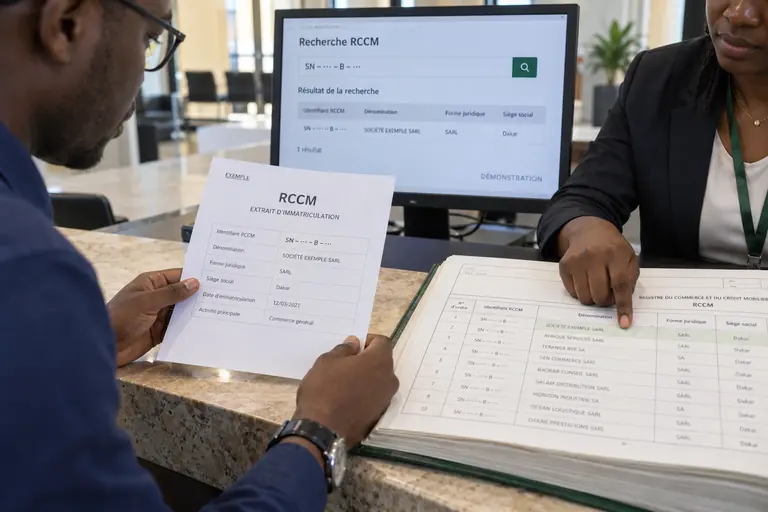
In Ivory Coast, a commercial register RCCM extract application is a request addressed to the registry that keeps the entry of a trader or company, asking for an official copy of the particulars recorded on a given date. The extract states the business name, legal form, address, activity, persons empowered to act and registration number. Banks, public buyers and foreign partners treat it as the identity card of a business. It describes a legal registration and nothing else: it says nothing about profits, debts or the quality of the firm's work.
What the extract shows and why people ask for it
The register of commerce and personal property security, known by its French acronym RCCM, lists traders, companies and certain security interests over movable assets. An extract reproduces, as at the day it is issued, the useful details about one registered entity. It is the document that most business partners ask for first when they need to confirm that a firm really exists. Lawyers and bankers in the region use the same habit when they screen a new counterparty.
Requests arise in many situations: opening a bank account, joining a tender, signing a distribution agreement, applying for an approval or dealing with an overseas supplier. A partner hesitating to work with an Ivorian company almost always starts with this paper, because it establishes that the business is officially registered. A recent copy gives much stronger comfort than a photocopy that someone happens to have in a drawer.
The document has limits that readers should keep in mind. It tells nothing about the financial health of the company or about its contracts. To evaluate risk, other information such as annual accounts or trade references is needed, so the extract should be treated as one piece of evidence in a wider check. Reading the extract alongside financial statements gives a far more balanced view of the business.
The OHADA background
Ivory Coast is part of the organisation for the harmonisation of business law in Africa, known as OHADA. General commercial law is governed by a uniform act that organises the register of commerce and personal property security, so the Ivorian register follows rules close to those of the other member countries. That similarity makes extracts easier to read abroad. Readers who know registers elsewhere in the zone will find the layout familiar.
The system envisages three levels of files: a local file kept at the court, a national file gathering the entries of the country and a regional file placed with the common court of justice and arbitration, whose seat is in Abidjan. This structure aims to centralise information across the whole OHADA area. Entries made locally therefore feed into a wider system, even if the applicant only ever sees the local copy.
Harmonisation explains why an Ivorian extract can be understood in other member states, but it does not remove national particularities. Application forms, charges and processing times are still set at country level. Texts of reference and the uniform acts are published by the organisation, and a reader can consult them to understand the general frame. Differences in practice, such as the forms used or the speed of service, remain worth asking about at the counter.
The registry of Abidjan and other courts
The register is kept by the registries of the competent courts. In Abidjan, the registry of the commercial court receives registrations and delivers extracts for entities within its area. In other towns, local courts carry out the same task, according to the judicial organisation of the country. The business address on the extract usually shows which court registry is competent.
Procedures described by formality-simplification websites show several stages at the registry, including the purchase of an application form and the lodging of the file. These precede the issue of the RCCM number that will appear on every extract. The administrative body in charge of these formalities describes the services involved on its own pages. Founders can therefore compare those descriptions with the information given at the counter, and favour the latter whenever the two differ.
To obtain an extract in Abidjan, then, the request goes to the registry of the place where the business is registered. A request lodged with the wrong court will be refused or redirected. When the registration number is known, it makes it much easier to retrieve the right file and to avoid confusion between businesses with similar names. Asking a clerk to repeat the number back to you is a simple way to catch a transcription error before the search begins.
Preparing the request
Applicants should gather the exact name of the business, its registration number if they have it and, if possible, its address. Someone acting for the business should carry proof of identity and, where relevant, written authority to act. A third party who is not the registered person may be asked to explain the purpose of the request. Entrepreneurs can save time by phoning ahead to ask which of these papers the registry will actually check.
The number of copies is worth thinking about. Banks, tender committees and administrations often keep the extract they receive, so several copies may be useful. Many recipients refuse an old extract, which is why a document issued recently is safer for any important operation. A short list of recipients, written down before the request, helps decide how many copies to order and avoids a second visit within days.
Fees, delays and whether an online request is possible depend on the registry and may change. They should be confirmed locally before travelling. If the request is made on behalf of a foreign client, the representative should ask in advance about the language of the document and about any legalisation needed abroad. Anyone acting from abroad should also ask whether a local agent can collect the document, and under what written authority.
Using the extract abroad
A foreign bank, a customs office or a partner may ask for the extract to be certified, translated or apostilled. Whether that step is needed depends on the country that receives it and on the use planned. The destination authority is the best source for its own requirements. Each of these steps may be handled by a different office, so allow for the time involved.
If a translation is needed, it is usually made by a sworn translator, who attaches the translation to the original or to a certified copy. The extract's issue date matters here as well, because the receiving party may count from that date when deciding whether the document is recent enough. Keeping the original and sending only copies is usually safer when the next office requests the paper by post, since a lost original must be reissued and may cost time.
Businesses that deal regularly with partners abroad often order several extracts at once and keep them in a dedicated file. This habit saves time when an opportunity appears at short notice. It does not remove the need to check the validity period each time a document is reused. A short email to the receiving authority, asking what exactly it wants, is often the quickest way to be sure.
Common slips and sensible precautions
One common slip is to ask for the extract of the wrong entity, for example a company with a similar name or a former legal form. The registration number resolves most such doubts. A second is to rely on an extract that is no longer current, since entries change when a manager is replaced or the seat moves. Seemingly small details such as a transposed digit can lead a bank to reject the document.
A further precaution concerns the quality of what one is given. The extract should be read in full, including the date, the stamp and the list of persons empowered, and any discrepancy should be raised with the registry immediately. Unofficial websites that display company data should be treated as leads, never as proof. Registry staff are generally able to correct clerical mistakes if they are told promptly and the applicant brings evidence of the right details.
General information of this kind cannot cover every case. Rules and practices change, and some services move online. For a specific operation, the registry or an Ivorian lawyer, notary or accountant will confirm what is required, and a dated note of the answer is worth keeping with the file. Keeping the answers together with the extract itself provides a clear trail if a question arises later.
Frequently asked questions
What details appear on an RCCM extract?
It generally shows the business name, legal form, address, activity, the persons empowered to act and the registration number, as recorded on the day of issue. It is a legal snapshot. It says nothing about turnover, profits or debts, so it should be combined with other checks when assessing risk.
Where should I ask for the extract?
At the registry of the court where the business is registered. In Abidjan this is the registry of the commercial court, and in other towns the local court. A request to the wrong court is refused or redirected, so quote the registration number whenever you have it.
Do I need a recent extract for a bank or tender?
Usually yes. Many recipients reject an old extract, and the issue date is the first thing they check. Ask the institution how recent the document must be, and request a new copy shortly before the operation instead of reusing one kept in a drawer.