
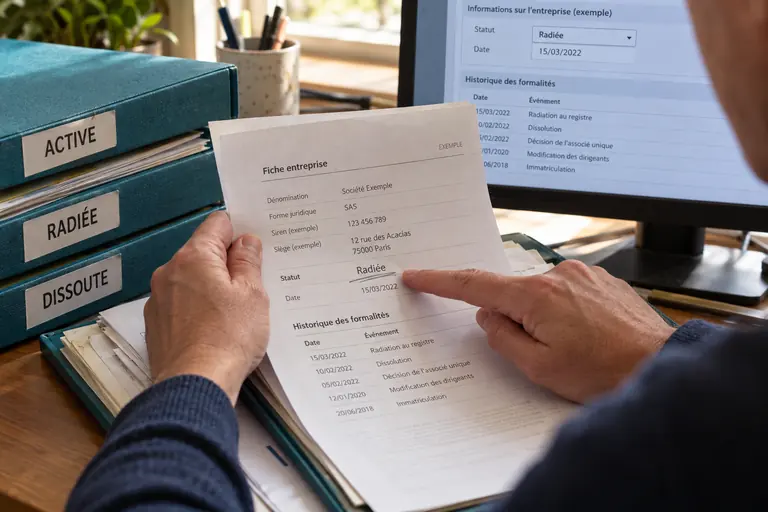
Lleida commercial register company records form the official, public account of every business inscribed in that Catalan province. The mercantile registry keeps them, and a registrar reviews each deed before recording it. A typical file shows the company's name, its legal form, the registered address, the corporate purpose, the people who administer it and the accounts it has deposited. The aim is legal certainty for anyone dealing with the firm, from banks and suppliers to customers and public bodies, without exposing details that belong to private life.
A province of farms, fruit and food processing
Lleida is known as one of Spain's major agricultural areas, with fruit orchards, irrigated crops, livestock and a food industry built around them. Many businesses in the province are therefore farming companies, cooperatives, packing houses and transport firms, alongside the services found in any provincial capital. Knowing this background helps to interpret what you see when you open a company file. A farming business may have several legal shapes. Some operate as limited companies, others as cooperatives or as agrarian bodies that are recorded in specialised registers rather than the mercantile one.
If a search for a farm-related name returns nothing, the entity may simply be kept elsewhere, which is not a sign that it does not exist. Seasonal rhythms matter too. A company that hires heavily at harvest time will have a very different profile on paper than in the field, and the register shows the legal skeleton rather than the workforce. For that reason the file is best used to confirm identity and authority, while commercial reality is checked through visits, references and trading history. Fruit-growing communities in the Segrià and Pla d'Urgell areas often rely on family companies that pass from one generation to the next, and the register keeps a faithful trail of each handover.
Catalan and Castilian in the same record
Catalan is a co-official language in Catalonia, and documents of companies in Lleida may use Catalan, Spanish or both. Company names, street names and municipalities often appear in their Catalan forms, so a search that uses only the Spanish spelling, such as Lérida, can miss a file or return confusing results. Trying both spellings is a simple precaution. Deeds can be drafted in either language, and the registrar is able to deal with both.
If you need a document for use outside Spain, you may want to ask which version is issued and whether a translation will be required by the receiving authority. Foreign banks and courts often ask for a sworn translation regardless of which Spanish language the original uses. Pay attention to legal-form abbreviations as well. The Catalan versions of certain terms differ from the Spanish ones, and the same company might be written slightly differently in two documents.
Match the tax number and registered address, not only the visible name, before concluding that two documents refer to different businesses. A practical example shows why this matters. A Swiss importer who receives an invoice from a fruit exporter in Lleida may see the company name written in Catalan on the invoice and in Spanish on the contract, and without the tax number it would be hard to be sure that both refer to the same entity. Matching the identifier settles the question in a minute.
Requesting a note or certificate for a Lleida company
The registry issues two main documents. A simple informative note summarises the sheet and is suitable when you want to see who administers a company or confirm its address. A certificate is a formal statement issued under the registrar's responsibility, intended for situations in which you must prove the content of the register to a third party. Requests can be made in person, by post or electronically through registrars' services. The tax number is the quickest way to point to the right company, and the exact name serves as a fallback.
Fees depend on the document and channel, so ask for the current scale instead of assuming that two documents cost the same. Remember that the paper describes the situation on the day of issue. If you plan to sign a loan, buy shares or award a contract, request the document close to that date and keep it with the transaction file. A note obtained long before can miss recent appointments, resignations or changes of address. If the buyer is a foreign wholesaler, a certificate showing the administrator and the corporate purpose is often what a bank abroad expects before it releases a payment.
Founding, changing and closing a company in the province
A new capital company starts with a name certificate from the central registry in Madrid, followed by a notarial deed and then inscription at the provincial register. Only after that step does the company acquire full legal personality. Simplified electronic procedures exist for certain limited companies, but their conditions change, so check the current requirements before relying on them. Later amendments follow a similar path. A change of corporate purpose, capital, registered address or administrators generally requires a public deed and a fresh inscription. When a Lleida company moves to another province, more than one registry is involved and the file travels with the company, which can create a short period where information seems incomplete.
Winding up is recorded too. The sheet can show dissolution, liquidation and finally cancellation, each marking a stage in the end of the company. Seeing a company in liquidation tells you it is no longer pursuing normal business, which matters when you are about to accept an order or release goods on credit. Entrepreneurs who relocate from Barcelona or Girona sometimes bring an existing company with them. In that case the sheet shows the earlier address, the transfer and the new registry, so a reader can follow the company's journey and understand why part of its history is documented elsewhere in Catalonia.
Annual accounts and how far they can be trusted
Capital companies deposit their approved accounts in the registry of their registered address. The deposit makes balance sheets and profit-and-loss statements available to those who ask, and it is one of the few ways to see actual figures for a private business. The registrar checks form and completeness, not the underlying accounting. Failure to deposit has consequences. After a prolonged omission the sheet may be closed to new inscriptions apart from limited exceptions, which can hinder the company from registering appointments or changes. If you see this on a Lleida business, ask management why, because the reasons range from simple negligence to genuine trouble.
When comparing accounts across several periods, use the same format and keep in mind that small companies may file shortened statements. A sudden jump in assets or a collapse in equity deserves an explanation. The records give you the questions to ask, and the answers should come from the company and from independent advice. A cooperative that sells fruit under a shared brand may own a subsidiary company for packing or export, and that subsidiary will have its own file with separate accounts, administrators and registered address.
Good habits for due diligence on Catalan companies
Start with identity: tax number, exact name, legal form and address. Then confirm authority, meaning who can sign on behalf of the company and whether they act alone or jointly. Many disputes arise because a person who signed did not actually hold sufficient powers, and the register is the place where those powers are published. Next, consider what lies outside the register. Debts to suppliers, tax matters, labour claims and informal arrangements will not appear. Combine the registry paper with a credit report and, for property, with the property registry, which is a separate institution with its own rules.
Lastly, keep copies and note the date of each document. If a dispute arises later, being able to show what the register stated at the time you relied on it is valuable. For complex or high-value operations, a Catalan lawyer or gestor can interpret the findings and warn about specific local or sectoral points. Whenever the transaction is large, ask the other side for the deed that created the company and compare its wording with the entry before signing anything.
Frequently asked questions
Do I need to search in Catalan to find a Lleida company?
Not necessarily, but both spellings help. Names and places can be written in Catalan or Spanish, so Lleida and Lérida may behave differently in a search. Using the tax number avoids the issue entirely, since it is the same regardless of language. If you only have a name, copy it exactly from the contract.
Will the register tell me if a company can pay its debts?
No. It confirms legal existence, administrators, address and deposited accounts, but it does not assess solvency or payment behaviour. For that, combine the accounts with a credit report, trade references and the company's own explanations. A lawyer or financial adviser can help interpret the combined evidence when the amounts involved are large.
Which document should I order for a foreign counterparty?
Usually the certificate, because it is issued under the registrar's responsibility. Ask the counterparty whether legalisation, an apostille or a sworn translation is also needed. Requirements vary between countries, so settling them first prevents ordering the wrong paper and repeating the process.