
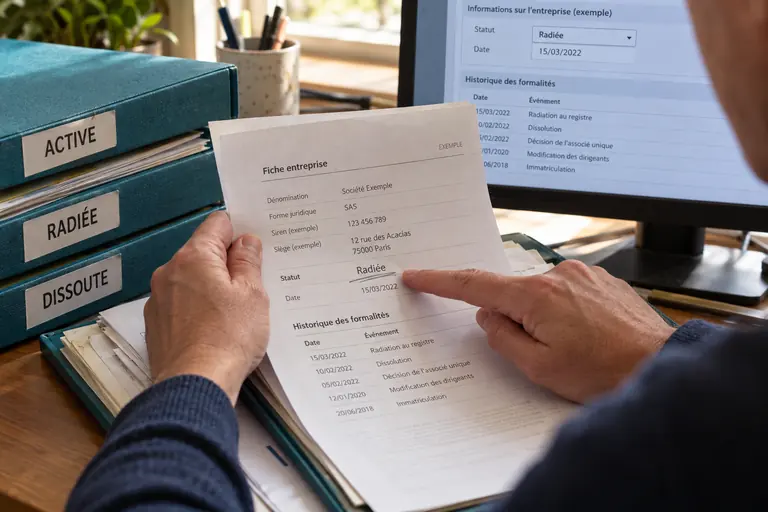
Morocco's commercial register amendments and deregistration are the two formalities that keep an entry truthful after it has been made. An amendment records a change in a registered fact, such as the seat, the manager, the activity or the capital, so that the entry matches reality. Deregistration ends the entry when a trader stops trading or a company has been dissolved and liquidated. Both are declared at the court registry, which updates the local and central records and so lets third parties rely on what they read.
A register kept at two levels
The commercial register in Morocco is kept locally by the registry of the commercial court or of the court of first instance with jurisdiction. The data are then gathered in the central commercial register, managed by the national industrial and commercial property office, abbreviated OMPIC. Because of this double structure, one formality concerns both the registry of the place where the seat lies and the national file.
Every trader, whether an individual or a company, must in principle be registered. The record of a company includes its name, seat, legal form, purpose, capital and managers, and it produces a registration number that follows the business through most dealings with administrations and partners. Amendments and deregistration are the later chapters of that same record.
The framework for creation, change and closure is set by the Commercial Code and by the legislation on companies. Details of documents and procedures can change, particularly as some services move online, so the current list should be confirmed with the registry or the regional investment centre before filing. The register remains the common checkpoint through which all businesses in the country pass.
Foreign owners of Moroccan companies are in the same position as local ones. A parent company abroad that wants to replace its representative, or change the name of its subsidiary after a merger, must go through the same registry and supply documents from its home country, often with translation. Planning these steps early avoids a gap between the corporate decision abroad and the registered situation.
Changes that call for an amendment
An amending entry becomes necessary as soon as a registered fact ceases to be accurate. The most frequent cases are the transfer of the seat, a change of name, an extension or change of corporate purpose and the appointment of a new manager. Capital increases or reductions, transfers of shares and a change of legal form belong to the same group, and each should be reflected so that it can be set against third parties.
For a company, the decision to change is first taken by the partners or shareholders under the rules in the articles. Amended articles or the relevant minutes are drawn up, registered and, where required, published in a legal announcements newspaper. The amending entry follows those steps, because its role is to record a change that has already been decided, not to create it.
An individual trader follows a simpler logic but must also declare a new address or a new activity. The declaration should be consistent with tax and social security records, for example those of the business tax and of the national social security fund. Legal time limits for declaring changes exist, and the exact period should be confirmed with the registry. A late filing can create practical problems.
Public bodies and banks often discover discrepancies only when they run a check. A company whose register entry still names a former manager may find that a bank refuses to accept a signature, or that a tender is rejected. Keeping the entry current is therefore less a bureaucratic ritual than a way of staying able to sign contracts.
Documents and people involved in an amendment
The amendment file usually includes a signed request, a copy of the manager's identity document and proof of the new seat if the address changes. Corporate documents supporting the change are added, such as the minutes of a meeting or a deed of transfer of shares. Depending on the operation, a notary, a lawyer or an accountant may draft or certify these acts.
Regional investment centres serve as a counter for many company formalities. Their role covers chiefly creation and certain amendments, although the exact scope varies with the type of formality. When in doubt, the court registry of the seat gives the definitive answer, so a call or a visit before assembling the file is a sensible investment of time.
Documents in Arabic or French are accepted in practice, but a foreign document often needs a translation. A foreign partner may supply a passport in place of a national identity card. Registration and registry charges depend on the act concerned and should be confirmed with each administration. The registry may also ask for supplementary papers, depending on the particular file.
Practical sequencing matters when several changes happen at once. A company that moves its seat, changes its manager and increases its capital in the same quarter should list the events, decide the order of the corporate acts and ask the registry whether the changes can be combined in one filing. Combining them correctly can reduce visits and keep the supporting papers coherent.
Ending an entry: when deregistration happens
Deregistration occurs when a trader stops trading, when a company is dissolved and liquidated, or when a transformation makes the old entry pointless. For an individual, it follows a declaration of cessation and the settlement of tax and social security matters. The death of a trader opens a specific procedure handled by the heirs, who must supply the relevant civil status documents.
A company does not vanish from the register overnight. The partners decide on dissolution, or a court orders it in the cases foreseen by law, and a liquidator is appointed to close the accounts. At the end of the liquidation, the approval of the accounts and the discharge of the liquidator allow the request for deregistration to be made.
Some deregistrations occur by the registry's own initiative, for instance when it finds that an entry no longer corresponds to a real activity. In insolvency cases the procedure takes place before the commercial court under its own rules. Whether voluntary or forced, the removal is a formal operation recorded in the file, and the date shown on the register marks the end of the registration.
Heirs of a deceased sole trader face a particular situation. They may wish to continue the business, sell it or close it, and each route requires its own formalities. Because the register must reflect who now operates the business, they should consult the registry and a legal adviser before trading under the former owner's entry, which could otherwise cause disputes.
Settling obligations first and checking the result
Before a deregistration, the business should put its administrative affairs in order. That means declaring the cessation to the tax administration, regularising social contributions and ending employment contracts and leases still running. The common company identifier, used for dealings with administrations, remains linked to the history of the entity. A request filed with open obligations risks being delayed or challenged.
Creditors keep their rights after the decision to stop. A manager cannot use deregistration to escape debts, since the liability of partners and liquidators continues to be assessed under the law, and accounting books and documents must be kept for the period the legislation prescribes. A transferred or leased business also needs its own entries, because it changes hands without disappearing.
After an amendment or deregistration, ask for an extract to confirm that the change was taken into account. It shows the legal situation on the date of issue and serves with banks, partners and authorities. Access to data varies, and some details about managers or partners are protected. Private information platforms do not replace an official extract.
Frequently asked questions
Must every change be declared at the register?
Any change in a registered fact should be reflected in the entry, including a new seat, name, manager, purpose, capital or legal form. Legal time limits apply, and the exact period should be checked with the court registry. Keeping the entry accurate prevents refusals by banks and difficulties in tenders and contracts.
Does deregistration cancel a company's debts?
No. Deregistration records that the business no longer operates under that entry, but creditors keep their rights, and the liability of partners and liquidators is still assessed under the law. A company normally has to be dissolved and liquidated before deregistration can be requested, and books must still be kept.
How do I confirm that the register was updated?
Ask for an extract after the formality. It shows the legal situation as of the date of issue, so you can see whether the new address, manager or closure appears. If it does not, return to the court registry with your receipt. Official extracts carry more weight than private databases.