
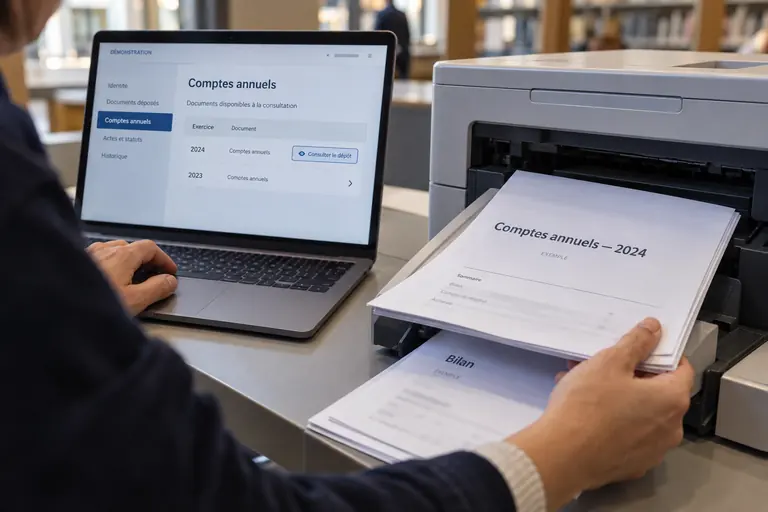
The company register annual accounts filing receipt is the acknowledgement a registry gives when a company submits its yearly financial statements. It normally shows the company's name, the financial year concerned, the date and often the time of receipt, and a reference number for the file. It proves that the submission arrived, not that the registry has accepted it. Examination can follow, and a file may be returned with comments. Prudent companies therefore keep the receipt next to the approved accounts and, later, the document confirming final deposit.
What the receipt records and what it leaves out
A filing receipt answers a narrow question: did the registry get the file, and when? It usually carries the company's name and identifier, the period covered by the accounts, the moment of receipt and a reference by which the case can be traced. With those details, a company can ask the registry about the status of its submission without having to describe it from memory.
The receipt is not the outcome of the procedure. In many systems the registrar or an examiner reviews the file after receipt and may accept it, query it or reject it. The initial acknowledgement only shows that the company acted by a given date. The legal duty to file is considered fulfilled once the registry actually completes the operation, which may happen later.
A good receipt can be read without technical help. The company name, the reference and the date must be legible, and if a detail is missing it is better to request a complete version from the registry or from the person who filed, before archiving the incomplete one. Rebuilding those facts years later, when a bank or auditor asks for them, is much harder than correcting the document today.
Time zones and cut-off hours deserve a word. A submission sent late in the evening on the last day may be stamped with the following day if the registry applies a daily cut-off or a different time zone. The receipt is the only neutral evidence of what the system recorded, so it should be read closely whenever a filing falls close to a statutory limit and the company later has to defend its punctuality.
When the acknowledgement is produced
Electronic submission is now the usual route, and the system typically returns a confirmation immediately. In the United Kingdom, filings made through the online service of the registrar of companies generate an acknowledgement and later an acceptance or rejection message. In Germany, annual financial statements are transmitted for publication through the federal electronic platform, which sends its own confirmation of receipt to the sender.
Paper filing still exists in some countries and for some company types. In that case the receipt may be a stamped copy, a postal acknowledgement or a document handed over at the counter. The format varies by office, which is why it is useful to ask at the time of delivery what the company will receive and when. A missing paper trail is hard to repair.
Where an accountant, lawyer or filing agent submits on the company's behalf, the confirmation goes first to the submitter. The company should ask for it at once and not wait until a deadline problem appears. If a reasonable period passes with no acknowledgement, nobody should assume that the filing succeeded; the sensible step is to contact the registry, quoting the company name, identifier and financial year.
Group companies add a layer of complexity. A parent may coordinate the filing of accounts for a dozen subsidiaries in several jurisdictions, each with its own portal and its own style of acknowledgement. A central tracker listing the entity, the financial year, the date of submission and the reference number gives management a quick view of which receipts have arrived and which are still outstanding.
Saving the proof in a way that stands up later
The electronic receipt is usually available as a download from the portal or software used for submission. Some carry a verification code or a digital signature, which lets a third party confirm authenticity on the issuer's portal. That feature protects against altered copies and against screenshots with no evidentiary value, so the original file should be preserved in its native format, not just a picture of it.
Many accounting departments store receipts in a shared digital folder with restricted permissions and a backup. Naming files with the company and the financial year makes them findable years afterwards. Where accounts concern several group entities, a simple naming convention across the group saves effort during audits, due diligence and bank reviews, when a stack of documents must be assembled quickly.
In companies with several directors, one person should be responsible for the accounting and corporate archive. That person keeps the receipt for each year, a backup copy and the correspondence with the registry. This way the evidence does not depend on a personal mailbox or on software that may no longer be used when the question arises. Retention periods are set by national law and should be checked locally.
From receipt to proof of deposit
Once the registry has examined the file, it may issue a further document, such as a confirmation of deposit, a notice of acceptance or an updated extract, showing that the accounts are on the public record. This later document is stronger than the first acknowledgement, because it confirms the result. Institutions that ask for evidence of compliance usually mean this version rather than the first receipt.
Documents carrying secure verification codes can be validated on the sites of the bodies that issue them. A registry may offer a function that lets the recipient enter the code and compare the document with the original. Before sending a receipt to a bank or a tender authority, it is reasonable to test that the code works, since a document that cannot be verified invites questions.
Each document has a different reach. The receipt proves entry, a defect notice explains what is missing, and the deposit confirmation proves the outcome. Supplying one when another is needed can delay credit decisions, audits or bids, where the recipient reads documentation closely. Matching the proof to the question is a simple discipline that prevents repeated requests.
Auditors and acquirers read these papers with a particular purpose. They compare the date of the receipt with the statutory timetable, check that the filed accounts match the approved version and look for any query raised by the registry. A clean sequence of receipt, acceptance and deposit confirmation shows discipline, whereas gaps in the sequence prompt further questions and can slow a transaction.
Missing receipts, defects and common uses
If no receipt arrives, the first step is to check the spam folder, the notifications area of the filing portal and the private account used to submit. Sometimes the document is available but no alert was sent. Failing that, the company should contact the registry or the person who filed. It is unwise to resubmit the full file before understanding why nothing came back, as duplicates complicate the record.
When the registry points out defects, a deadline to correct them normally runs from the notification. The company responds with the corrected document or the requested explanation and keeps the new acknowledgement. Frequent causes include figures in the accounts that do not match the supporting resolution, a missing auditor's report where one is required, invalid signatures and files that cannot be opened.
Lenders, grant bodies and procurement authorities often ask for evidence that accounts are up to date. Directors and shareholders may need the same proof when a director changes, shares are sold or due diligence takes place. An organised archive saves time and argument. This text is general information, rules differ among countries, and individual cases call for professional advice or for the registry's own guidance.
Companies that outsource bookkeeping should write the duty into the service agreement. The contract can state who files, by what date, in what format and who delivers the receipt to the directors. Without such clarity, responsibility is blurred, and a missed deadline or an unnoticed rejection may surface only when a penalty notice or a bank query arrives.
Frequently asked questions
Does the receipt prove that my accounts have been accepted?
No. It proves that the registry received the file at a given moment. Examination comes afterwards, and the registry may accept the filing, ask for corrections or refuse it. For proof of the result, request the confirmation of deposit or an updated extract, whichever document the local registry issues once processing is complete.
Where should I keep the receipt?
Keep the original electronic file, not only a screenshot, in a secure shared folder with a backup, and name it with the company and the financial year. Store it next to the approved accounts and the resolution approving them. This makes it easy to find when auditors, banks or buyers ask.
What should I do if no receipt arrives after filing?
Do not assume the filing succeeded. Check your email, the portal's notification area and the account used for submission, then contact the person who filed. If it is still missing, ask the registry whether the filing was entered, quoting the company name, identifier and financial year.