
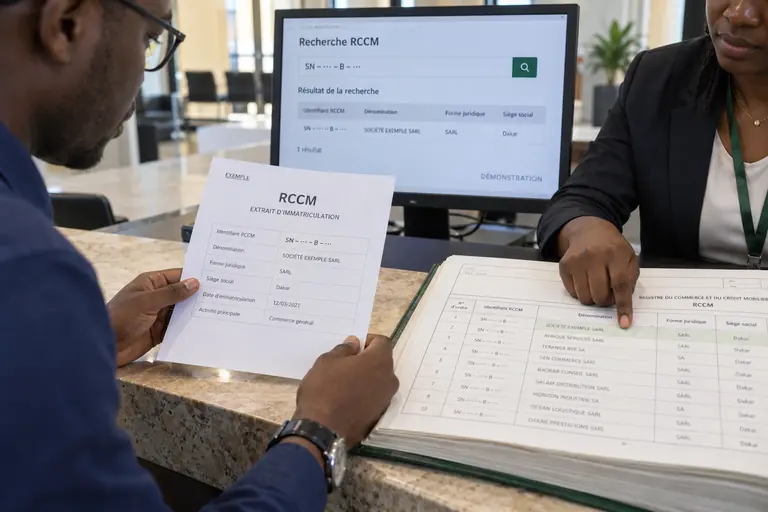
Senegal's commercial register RCCM registration is the legal step through which a trader, a company or a branch of a foreign firm becomes officially known as carrying on business. The register belongs to the OHADA family of national files and is kept by the court registry that covers the business address. Each entry receives a unique number that appears on extracts and contracts. For a company, registration also brings legal personality, while for the public it creates a reliable record of who the business is, where it sits and who may act for it.
A register shared with other OHADA states
The RCCM is the French abbreviation for the register of commerce and personal property security. Senegal belongs to OHADA, the organisation that harmonises business law across many African states, so its register follows common rules on who must register, what the entry says and what effects it has. National practice then fills in the details, such as which office receives the file.
The register does three jobs at once. It proves that a trader or company legally exists, it informs third parties about the business, and it records certain security interests over movable assets, which explains the words credit mobilier in its name. Registration therefore matters to the business itself and to everybody who deals with it. Lenders in particular rely on that last function when they take a pledge over equipment or stock.
A national file sits alongside a regional file that gathers data from member states. That link helps businesses be recognised across borders, but it does not remove the responsibility of each national registry office for its own entries. A reader checking a Senegalese firm should still expect the local record to be the starting point. Both levels draw on the same rules, so an entry made in Senegal can be understood by a partner elsewhere in the zone.
Working out your own legal position first
The file depends entirely on who is applying. An individual trader registers in his or her own name, a company registers once it has been formed, and a foreign business opening a presence files as a branch. Each of these situations calls for different papers and different statements, so the first task is to decide which one applies. Noting down the answer before opening any form saves a good deal of rework.
OHADA law also knows the entreprenant, a small individual operator who makes a lighter declaration of activity. That status should not be confused with ordinary registration as a trader, and its tax and social treatment follows rules of its own. Choosing between the two routes is worth doing deliberately, because a start-up that outgrows the light regime has to change status later.
The type of activity matters too. Regulated sectors such as health, private education, banking or transport need an approval from the sector authority, and without it the registration may be delayed or refused. Gathering these authorisations early prevents a file from stalling at the registry desk. A founder who is unsure whether the planned activity is regulated should ask the sector ministry before approaching the registry, and keep any written reply with the other papers.
What goes into the file
For an individual, the file generally contains proof of identity, a criminal record extract, evidence of the place of business and a registration declaration completed on the registry form. A company adds its articles of association, the list of managers, their identity documents and sworn statements that they have not been convicted of barred offences. The registrar checks each item before entering anything.
The declaration itself states who the operator is, the business name, the activity, the address, the starting date and the legal form. Everything in it has to agree with the articles and the supporting papers. A mismatch between two documents is one of the commonest reasons for a request to correct the file, and it can add days to the process. It is a good habit to read every document aloud against the declaration before depositing the file.
Charges, stamps and processing times are set by legislation and by registry practice, and they change. They should be taken from the registry or the one-stop desk and not from old documents. Every payment should produce a receipt, which belongs in the permanent folder of the business together with the stamped copies. Original documents should be kept safely, while copies travel with the application.
One-stop help and related identifiers
Senegal has a business-creation counter attached to the investment promotion agency, which brings several administrations together in one place. It guides founders, gathers the files and smooths the sequence of registrations. The Dakar chamber of commerce, industry and agriculture also offers help with company formalities. These services prepare the way for registration and do not replace it. Founders from abroad often find this single entry point the easiest place to start.
Beyond the RCCM, a new business receives the NINEA, the national identification number for enterprises and associations, which comes from the national statistics agency. It also registers with the tax administration and, when it hires staff, with the social security and pension institutions. Each body keeps its own procedures and its own number. Where the founders are foreign, the immigration and employment rules for non-resident managers should be checked in parallel.
Together these identifiers form a coherent set. The register proves legal existence, the NINEA is an administrative and statistical reference and the tax number governs filing duties. Treating them as interchangeable is a frequent mistake, and it is avoided by remembering that different offices issue them for different purposes. Writing each number down once, next to the name of the issuing body, prevents the mix-ups that tend to occur when forms are filled in quickly.
Dakar and the regional registry offices
In Dakar, the commercial court holds a large share of registrations because of the capital's economic weight. In other regions, the registry of the competent court receives the application. The right office is normally the one covering the registered seat or the main establishment, so the address given in the articles decides where the file goes. A company with several establishments should be especially careful to state the seat in the same wording everywhere.
The registrar maintains the register under the supervision of a judge appointed for that purpose. The registrar checks that the file is formally correct but does not judge whether the project makes economic sense. Where a dispute arises over what an entry says, the judge decides, and the registrar acts on that decision. Neither the registrar nor the judge gives business advice, so planning remains with the founders and their advisers.
French is the working language of the administration, so documents drawn up abroad usually have to be accompanied by a sworn translation. Practical matters such as reception hours or the way queues are managed vary from one registry to the next and can change without notice, which is why a visit or a phone call beforehand is worth the effort. A short call to confirm the exact documents saves a wasted trip.
What registration gives you and how to keep it accurate
Once registration is complete, the registry issues an extract or certificate showing the registration number. Banks, public buyers and many commercial partners ask for it. Under OHADA law, registration also creates a presumption that the person is a trader, and for a company it confers legal personality, which changes the nature of its commitments compared with acts made before registration. Keeping a recent extract on file speeds up bank and tender requests, because many recipients refuse older ones.
Third parties can ask the registry for an extract of the entries. Access follows the registry's rules and data protection requirements, and may involve charges. Online services have grown, but their scope differs, and the registry remains the source for extracts that serve as proof. Anyone relying on a screen display for a serious decision should confirm it with an official extract.
When a manager, address or activity changes, a corrective entry is required within the period fixed by law, and when the business stops, a cancellation closes the file. Neglecting these updates can bring penalties and awkward moments with partners. This summary is general and is not legal advice for a specific case. A lawyer or notary in Dakar can confirm the current requirements.
Frequently asked questions
Which office registers a business in Senegal?
The registry of the competent court receives the file. In Dakar that means the commercial court, and in other regions the registry of the local court, chosen according to the registered seat or main establishment. A founding team can also begin at the business-creation counter, which gathers several formalities in one place.
Is the RCCM number the same as the NINEA?
No. The RCCM number comes from the commercial register and shows legal registration, while the NINEA is an identification number issued through the national statistics system. A business normally holds both, and each appears in different forms, so the right number must be written in the right box.
Do I need a lawyer or notary to register?
It depends on the legal form and on the activity. A company often relies on a legal professional to draft its articles, and some acts may need a notary. A very small trader may handle the file personally. The registry or the creation counter can confirm what is required in a given case.