
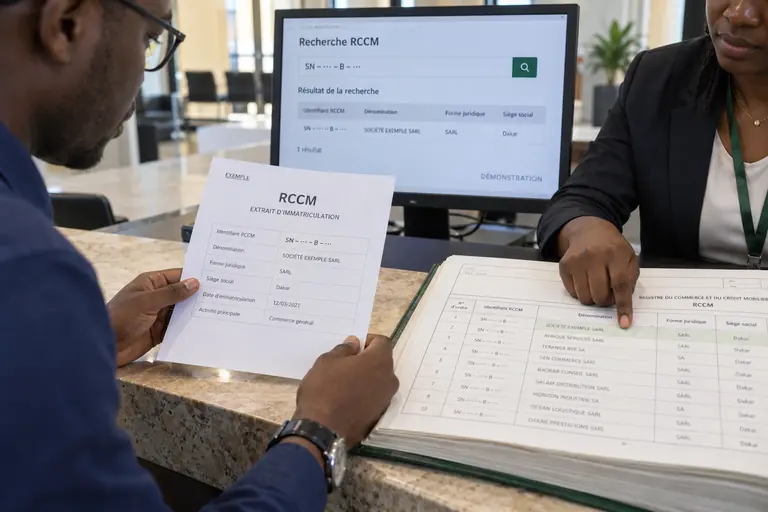
Gabon RCCM company register and business records are the first documents that anyone doing business in Libreville or Port-Gentil will meet. The RCCM, the register of commerce and personal property credit, is the OHADA tool through which traders and companies declare their existence. It stores the name, legal form, address, activity and managers of each entry, and it records later amendments. Counterparties, banks and public purchasers use its extracts as the starting proof that a Gabonese business is lawfully established and who may sign for it.
A register shaped by a resource-based economy
Gabon’s economy leans on oil, manganese, timber and related services, which means many contracts involve both large foreign groups and small local subcontractors. In this setting, the commercial register acts as a common reference point. A multinational hiring a catering firm near an oil site and a bank financing a sawmill both look for the same basic evidence of legal existence.
The country is a member of OHADA, so the uniform acts on commercial law shape the register. The same principles that apply in Cameroon, Chad or Mali govern the status of a trader, the personality of a company and the publicity of security interests over movable goods. This common base lets a lawyer from one member state read a Gabonese entry without learning a new system.
Still, local colour matters. Offices, forms, documents and administrative habits belong to Gabon, and they change when reforms are adopted. Readers should treat the OHADA frame as stable and the day-to-day procedure as something to confirm directly with the competent registry or with a local adviser who files such documents every week.
A short note on vocabulary helps readers who meet the register through English-language contracts. The abbreviation is French, and translated documents may speak of a trade and personal property credit register, a commercial register or simply the company register. All these labels point to the same OHADA institution, so a lawyer asked for proof of registration should know which extract is meant.
Registries, courts and the capital’s central role
Registrations are handled by the registry of the competent jurisdiction. In practice, most filings concern the capital, Libreville, and the oil port of Port-Gentil, where economic activity is concentrated. A company generally registers in the area where its principal establishment is located, and amendments follow the same path.
OHADA law adds a national file that gathers information from all local registries and a regional file kept at the common court of justice and arbitration. These layers aim to prevent duplicate identities and to allow wider searches. For a user, the main message is that the document in hand shows what a particular registry has recorded, and further checks may be needed.
When a company transfers its head office from one jurisdiction to another, its record has to be transferred as well. This can create gaps if the move was carried out hastily. A researcher who finds no entry under a current address might therefore try the previous location, or ask the clerk whether a file has been moved.
Mining and forestry groups with sites far from the coast often keep their head office in the capital while operating in remote provinces. The entry will usually show the main establishment and may also mention secondary ones. Reading these mentions carefully helps to see where the real activity takes place and which local authorities are involved in supervising it.
What the file contains and why signatory powers matter
The entry begins with the identification of the business: name, any trade name, legal form and registered address. A short statement of the activity follows, along with the capital for a company and the persons who manage it. Dates of creation and of later amendments help to rebuild the history of the business, which is often as informative as the current picture.
Signatory powers are a crucial element. When a manager signs a lease or a supply contract, the counterparty wants to be sure he or she can bind the company. The register indicates who holds that power and whether limits apply. A mismatch between the person who signs and the person named in the entry is a warning sign that deserves clarification.
Gabon also uses a tax identification number assigned by the revenue authority, separate from the register number. Invoices, bank files and public tenders may ask for both. If a supplier supplies one without the other, do not guess or fill in the gap yourself; request the missing document from the business or verify it with the issuing office.
The history of the entry can be as valuable as its present state. A company that has changed its name several times, shifted its capital or replaced its managers within a short period deserves a closer look. None of this is wrong in itself, yet patterns of frequent change are worth asking about during due diligence.
Opening a company and using the investment one-stop desk
People creating a business in Gabon are directed to a one-stop service run with the national agency in charge of promoting investment. The service gathers procedures that would otherwise involve separate offices, including registration, tax identification and social security. It saves time for founders, who can bring a single dossier instead of moving from desk to desk.
The articles of association must comply with OHADA rules and with the type of company chosen. Founders need proof of identity, a registered office and, depending on the structure, evidence of capital contributions. The exact checklist depends on the legal form, and the one-stop desk or a notary can provide the current list.
Registration does not authorise every activity. Forestry operations, oil services, mining, banking and transport need sector permits delivered by ministries or regulators. Gabon’s authorities take these controls seriously, and a company that trades without the correct authorisation may face sanctions even though it holds a valid commercial registration.
Founders sometimes underestimate the importance of the registered office. It is the address to which official letters, court notices and tax mail are sent. Using a fictitious or unstable address creates risk, because notices may go unanswered and the business may be considered unreachable when a dispute or an inspection arises.
Searching, requesting extracts and handling foreign use
A search is most efficient when the exact company name or the registration number is known. Where only the trading name is available, the manager’s identity, the town and the sector help the registry to find the right file. Similar names among local firms make careful spelling important, including the exact legal form that follows the name.
An extract is the document that proves what the register shows on the day it is issued. Lenders and procurement officers usually ask for a recent one. Details about online access, the price of extracts and the time needed are best confirmed with the registry, since they can change independently of the law.
French is the language of Gabonese official documents. A partner in another country may need a translation, and some destinations require a legalisation or an apostille-type certification of signatures. Check the requirement with the authority receiving the document before ordering copies, because mistakes can cost weeks and force a second request.
Reading the register with realism
The register is a record of declarations. It does not measure whether a company pays its bills, delivers on time or still operates. Some entries remain after trading has stopped, and some businesses start activity before every formality is complete. Experienced buyers therefore look at several sources before awarding a large contract.
A simple verification kit includes a recent extract, the tax identification, proof of the registered address, a bank reference and, for regulated work, the relevant licence. Where possible, a short visit to the premises completes the picture. None of these steps is exotic, and together they reduce the chance of dealing with a shell company.
The explanations above are broad and informational, not tailored legal advice. Rules and practices can change, and exceptions exist for particular activities and forms. Before committing money, confirm the situation with the competent registry or with a Gabonese lawyer, and keep dated copies of everything received for later reference.
Frequently asked questions
Which cities matter most for Gabon’s register?
Libreville and Port-Gentil are the main centres of business activity, so many filings relate to them. A business is registered with the competent registry for its principal establishment, and amendments are filed there too. Smaller towns fall under the jurisdiction that covers them.
Can I rely on the RCCM to confirm a licence?
No. The RCCM shows that a business is registered as a trader or company. Activities such as oil services, timber, mining or banking need separate authorisations from the relevant ministry or regulator. Ask for the permit and, if possible, confirm it with the authority that issued it.
Is an extract valid forever?
No. An extract reflects the register on the day it was issued. After a change of manager, address or capital, it becomes outdated. Banks and public buyers therefore tend to require a recently issued document, and a careful partner will ask for a fresh one before signing.