
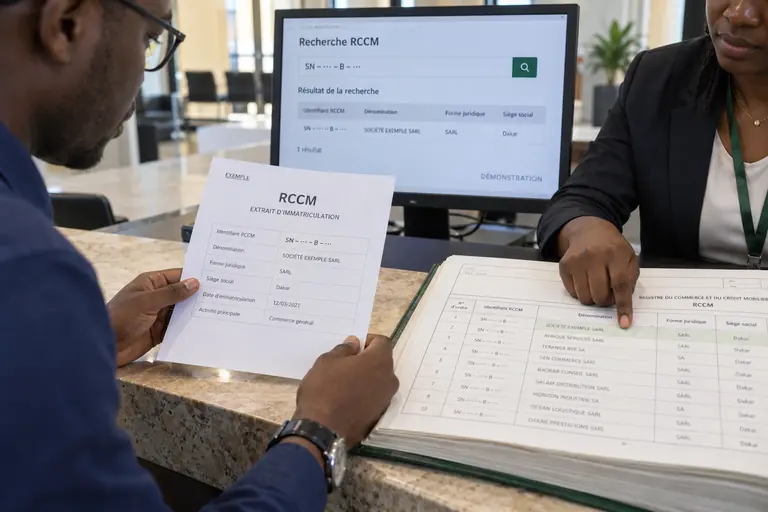
Mali’s RCCM company register and business records are the official file where merchants and companies declare who they are. The initials stand for the register of commerce and personal property credit, set up by OHADA law. In Mali the register is kept by court registries, with Bamako at the centre of commercial life. Each entry gives a name, a legal form, an address, an activity and the people who run the business, so that partners, lenders and authorities can confirm a counterpart before they trade.
The RCCM and the OHADA rulebook that Mali shares
Mali has applied OHADA business law since the early days of the organisation, so its commercial register follows the uniform act on general commercial law. The text defines who must register, what the entry must contain and what legal effects registration produces. For a trader it confirms professional status, and for a company it fixes the date on which legal personality begins.
The second half of the name, personal property credit, refers to the publicity of security interests over movable goods. A lender who accepts a pledge on equipment, a vehicle or stock may have it recorded so that others can see it. Anyone granting new credit to the same business has an interest in checking that part of the file before agreeing.
Because the rules are regional, a reader familiar with Senegal, Niger or Burkina Faso will recognise much of the logic. Differences nevertheless exist in offices, forms, working habits and reforms. The common text is a reliable map, while the local registry is the place to confirm how the journey is made in Mali today.
Readers working in English sometimes meet the term trade register or company register in translated contracts. These labels usually refer to the same OHADA institution, and a lawyer asked for a certificate of registration will know that the extract from the commercial register is meant. Clarifying the exact document wanted at the start of a transaction avoids a round of corrections later.
Court registries, the capital and regional reach
The register is held by the registry of the competent court. In Bamako, the commercial court registry is the best known, and a large share of Malian businesses are registered there. Elsewhere in the country, other jurisdictions handle filings for their own areas, so a trader in a regional town generally deals with the court that covers it.
Mali is a large country with long distances between towns such as Kayes, Sikasso, Ségou and Mopti. A business with several sites declares its main establishment and may list secondary ones. Understanding which establishment is the principal one tells you which registry is responsible and where to ask for a copy of the file.
As elsewhere in OHADA, local files are complemented by a national file and a regional file held at the common court of justice and arbitration. They exist to prevent a person or company from being registered twice under different identities. Whether an inquirer can reach them directly depends on the services offered at the time of the request.
A practical point concerns security. Mali has faced difficult periods in some regions, and travel to certain areas may be inadvisable. Hiring a representative in Bamako or relying on written requests can therefore be more sensible than a long trip. Partners should plan for this when fixing deadlines for the supply of documents.
Anatomy of a registration entry
A typical entry starts with the name under which the person or company trades and, for a company, its legal form. Limited liability companies are common for small and medium projects, while public limited companies suit larger ventures. The address of the main establishment follows, then a description of the business activity that helps to judge whether the company really does what it advertises.
Management details are central. The register names the managers or directors and sets out how far each of them can commit the company. This matters in practice, because a purchase order or loan signed by someone without authority can be challenged. Checking that the signatory and the entry match is a cheap safeguard that experienced buyers never skip.
The registration number is not the only identifier a Malian company holds. The tax administration issues a tax identification number, and social bodies may issue their own references. Treat these as complementary documents. When a supplier produces only one, ask politely for the others, since each one answers a different question about the business.
The date of creation and the dates of later entries help to measure the maturity of a business. A company registered only a few weeks ago and already claiming a large national network deserves questions. Conversely, a long-established firm with a stable manager and a consistent address offers a more reassuring profile, though not a guarantee.
Creating a business: the investment agency’s one-stop desk
Mali’s agency for the promotion of investment hosts a one-stop desk for business formalities. It gathers representatives of the offices involved in starting a company, such as the registry and the tax authority, so that the founder can submit one dossier. The desk guides applicants, but the legal entry in the register is still made by the court registry.
Preparing the file starts with the articles of association, which must respect OHADA rules and the form chosen. Founders also provide identity documents, proof of a registered office and information on their contributions. Lists of required documents are updated from time to time, so confirm the current checklist with the desk or a notary before printing anything.
Registration is not a licence for every activity. Gold mining, cotton processing, banking, insurance, transport and health services each need specific approvals. A company may exist legally and still be unable to start a regulated business until the relevant authority has agreed. Keep these two steps separate when planning a launch or evaluating a counterparty.
Searching the file and requesting official copies
To find a business, begin with the registration number if you have one. Otherwise supply the exact corporate name, the town and, if possible, the name of the manager. The more precise the details, the less risk of mixing two similar companies, which is a real hazard when many firms use the same words in their names.
The registry issues extracts that restate the entries on the day of issue. Banks, ministries, buyers and international partners often request a recent one. Whether a request can be made online, how long it takes and what it costs are matters that evolve, so ask the registry or a local agent instead of relying on outdated information.
Documents prepared in French may need to be translated for use abroad, and some countries require legalisation. Foreign readers sometimes forget that a perfectly valid Malian extract is refused simply because it is not in the expected form. Ask the receiving authority in advance, and keep a record of the date, office and reference of every document.
For international banks performing compliance checks, an extract from the register is only one element of the file. They usually add identification of the people who ultimately control the company, proof of address and an explanation of the source of funds. Preparing these documents in advance shortens the opening of an account or the approval of a credit line.
Where the register stops and judgment begins
The register states what has been declared. It does not guarantee that a company is solvent, that it delivers what it promises or that its activity continues. A business may stay on file long after it has stopped trading, and a newly founded company may have little history to examine. Entries are evidence, not endorsements.
Prudent buyers build a short verification routine. They ask for an extract, the tax identification, proof of address and a bank reference, and they compare names across documents. For larger orders they visit the premises or speak to existing customers. This routine reflects ordinary commercial caution rather than any special distrust of Mali.
The comments here are general and cannot replace advice tailored to a specific situation. Procedures, offices and electronic services may change, and exceptions apply to particular legal forms and sectors. Before committing money, confirm the current rules with the registry or an experienced Malian lawyer or accountant.
Frequently asked questions
What is the RCCM in Mali?
It is the register of commerce and personal property credit, the OHADA register in which traders and companies are recorded. In Mali, court registries keep it. An entry identifies the business, its form, address, activity and managers, and it can also publish security interests over movable assets.
Is Bamako the only place to register?
No. Bamako is the main commercial centre and many filings are made there, but other jurisdictions handle businesses established in their areas. The competent registry is generally determined by the location of the main establishment, so confirm which court applies before filing.
Why is the registration number not enough?
Because it only identifies the entry in the commercial register. Tax identification, licences, bank references and proof of the signatory’s powers answer other questions. A careful counterparty reviews them together, comparing names and addresses across all documents before signing a contract.