
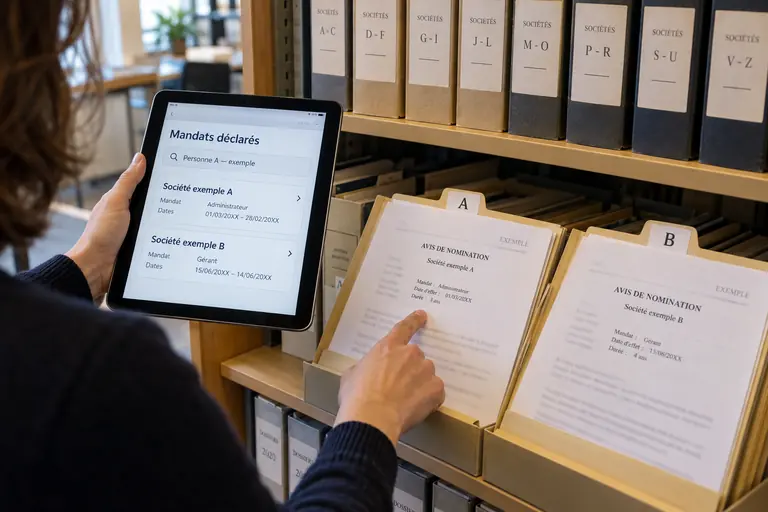
Teruel's commercial register and company records belong to the provincial office of Spain's mercantile registry, which covers businesses whose registered address lies in this inland corner of Aragon. In a province with few inhabitants and many small family firms, it is the dependable place to confirm that a business legally exists. A registrar examines each deed, then enters the company name, address, purpose, capital and administrators on a dedicated sheet. The content is public in principle, and the entries benefit from a presumption of accuracy when third parties rely on them.
A small province with its own registry
Teruel is among the most sparsely populated provinces in Europe, yet in legal terms it is treated like any other: it has a registry of its own within the Spanish mercantile network. Aragon has one such office for each of its three provinces, so a company whose address is in Teruel is not filed in Zaragoza or Huesca. The office handles a modest volume of work, and that scale shapes how businesses use it.
Companies here include agricultural and livestock enterprises, food processors known for cured ham, construction and quarrying firms, tourism businesses linked to the mountains and to heritage towns, and a growing group of renewable-energy projects. Many are limited companies with only a few partners, so the register often shows owner-managers whose names are well known locally.
The registrar who runs the office is a legally qualified public official. Before anything is recorded, the registrar checks that the deed respects the law and that it is consistent with earlier entries. This verification is what makes the register more than a filing cabinet, and it is the reason why banks and notaries treat it as a trusted source.
Understanding the legal forms you will meet
Private limited companies dominate, because they require less formality than public limited companies and protect the personal assets of the partners. Public limited companies appear mostly in larger undertakings. Both are capital companies and become fully effective as legal persons once the deed is entered. Branches of foreign firms are also recorded when they set up an establishment in the province.
Many local activities are carried out by individuals instead. A farmer, a craftsperson or a small shop owner may trade without forming a company, and such sole traders are normally not entered unless they decide to register voluntarily. Proof of their activity comes from tax and social security records, which are not part of the mercantile registry.
Rural cooperatives, associations and foundations have their own regimes. When you meet one of those names, ask for the registration reference given by the entity itself and look in the corresponding register. Searching only the mercantile files for a farmers' cooperative or a village association is a common cause of disappointment, and it is easily avoided by checking the legal form first.
Information held on each company
The sheet begins with incorporation and grows with every later event. It states the exact denomination, the registered office, the corporate purpose, the capital and the form of administration. It then records who the directors are, who holds powers of attorney, whether the company has changed its address and whether it has merged, been dissolved or entered liquidation. Each entry is dated and can be followed in sequence.
In a province where businesses are often inherited, this chronology is helpful. An heir who takes over a firm, a buyer who wants to confirm who may sign a contract, or a lender who needs to see the corporate history can all follow the line of changes without relying on verbal assurances. The page does not show the private agreements between partners, but it records what the law requires to be public.
Annual accounts are deposited at the same registry. Their filing allows a reader to compare the size and evolution of a business over several periods. Some smaller firms benefit from simplified formats and disclose less detail, so the absence of a long financial statement should not be read as concealment. It may simply reflect the reporting regime applicable to the company.
Obtaining documents
The routine document is the simple note, an informational extract of the present situation. For official purposes, the certificate signed by the registrar is the proper instrument, since it certifies the content of the books. Which of the two is suitable depends on who will receive it, so check whether the bank, authority or court asks for a formal certification.
Requests may be made at the counter, by post or electronically through channels linked to the professional body of registrars. Remote applicants should identify the company with its exact name and tax number. Because several firms in a small province can share similar words in their names, the tax number is the safest way of getting the right file.
Fees, formats and turnaround depend on the product requested and are updated from time to time. Confirm them on the official service on the day of the request. If you plan to use the paper in another country, find out beforehand whether that country requires translation or legalisation, since arranging this at the last minute can delay a transaction.
Limits and sensible follow-up
A registry sheet is a legal statement, not a reputation check. It confirms existence, address, capital and management, but it does not say whether invoices are paid on time or whether a plant is actually working. If you plan to sign a major contract, combine the sheet with the latest filed accounts, notices of insolvency and a direct conversation with the company.
Another limit concerns beneficial ownership. A chain of holding companies can hide the individuals who finally benefit from a business, and the mercantile sheet only shows the immediate structure. Other tools and declarations deal with that topic under their own access conditions, so a reader needing that level of detail should ask the specific body that holds it.
Keep timing in mind as well. Registrations are not always instantaneous, so very recent changes may not appear immediately. When a transaction depends on a fresh event, such as the appointment of a new director, ask the company for the deed and request an updated note shortly before closing.
Place names appear in many company names, and a business called after the province or after one of its towns is not necessarily linked to others using the same words. Two firms may share the name of a village and have unrelated owners. The sheet tells them apart through the tax number, the date of incorporation and the list of administrators, so those details are worth noting on first reading.
Renewables, rural business and the value of verification
Wind and solar developments have brought a new kind of company to the province: special-purpose vehicles created to hold one project, often owned by funds or utilities based far away. Landowners who sign lease agreements with such companies should look at the sheet to see the registered name, the administrators and the amount of capital, and to check that the person who signs really has the power to bind the company.
The same advice applies to rural tourism, where a guesthouse may be run by a company or by an individual. Travellers rarely need to search a register, but a buyer, a lender or a business partner certainly does. A short note requested before a deposit or a long lease is signed costs little compared with the problems that can follow from a mistaken assumption.
Finally, lawyers and notaries serving small towns often use the register as a routine step in succession planning, since the transfer of shares or the appointment of a new administrator must be recorded to take full effect. Families who inherit a business can follow the same path and ask the advisers who handled the deed which entries still need to be presented.
Frequently asked questions
Is Teruel covered by the registry in Zaragoza?
No. Each Aragonese province has its own mercantile registry, and companies with their registered address in Teruel are recorded in the Teruel office. A firm that operates in Teruel but has its legal seat in Zaragoza, however, will be found in the Zaragoza files, because the registered address decides competence.
Can I check whether a local farm business is registered?
It depends on its legal form. A limited company will appear in the mercantile registry, but an individual farmer, a cooperative or an association is usually recorded elsewhere or not at all in that registry. Ask the business for its legal name and tax number, then search the register that matches its form.
Are the accounts of every company available?
Capital companies must deposit annual accounts, and the filing can be requested from the registry. The level of detail varies, since smaller firms may use shortened formats, and a missing deposit may reflect delay or a legal exemption. It is a prompt to ask questions, not an automatic sign of wrongdoing.