
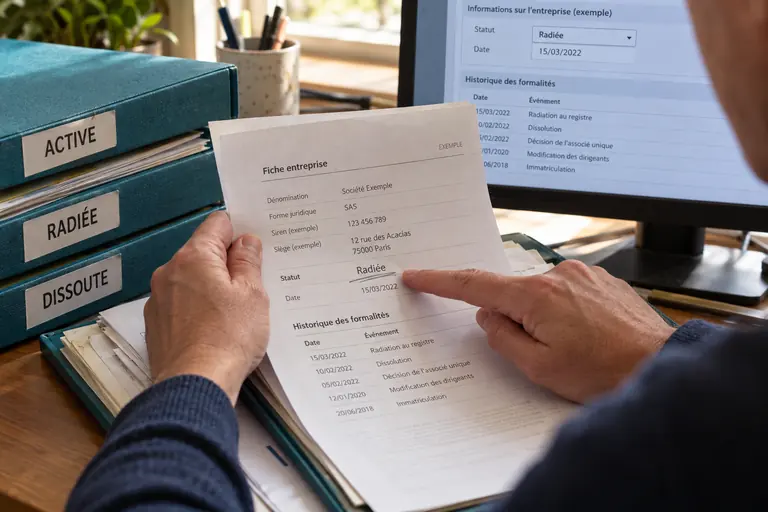
Company register free access and paid services refer to the two ways of reaching information about a firm: open data anyone can read at no cost, and formal documents issued under the registrar's responsibility for a fee. Free sources, such as the daily official bulletin of the commercial register and verification tools of the Central Commercial Register, show recent events and confirm documents. Paid items, such as simple notes and certificates, summarise or prove the contents of a company's sheet. Choosing between them depends on what must be shown and to whom.
Two ways of consulting a commercial register
When people speak of consulting the commercial register, they should separate two realities. One is information of public access disseminated through open sources, such as the official announcements of entries. The other is the formal publicity provided by the registry itself, consisting of documents issued under the responsibility of the registrar and requested one by one. The distinction matters because the two answer different needs. Open sources suit curiosity, monitoring and quick orientation. Formal documents suit situations in which someone must rely on the information or prove it to another party.
Confusion between them leads to two typical errors: paying for a document when an open source would have been enough, and relying on open information in a situation that required a formal document. Understanding the line between them is the first step to spending money only where it adds value. A third consideration is speed. Open information is available at once, while documents issued by the registry may take time to be prepared, signed and delivered. If you must act within hours, free sources can give an immediate impression, but they should be followed by the formal document before any binding commitment is made.
What public data can be seen at no cost
For consulting the register without paying, the official bulletin of the commercial register lets anyone examine, openly, the entries published each day, such as incorporations, appointments or changes of registered office. It is a good tool for following a company's recent history or for watching a sector. The Central Commercial Register also offers online services of free access, for example to verify documents that it has issued, although they do not replace consulting a company sheet. Such verification tells you that a document is genuine, not that its content is current.
Some ancillary information may be available on official portals at no cost, but each service defines what it shows. The absence of a result in a free tool does not prove that nothing is registered. Treat these sources as a first screen: helpful, immediate and limited. Another free route is the company's own website or documents. Businesses frequently publish their registered name, tax number and address, and these details can be compared with what the official bulletin shows. A mismatch between the two is a signal worth investigating further, though it is not proof of wrongdoing.
Simple notes and certificates: documents with a fee
The simple informative note summarises the content of a company's sheet. It is the most requested document by those who want to consult the commercial register quickly, and it costs less than a certificate. Its character is informative, so it serves for a preliminary check but does not formally prove the company's situation. The certificate is issued by the registrar and, when electronic, carries a signature. It is used when the content of the entries must be established with formal effect, for instance before a court, a public body or a bank that demands proof. For that reason it normally carries a higher tariff.
Tariffs are set by regulation and displayed before the order is confirmed. Prices can change, so read the amount shown by the service and not figures quoted in older articles. Delivery methods vary between electronic receipt and other channels, and the service lists them at the time of the request. Certificates may be requested for several purposes, each with its own formal wording, such as proving the existence of a company, the powers of its representatives or the absence of certain entries. Specifying the purpose when you order helps the registry to issue the right content and prevents rejection by the receiving body.
How to choose between free and paid consultation
The practical rule is simple. If it is enough to know that the company exists and to understand recent corporate events, open sources are often sufficient. If you must take a decision of some importance, such as granting credit or signing a high-value contract, ask at least for an updated simple note. When a third party requires proof, ask what form they accept. Some institutions are content with a note, others insist on a certificate, and a few ask for a document with a verification code that they can check themselves.
A staged approach works well: begin with open data, move to a note if the case justifies it, and order a certificate only when formal proof is demanded. Each step costs more and tells you more. Keep a record of what you ordered and why, so that you can justify the expense and reuse the document where permitted. Cost control matters for organisations that run many checks. Decide in advance which kinds of counterparties justify a note, which justify a certificate and which need no purchase at all, and write the rule into the procedure. This prevents both overspending and the opposite risk of skipping a check on a significant partner.
What to expect in a company's records
Documents from the register reflect identification data, the registered address, the corporate purpose, the administrators, the capital and registered modifications. Depending on the type of document, they may also include data on the filing of accounts or mention closures of the sheet. The precise content depends on what was requested and on the entries that exist. A document shows the register, not the whole company. Contracts, debts not registered, tax position and day-to-day trading do not necessarily appear. Anyone assessing a business should complement the register with accounts, references and, where appropriate, professional advice.
The date of issue is crucial. Entries can be made the day after, and a document that was correct on the day of issue may not reflect events since then. When you rely on a document for a decision, record the date and keep the original. Two companies with the same sector and similar names can have completely different records, so reading the identification block first is vital. Make sure that the tax number, address and denomination on the document match the entity you are dealing with before you analyse anything else in it.
Tips to avoid overpaying or missing the proof you need
Before consulting the register and ordering anything, define the objective and find out whether the recipient of the document requires a specific type. Asking beforehand avoids ordering a note when a certificate is required, or the reverse. It also helps to gather the tax number, the denomination and the province, so the request is not returned for lack of data.
Beware of intermediaries that sell public information at an inflated price or present themselves as the official registry. Reach the services through the portal of the professional body or of the Central Commercial Register, and compare what you are charged with the tariff displayed there. If you will need the same company's data repeatedly, ask whether the service offers subscriptions or alerts, and weigh them against the number of consultations you really expect to make.
This is general guidance and not legal advice; tariffs and procedures can change, so check the current rules with the registry. If a document arrives with errors, such as the wrong company or an outdated address, contact the service promptly. Registries have procedures for correcting mistakes in issuance, and a quick report usually prevents extra charges, but waiting weeks makes it harder to show that the error was not yours.
Frequently asked questions
Can I check a company in the commercial register for free?
Partly. The official bulletin of the register publishes entries openly, and the Central Commercial Register offers free tools such as document verification. A full summary of a company's sheet, however, comes through a paid note or certificate.
Is a simple note enough for a business decision?
For a preliminary check it usually is, since it summarises the sheet. If a bank, court or counterparty demands formal proof, a certificate is required. Ask the recipient which document they accept before you pay for either of them.
Why does the date on a register document matter?
Entries are made continuously, so a document shows the situation only on the day of issue. A copy that was correct then may miss later changes. For important decisions, order a recent document and keep the original with its date.