
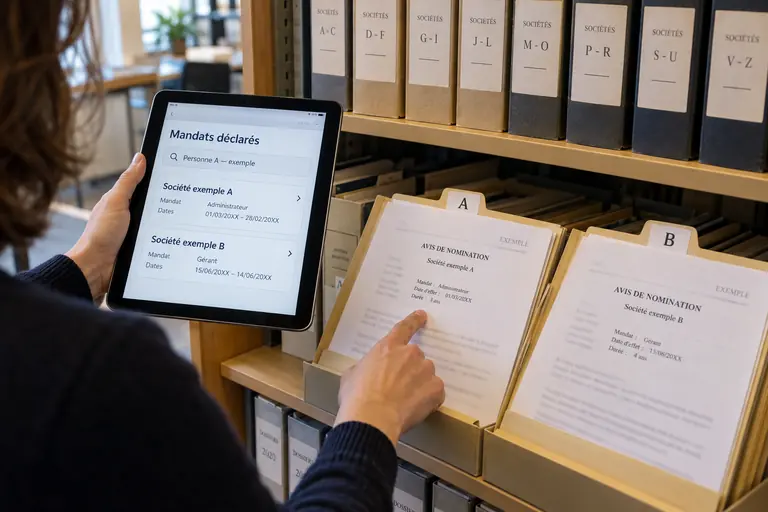
Gipuzkoa commercial register company records document every business whose legal seat is in the province, from machine-tool makers and paper mills to restaurants in the capital. A registrar examines each deed under national commercial law, then enters the firm's name, form, address, corporate purpose and administrators, and adds later events in order. The Basque foral system affects taxation and administration, not the content of these entries. What the files provide is legal identity and structure, whereas cooperatives and non-commercial bodies are listed elsewhere and finances are only partially visible.
A province of factories, ports and kitchens
Gipuzkoa is a small territory with a dense industrial tradition. Valleys inland host foundries, machine-tool builders, components manufacturers and paper producers, while the coast combines fishing ports, shipping services and a visitor economy centred on the capital and its renowned food culture. Most of these enterprises take the form of limited companies, public limited companies or cooperatives, and the commercial register is where the first two categories are documented. Sectors that look unrelated often share suppliers and ownership ties.
The structure of the local economy shapes how the register is used. Many firms are medium-sized and family controlled, and supply chains tie them closely to large manufacturers elsewhere in Europe. A purchaser in Germany or France who considers adding a Gipuzkoa supplier will often start with a registry extract to confirm legal identity before technical audits begin. Such checks are routine in international purchasing departments.
Service companies appear alongside industry. Architecture studios, engineering consultancies, software houses, hotel operators and restaurant groups all register in the same way. This uniformity helps analysts compare firms of different types using a common vocabulary of names, forms, purposes and administrators, even if their activities have little in common. Smaller practices in particular may be incorporated as limited companies purely for liability reasons, which explains why very modest businesses have full files.
Seasonality plays a role on the coast. Hotels, bars and tour operators may swell in summer and shrink in winter, yet their legal structure stays the same all year. The registry therefore gives a stable reference point for firms whose activity level varies, and it helps lenders separate genuine businesses from short-lived ventures that open only for a season. Sudden openings and closings are common in hospitality.
Foral tax rules and national commercial law
The Basque territories have their own tax arrangements, and the provincial Treasury administers taxes in Gipuzkoa. This distinctive regime is often cited in the press, and visitors sometimes assume that company law also differs. It does not. Commercial law, including the rules on forming companies, keeping accounts and registering corporate acts, is a matter for the Spanish state and applies equally across the country.
The practical consequence is that a limited company in Gipuzkoa is incorporated before a notary and registered with the registrar in the same manner as a company in Zaragoza or Valladolid. What differs is the tax office to which the company reports and, in some cases, the language in which local officials communicate with the public. Professionals moving between provinces therefore find the procedure familiar.
This distinction matters to foreign investors comparing Spanish locations. They should not expect a different corporate register, different company types or different disclosure duties. They should, however, take tax advice specific to the territory, because the forms, deadlines and procedures with the tax authority differ from those in other provinces. Tax residence and registry competence are separate questions with separate answers.
A related point concerns groups. Large employers in the province often own several operating companies, each with a separate file and sometimes a separate seat. Parent firms may sit in another province or abroad, so tracing the chain upward requires reading administrators and shareholder information across entities and, where relevant, the registers of other countries. Group structure is rarely visible in a single sheet.
Cooperatives and what the commercial register leaves out
The Basque Country is famous for its cooperative movement, and one of the best-known cooperative groups in the world has its roots in the province. Cooperatives, however, are governed by their own legislation and are recorded in a cooperative register. Searching for them in the commercial files typically produces no result, and that absence should not be mistaken for non-existence. This cuts both ways for researchers who rely on a single search.
Many cooperative groups nevertheless include commercial companies, set up to hold shares, run international subsidiaries or manage specific lines of business. Those subsidiaries are entered in the commercial register, and their files can reveal links to the parent group. To understand a complex organisation, an analyst often needs to read both sets of records and match the names. Reading both sides avoids underestimating the size of an organisation.
Foundations, associations and professional bodies are also kept apart from the commercial register. If a counterparty describes itself as a foundation or a society that is not a company, ask for its legal form and look in the register that corresponds to it. Searching in the wrong place wastes time and can lead to the false impression that the entity is unregistered.
The same applies to civil partnerships, communities of property owners and temporary joint ventures created for a single project. These arrangements are common in construction and engineering, and they may not appear in the commercial register at all, although their members do. Contracts with them need extra care about who is actually liable. Always ask counterparties to state their exact legal form in writing.
Language and documents
Gipuzkoa is a bilingual society, with Basque and Spanish both in daily use. Registry entries and documents submitted for registration are generally in Spanish, and documents drawn up in other languages are accompanied by translations where required. Anyone reading a file should be prepared for legal vocabulary that is precise and formal, with terms that do not translate neatly into English. Careful translation is part of good due diligence.
For foreign readers, a few terms recur. The administrator is the person or body who manages the company and may act alone or jointly with others. The corporate purpose describes the activities permitted in the articles, the registered seat is the legal address, and the share capital is the amount contributed by the owners. Understanding these concepts makes extracts much easier to follow. A short glossary prepared in advance speeds up every later reading.
Where documents are to be used abroad, the receiving authority may ask for a legalised or apostilled copy and a certified translation. Requirements vary by country and by purpose. Contact the recipient first, so that the certificate ordered from the registrar matches its needs and does not have to be requested a second time. Embassies and consulates can usually advise on the formalities.
Ordering extracts and certificates
A simple extract is the standard tool for checking a company. It gives a summary of current data, is obtained using the company name or tax number and arrives in electronic form. For purchasing, supplier approval or a first meeting with a prospective partner, it usually provides everything needed at modest cost and without delay. Few alternatives are as efficient for first-level verification.
If formal evidence is required, ask the registrar for a certificate. It attests to what appears in the books and can be adapted to show full entries, selected facts or the absence of a particular registration. Banks, notaries and public bodies frequently insist on this document for transactions that carry legal consequences, such as opening accounts or signing powers of attorney. Choosing the wrong certificate type is the usual cause of refusal.
Prices and processing times depend on the service chosen and are subject to change, so they should be confirmed in the official channels of the registrars at the time of ordering. Applicants are expected to identify themselves and state why they need the information, and misuse of personal data from the register can lead to legal consequences. Official quotes avoid unpleasant surprises at the checkout stage.
One practical tip concerns timing. Certificates are generally valid for use only for a limited period after issue, according to the rules of the receiving authority. Ordering too early may force a repeat order, while ordering too late can hold up a signing, so agree the date with the notary or the bank first. Keeping the date of issue on file proves that the document was recent when relied on.
Accounts, closed sheets and reading between the lines
Capital companies deposit their annual accounts after approval, and the deposit makes balance sheets and notes available to those who request them. For an industrial firm, the accounts can reveal investment in equipment, reliance on borrowing and the weight of inventories. They are the company's own statements, so independent analysis adds credibility, especially when lending or entering long contracts. Lenders often compare several years in sequence to see the direction of travel.
When a company fails to deposit its accounts, the registrar can close its sheet to most new entries. In an industrial province with many closely managed firms, a closed sheet is not necessarily a sign of trouble. It can come from an oversight or a change of advisers. Still, it justifies direct questions and a careful look at other indicators. A prompt reply from the company is a reassuring sign.
The registry gazette lists important entries by date and area. Monitoring it helps suppliers, competitors and journalists notice new incorporations, administrator changes or dissolutions. The gazette gives short summaries only, so for the full, current picture of a company one still needs an extract or certificate from the registrar. It is best used as an alert system rather than as an archive.
Frequently asked questions
Does the Basque tax regime change how companies are registered?
No. The foral tax arrangements affect how taxes are administered, but commercial law is national. Companies in Gipuzkoa are incorporated before a notary and entered in the commercial register under the same rules as elsewhere in Spain. Take specific tax advice for filings and deadlines with the provincial Treasury.
Why can't I find a cooperative in the commercial files?
Cooperatives are governed by separate legislation and recorded in a cooperative register, not in the commercial register. Their commercial subsidiaries, however, may appear in the commercial files. If a search fails, confirm the entity's legal form and look in the register that matches it before concluding that it does not exist.
Are the documents available in Basque?
Registry entries and documents are generally in Spanish, and documents in other languages are accompanied by translations where required. Foreign users should ask whether the receiving authority needs a certified translation or an apostille, and check with the registrars' official channels which services and languages are currently offered.